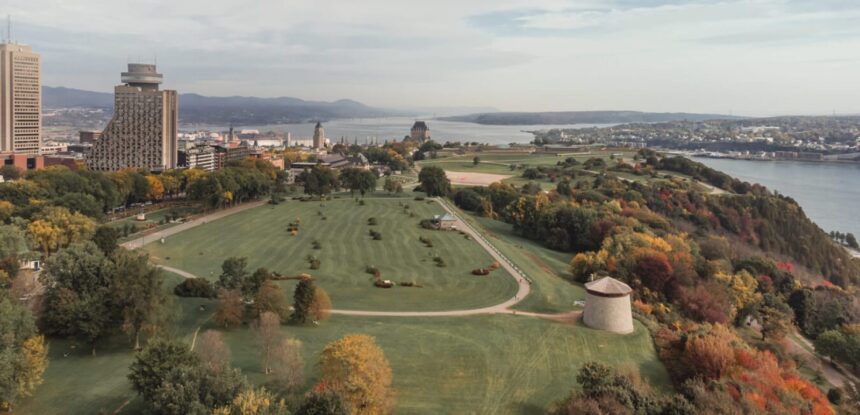
Parc des Champs-de-Bataille is what the Plains of Abraham officially are: a national historic park administered by the Commission des champs de bataille nationaux, created in 1908 on the three hundredth anniversary of the founding of Quebec City. The park covers about one hundred and eight hectares along the clifftop west of the walled city, and it is simultaneously the site of the 1759 battle, the largest urban green space in the city, a concert venue, a winter recreation site, and a daily running circuit. Understanding what the park does today requires understanding how it got from battlefield to park, and what the commissioners who designed it had in mind.
From battlefield to parkland
The land where the battle took place belonged in 1759 to a number of small farmers, including Abraham Martin, from whom the Plains of Abraham take their name. After the battle the land returned to farming.
Over the nineteenth century it was gradually cut up for institutions. The Ursulines owned a section. The jail sat at the eastern end. The Convent of the Good Shepherd operated on part of it. Racing was held on a grandstand along the river side for several decades. The result, by 1900, was a patchwork of uses with no coherent identity.
The tercentenary celebrations of 1908 supplied both the occasion and the federal money to consolidate the site. The Commission des champs de bataille nationaux was created by act of Parliament, land was purchased or expropriated, and the landscape architect Frederick Todd was engaged to design a park on the site. Todd’s vision drew on the City Beautiful movement then current in North American parks design: broad lawns, groves of trees at strategic angles, winding drives, and a deliberate looseness that would read as countryside within the city. The plan has been modified across the twentieth century but its bones are still legible.
What the visitor encounters today
A walker entering the park from the Old City passes the Citadel on the right and then emerges onto the broad lawns of the central Plains. Two Martello towers, squat cylindrical defensive structures built by the British between 1808 and 1812, stand at intervals along the clifftop. The Musée des Plaines d’Abraham, at the western end of the walled city, provides the interpretive context for the 1759 battle and the park’s subsequent history. A network of paths, some paved and some gravel, crosses the lawns in every direction and connects to the Governors’ Promenade along the cliff edge.
The western end of the park, the Plaines, is flatter and more open, with fewer trees and longer sight lines. This is where the major summer events take place: the Festival d’été de Québec mounts its main stages here, the Fête nationale stages its concerts, and fireworks are regularly launched from positions that use the open lawns as sight lines. The eastern end near the Citadel is more wooded, with older plantings and a denser network of paths, and it is quieter even on busy summer afternoons.
Winter use
In winter the park transforms. Cross-country ski trails are groomed across the lawns, totalling roughly fifteen kilometres, with equipment rental available at the western pavilion during the season. Fat-biking is permitted on marked trails. Snowshoeing is encouraged anywhere the snow cover is sufficient. A skating rink is set up in the central section and maintained through cold months. The winter version of the park sees fewer visitors than the summer one but serves a different, more local audience: people who live in the surrounding neighbourhoods and use the park as a daily recreation venue rather than a destination.
The monuments and memorials
The park holds a growing collection of public monuments, which together constitute an informal history of how Canada has understood the battle over the past century. The Wolfe monument marks the spot where the British general fell in 1759. A Montcalm memorial, further east, acknowledges his mortally wounded passage through the city. A Jeanne d’Arc equestrian statue in the adjacent garden was a gift from an American donor in the 1930s and an odd but permanent presence. More recent additions include memorials to the First Nations presence on the site before 1608 and to the successive groups of immigrants who helped shape the city. The park is not a single coherent monument but a layered accumulation that rewards slow walking.
Events and seasonality
Summer is the busy season. The Festival d’été in early July fills the western lawns with crowds of tens of thousands for eleven consecutive evenings of concerts. The Fête nationale on 23 and 24 June brings its own major crowds. Weekend running events, food truck festivals and organised picnics fill most weekends between May and September. The park adapts to the scale of these events because it was designed, in Todd’s original plan, as a flexible open space rather than a series of specific gardens. The design tradeoff, which becomes clear during the largest concerts, is that the lawn surface takes heavy wear and requires regular reseeding.
Practical visit information
The park is free and open year-round. The Musée des Plaines d’Abraham charges admission and is worth a visit for any first-time traveller interested in understanding the 1759 battle in its Canadian and imperial context. Parking is available at the western end and along Avenue George-VI. Public transit reaches the eastern edge from downtown in under fifteen minutes. Dogs are permitted on leash. Running and cycling are welcome on the paths, though bicycles are expected to yield to pedestrians on the narrower sections. A full circuit of the park, along the clifftop and back through the interior paths, covers roughly six kilometres and makes an excellent orienting walk for anyone spending several days in the city.