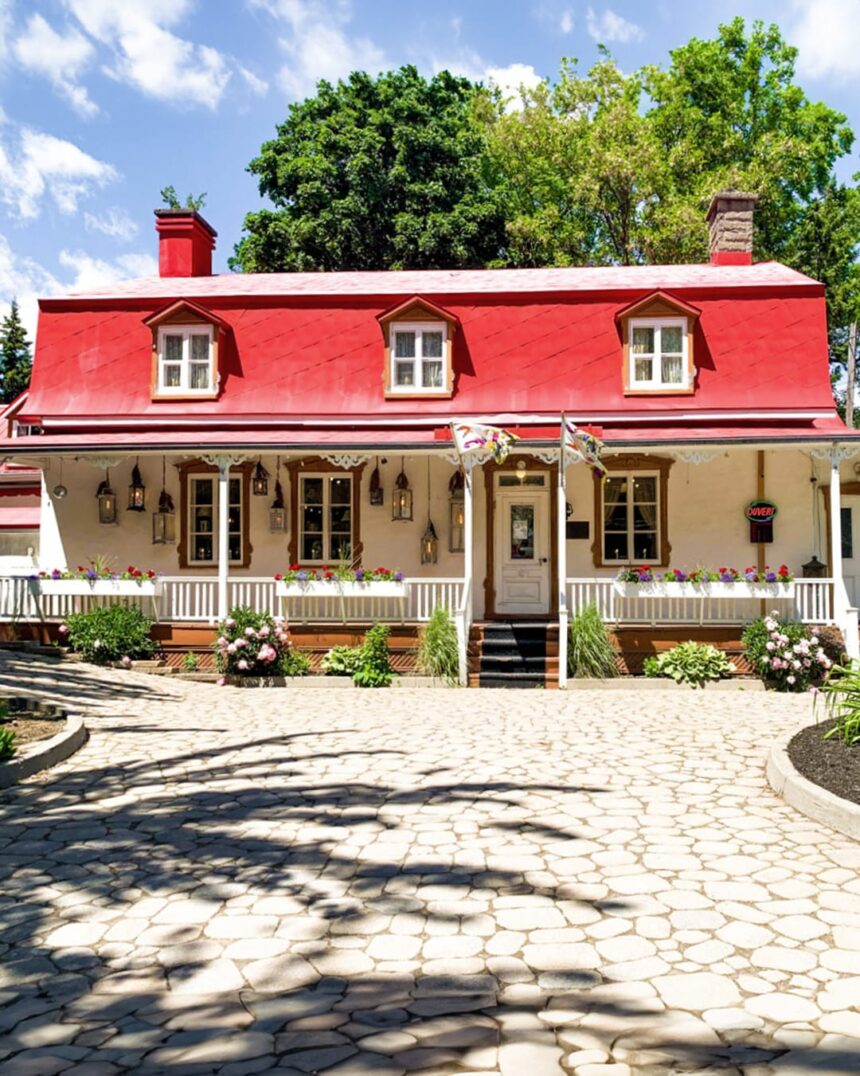
Charlesbourg is one of the most historically remarkable parts of Quebec City: not just the city’s second most populous arrondissement, but the site of one of North America’s earliest systematic planned urban communities. In 1665, the Intendant Jean Talon laid out the radial street plan centred on the Place du Trait-Carré a bold geometric design in which each colonist received a triangular land grant with his home at the narrow end near the central square and his agricultural fields extending outward. This plan, unprecedented in North America, created a settlement form that combined communal defence (all homes clustered near the centre) with individual agricultural production (the radial fields extending outward from each dwelling).
The Quartiers
Charlesbourg comprises four quartiers: Charlesbourg (the historic core centred on the Place du Trait-Carré), Bourg-Royal (a post-war suburban residential quartier on the plateau north of the historic village), Lac-Saint-Charles (the quartier surrounding Quebec City’s primary drinking water reservoir development is strictly controlled to protect water quality), and Château-d’Eau (named for the water treatment infrastructure). The arrondissement covers approximately 140 square kilometres, most of it suburban residential development from the 1950s-2000s, with the historic village core as its most significant heritage asset.
The Place du Trait-Carré
The Place du Trait-Carré at the centre of Vieux-Charlesbourg ( preserved as a heritage park where the four main roads of the 1665 radial plan meet ) is the most tangible surviving example of Talon’s land planning genius in Quebec. The surrounding heritage area preserves an extraordinary concentration of 18th and early 19th-century Quebec rural architecture: stone farmhouses with tin roofs, the church of Saint-Charles-Borromée (begun 1828), and the Maison des Jésuites de Charlesbourg a 17th-century Jesuit farm property among the oldest surviving buildings in the greater Quebec City region. Several of these buildings now operate as heritage interpretation sites or artisan boutiques, making the Vieux-Charlesbourg zone the most accessible rural Quebec heritage experience within Quebec City’s administrative boundaries.
Contemporary Charlesbourg
The vast majority of Charlesbourg’s territory is suburban residential ( the bungalows, semi-detached houses, and commercial strips along Boulevard Henri-Bourassa and Boulevard Louis-XIV that serve the arrondissement’s approximately 80,000 residents. The Galeries Charlesbourg mall serves as the commercial anchor. The TramCité project’s northern terminus at Parc des Mélèzes in Charlesbourg will be one of the system’s 29 stations ) bringing high-frequency transit to an arrondissement that has historically been deeply car-dependent.