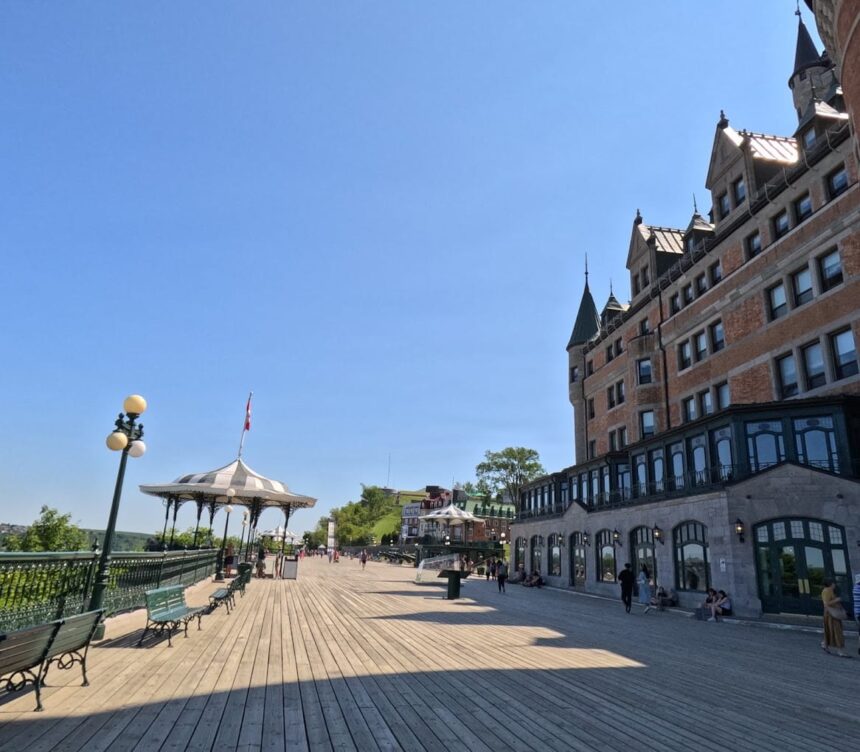
The Château Saint-Louis ( the succession of official residences occupied by the Governors of New France and the British governors of Quebec from 1647 until the building’s destruction by fire on January 23, 1834 ) was for nearly two centuries the most architecturally ambitious and politically significant building in North America north of Mexico. On its site, now occupied by the Dufferin Terrace boardwalk and the Château Frontenac above, the governors of New France (Frontenac, Vaudreuil, Beauharnois) and the British governors of Quebec (Carleton, Haldimand, Dufferin) received ambassadors, made colonial policy, hosted the social events that defined colonial Quebec City’s elite culture, and conducted the governance of a territory that at its peak extended from Newfoundland to the Gulf of Mexico. The building’s 1834 fire ( which destroyed the fourth and most elaborate iteration of the structure ) erased the physical presence of what was arguably the most historically consequential building in Canadian history.
The Building’s History (1647-1834)
The first Château Saint-Louis (1647) was a modest structure built for Governor d’Ailleboust the first dedicated governor’s residence at the cliff-edge site above the Lower Town. Successive governors expanded and rebuilt the structure through the 17th and 18th centuries; the French regime’s final Château Saint-Louis (substantially rebuilt under Governor Frontenac in the 1690s and expanded repeatedly thereafter) was the grandest building in New France, with formal reception rooms, private apartments, service wings, and the cliff-edge terrace that provided the panoramic view of the St. Lawrence that subsequent generations would preserve through the Dufferin Terrace. The British Conquest of 1759 damaged the building but did not destroy it; British governors occupied the structure through the late 18th century, with the Duke of Kent (future father of Queen Victoria) among its most notable residents. The fire of January 23, 1834 consumed the building in a single night; the then-Governor General, Lord Aylmer, escaped with his family but the building and most of its contents were destroyed.
The Archaeological Excavations
Archaeological excavations beneath the Dufferin Terrace ( conducted in conjunction with the terrace’s periodic structural maintenance and specifically during a major conservation program in the 1980s ) have revealed the most complete surviving physical evidence of the Château Saint-Louis. The stone foundations, the cellar vaults (which survived the fire’s heat better than the superstructure), and the extraordinary collection of artifacts recovered from the destruction layer (ceramics, glass, metal objects, architectural fragments, and the remains of the building’s furnishings) provide a material record of the governors’ palace that no documentary source alone could provide. The artifacts are divided between the Musée de la Civilisation’s collections (accessible in rotation through the permanent and temporary exhibition program) and the Parks Canada facility that manages the national historic site designation.
The Underground Visit
Parks Canada provides seasonal guided underground tours of the Château Saint-Louis archaeological remains ( access through a discrete entrance on the Dufferin Terrace to the excavated vaulted cellars beneath the boardwalk. The experience ) descending below the Terrace’s surface into the preserved stone vaults of the 18th-century structure, with interpretation of the building’s history and the archaeological findings is among the most unusual heritage experiences available in Quebec City: the chance to stand in the physical remains of the most historically significant building in Canada that no longer exists above ground. Tour availability is limited; check Parks Canada’s Quebec City programming at pc.gc.ca for current tour schedules and advance registration requirements.