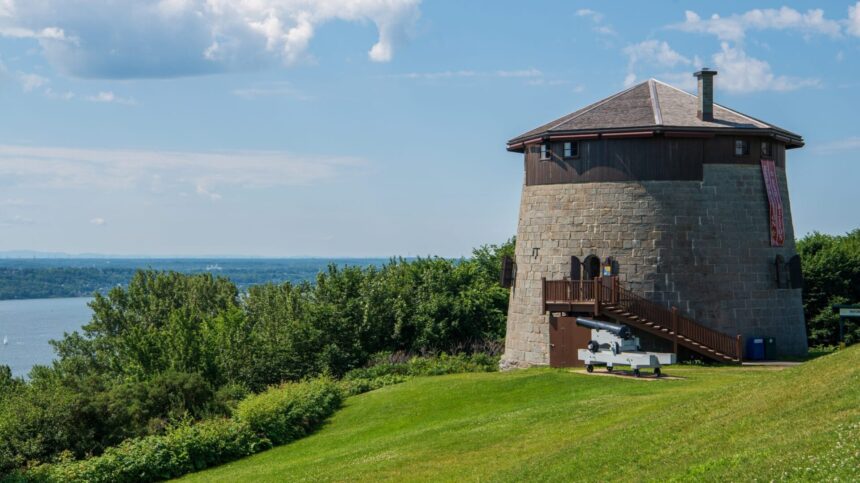
The Plains of Abraham‘s Martello towers ( four circular stone defensive structures built between 1808 and 1812 by the British Royal Engineers in anticipation of American invasion during the deteriorating diplomatic climate that preceded the War of 1812 ) are the finest surviving examples of the Martello tower defensive architecture in North America and one of the most complete ensembles of early 19th-century British military engineering accessible to the public on the continent. The towers (designated Towers 1 through 4, with Tower 4 now reconstructed rather than surviving in original condition) were designed to provide mutually supporting defensive positions across the Plains of Abraham plateau, with each tower’s field of fire overlapping its neighbours to eliminate dead ground that an attacker could exploit.
Martello Tower Design
The Martello tower form ( derived from a Corsican tower at Mortella Point that proved surprisingly effective against British naval bombardment in 1794 ) was adopted by the British military as the standard small defensive fortification type in the Napoleonic era, deployed extensively in Ireland, the British coastal counties, and the British colonies where small garrisons needed positions defensible against infantry attack without the resources to construct full-scale fortification works. The Quebec City towers follow the standard Martello design: a thick circular stone wall (2-4 metres thick at the base, tapering toward the parapet) containing a circular interior with gun platform on the roof, powder magazine in the basement, and garrison quarters in the intermediate floors. The design’s strength: the circular form presented no corners for artillery to breach, and the thick walls absorbed projectile impact without the catastrophic structural failure that angular masonry walls experienced. The design’s limitation: the towers could not provide effective defence against artillery from elevated positions (a vulnerability that the American advance on Quebec City in 1812-1814 would have exploited had it occurred).
The Quebec City Towers
Towers 1 and 2 (the two surviving original towers, now part of the Battlefields Park heritage infrastructure managed by the National Battlefields Commission) are open to visitors during summer season interpretation programming: Parks Canada interpreters in period costume provide guided access to the towers’ interiors, explaining the garrison life, the engineering of the defensive works, and the military history of the British occupation period in Quebec City. Tower 1 (adjacent to the Joan of Arc Garden) is the best-preserved of the surviving towers and the one most frequently used for interpretation programming; Tower 2 (at the Plains’ western end, near the Sainte-Foy approach) provides a different vantage point with views toward the Boulevard Champlain and the St. Lawrence approach. Tower 3 was demolished in the 19th century to allow development of the area it occupied; Tower 4 (reconstructed in the 20th century on its original foundations) houses a café and visitor facilities. Check the National Battlefields Commission website (ccbn-nbc.gc.ca) for current interpretation programming schedules.
The English Military Heritage on the Plains
The Martello towers represent only one element of the extensive English military heritage preserved on the Plains of Abraham. The full ensemble includes: the network of trenches and earthworks constructed during the Seven Years’ War sieges (partially visible as topographic irregularities in the plateau surface), the Governor’s Walk (the formal promenade that British governors used for their daily exercise, now the Promenade des Gouverneurs cliff-face walkway), the stone powder magazine (one of the most complete surviving British military heritage structures on the Plains, now used for storage), and the monument to Wolfe and Montcalm in the Governors’ Garden (the unique bilingual memorial discussed elsewhere in this guide). The British military’s investment in Quebec City’s defences ( from the Martello towers through the Citadelle‘s construction (1820-1850) ) constitutes one of the most complete physical records of British colonial military engineering in North America.