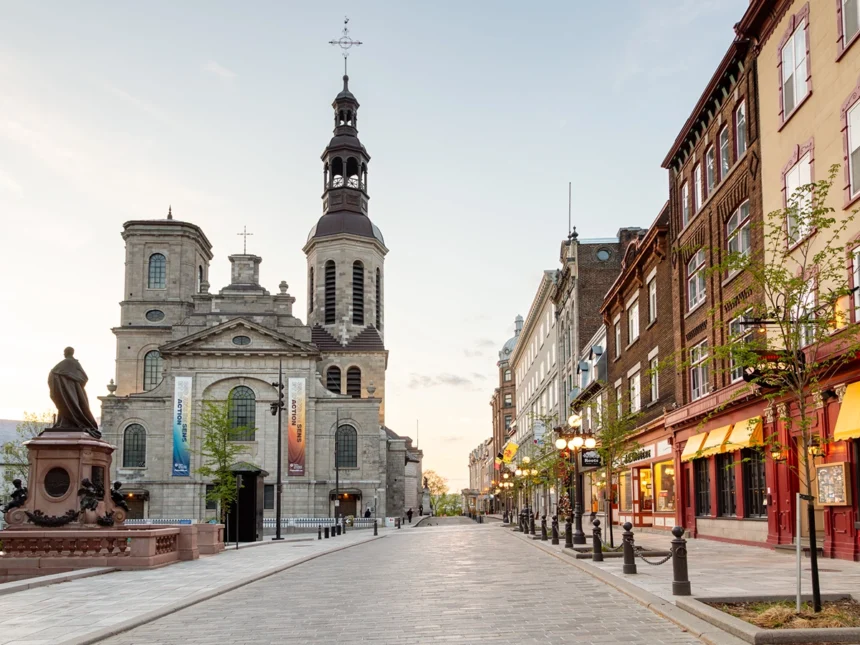
The Basilique-Cathédrale Notre-Dame de Québec ( mother church of French Canada, standing on the Rue de Buade since the first permanent church was built here in 1647 ) is the oldest parish church in Canada north of Mexico and the ecclesiastical centre around which the Catholic culture of New France organised itself for 375 years. The current building (exterior substantially rebuilt after a 1922 fire) presents a neo-Baroque limestone facade; the interior preserves the most complete collection of New France ecclesiastical art accessible in any single church. Bishop François de Laval ( who founded the Séminaire de Québec in 1663, served as the first Bishop of Quebec, and was canonized by Pope Francis in 2014 ) is interred here; his tomb has become a site of Catholic pilgrimage since his canonization.
Construction History
The first stone church at this site (1647) was progressively enlarged as the colony grew; Laval’s patronage drove the most ambitious expansion of the 1660s-1680s. The British bombardment of 1759 severely damaged the structure, destroying the tower and collapsing the roof; post-Conquest reconstruction through the 1770s-1780s restored the building’s function. Two subsequent fires (1843, 1922) required further rebuilding; the current interior dates primarily from the post-1922 restoration, with significant older elements retained in the lower church and sanctuary. The Baldaquin above the main altar ( a gilded canopy inspired by Bernini’s Vatican original, built in the 1780s ) is the most magnificent single furnishing in the building and one of the finest pieces of ecclesiastical goldwork in Canada.
The Lower Church & Tombs
The lower church (crypt) of Notre-Dame de Québec contains the tombs of several of the most important figures in the history of New France and colonial Quebec: four governors general of New France (including Louis de Buade de Frontenac, the most celebrated French governor, who died in office in 1698), and Bishop François de Laval, whose canonization in 2014 elevated the basilica to a site of international Catholic pilgrimage significance. The lower church’s sepulchral atmosphere ( the low vaulted ceilings, the stone floors worn by centuries of devotional passage, and the inscribed tomb slabs ) provides the most direct physical connection to the personalities of New France history available anywhere in Quebec City. Guided visits to the lower church are available through the basilica’s heritage programming.
Visiting
Notre-Dame de Québec is open for visitor entry (free) outside scheduled masses; the mass schedule is available at nddq.org. The adjacent Séminaire de Québec ( whose courtyard visible from the Rue de la Fabrique ) provides additional heritage context. The Musée de l’Amérique francophone within the Séminaire complex, the Basilique itself, and the adjacent Sanctuaire Notre-Dame du Sacré-Coeur (a smaller devotional chapel on the Rue Sainte-Ursule) together constitute the most concentrated ecclesiastical heritage ensemble in the Old City, requiring approximately half a day for thorough exploration.