



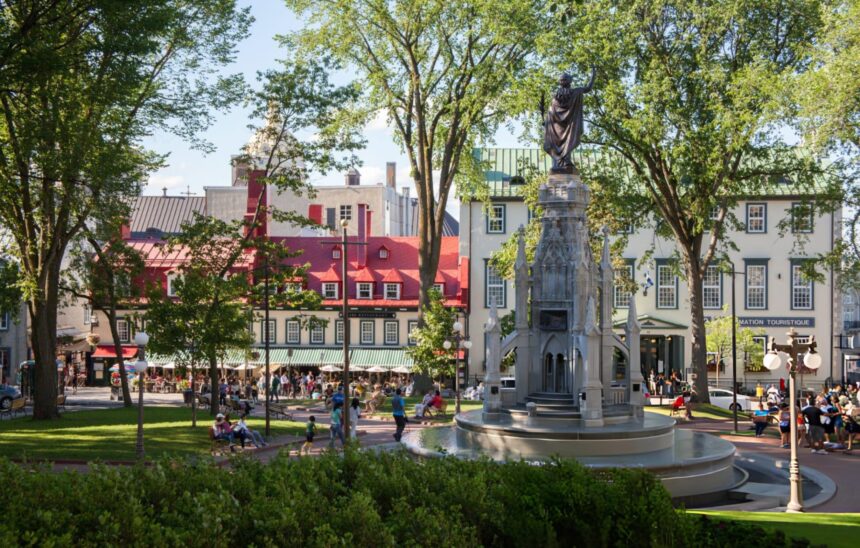
Place d’Armes is where the city gathers by default. Bounded by the Château Frontenac on the east side, the Price Building to the north, the Anglican cathedral complex beyond that, and the entrance to Rue Sainte-Anne on the south, the square works as a hinge between the religious, commercial, and lodging corners of the upper town. At less than half a hectare, it is smaller than visitors expect from photographs, and its modest scale is much of what makes it work. A place first designed as a parade ground in 1645 still operates, nearly four centuries later, as the city’s central meeting point for both residents and visitors.
The military origins
The square’s original function gave the place its name. From 1645 until 1832, Place d’Armes served the French and later British garrisons as a drill ground and mustering point. The wooden Recollet monastery occupied its eastern edge until a fire in 1796. The open rectangular form of the square took shape in the mid-eighteenth century under French military engineers, and the British administration preserved the layout after the 1759 Conquest. The final change to the square’s basic perimeter came in 1832 when the Recollets’ successor buildings were cleared to create the fuller civic space visible today.
The 1915 monument
The Monument de la Foi standing at the centre of the square commemorates the arrival of the Récollet friars in 1615, the first Catholic missionaries to establish themselves in New France. The monument was erected in 1915, three centuries after their landing, and was designed by sculptor Alfred Laliberté and architect Eugène-Étienne Taché. The column of Stanstead granite rises twelve metres, topped by a bronze figure of a friar holding a cross aloft. Laliberté’s work appears elsewhere in the city, notably at the Parliament’s facade niches; this piece remains among his most widely photographed commissions.
The surrounding buildings
Each corner tells part of the city’s story. The Château Frontenac, opened in 1893 and expanded several times since, dominates the eastern view. The Price Building to the north, completed in 1930, is Québec City’s only true Art Deco skyscraper at seventeen storeys. The Maison Kent on the southwest corner, the oldest surviving building on the square, dates to 1648. The Anglican Cathedral of the Holy Trinity, built in 1804 as the first Anglican cathedral outside the British Isles, sits across Rue des Jardins. The architectural dialogue across these structures spans four centuries, from pre-industrial stone vernacular through Victorian château style to interwar modernism.
The square today
Use of the square has shifted decisively toward tourism in the past half-century. In summer, horse-drawn caleches queue along the eastern edge, street performers work the benches, tour groups cluster around the Monument de la Foi. The winter version is quieter. The Christmas market of December and the Carnaval period in February bring their own activations. For residents, the square is most valuable in the shoulder seasons: early May and late September, when the tourist density drops and the benches on the western edge become available for reading or simply sitting. The Château Frontenac’s lobby is accessible without a key card and offers washrooms and a piano bar for anyone walking in from the square.
Logistics for visitors
Place d’Armes is a three-minute walk from Porte Saint-Louis and two minutes from Dufferin Terrace. The square is fully pedestrianised except for the caleche stand and some early-morning delivery access. Benches are free, numerous, and typically occupied on summer afternoons. Public washrooms are available in the Château Frontenac’s lobby and in the nearby Maison du tourisme on Rue Sainte-Anne. Street performers operate under a municipal licensing programme that rotates performers every thirty minutes during daylight hours. For anyone arranging to meet someone in the old city, the phrase “on se retrouve à Place d’Armes” remains the default, which is the truest measure of a public space’s continued civic usefulness four hundred years after its founding.





