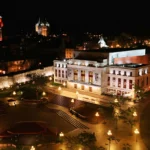
The Archdiocese of Quebec ( the oldest Catholic diocese in Canada, established in 1658 under Bishop François de Laval (canonised 2014), whose territorial jurisdiction originally covered all of New France and today encompasses a significantly reduced but still substantial area of the Quebec City metropolitan region ) maintains its institutional seat adjacent to the Basilique Notre-Dame de Québec on the Rue de Buade in the Old City’s Upper Town. The Archbishop’s Palace (the administrative buildings that adjoin the Basilica’s north flank, accessible through the heritage courtyards that connect the various institutional buildings of the archdiocese’s Old City complex) represents the spatial legacy of 375 years of Catholic institutional centrality in Quebec City’s urban governance: the Church’s buildings occupy the most prominent positions in the Upper Town’s institutional geography, adjacent to the fortification walls that the colonial government built and within sight of the Château Frontenac that represents the secular colonial power.
The Catholic Church’s contemporary institutional presence in Quebec City is a significantly diminished version of the dominant social force it represented through the pre-Quiet Revolution period. The Church’s retreat from Quebec’s institutional life ( the transfer of the school system to the provincial government (1964-1966), the hospitals to the public health system (1960s-1980s), and the social welfare functions to the provincial welfare state ) has reduced the institutional footprint dramatically while the physical heritage (the Basilica, the various convents, the episcopal palace, and the dozens of parish churches distributed through the city’s neighbourhoods) remains as a material record of the pre-Quiet Revolution institutional scale. The parishes that continue to function (reduced in number by successive consolidations as attendance declined from the near-universal church participation of the 1950s to the approximately 15-20% regular attendance of the contemporary Quebec Catholic community) serve an aging and committed core congregation while simultaneously managing the heritage buildings that the declining congregational revenue can barely sustain. The Basilique Notre-Dame de Québec ( the cathedral church of the archdiocese, on the site of the first Quebec City church (1647) and hosting approximately 1.5 million visitors annually ) is simultaneously the active liturgical centre of the diocese and the heritage tourism destination that the Old City’s visitors experience as a heritage site rather than primarily as a place of active worship.