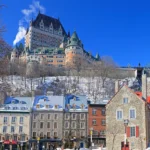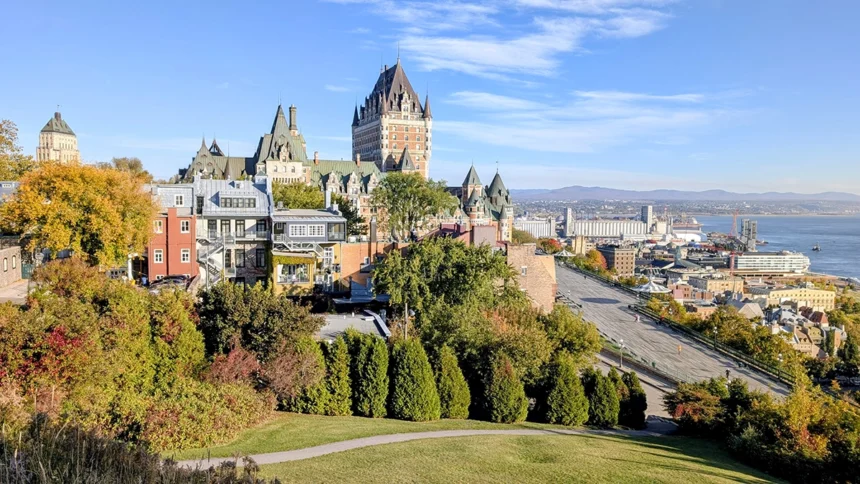
There’s a moment every visitor to Québec City eventually has with the Château Frontenac — usually on the Terrasse Dufferin, usually right around golden hour, when the copper roof catches the last of the afternoon sun and the river stretches out below like someone unrolled a sheet of hammered pewter. It’s the shot everyone takes. It’s on every postcard, every guidebook cover, every Instagram feed tagged #QuebecCity. And it’s the reason the Fairmont Le Château Frontenac holds, with remarkably little competition, the title of the most photographed hotel in the world.
But here’s what nobody tells you before you arrive: the view of the Château is the main event. The view from inside the Château is a completely different conversation. After living in Québec City for years and bringing dozens of visitors through those doors, I can tell you that understanding the difference between these two experiences is the single most useful thing you can do before planning your visit.
A Quick History: Because the Building Itself Is Already a Story
The Château Frontenac opened its doors in 1893, commissioned by the Canadian Pacific Railway as part of a national network of château-style railway hotels designed to give wealthy train travellers a reason to stop. The original 170-room structure — designed by the American architect Bruce Price, who also designed Banff Springs and Windsor Station in Montréal — was meant to evoke the Loire Valley castles of France. The result is one of the most convincing pieces of architectural theatre in North America.
What most people see today isn’t the 1893 building. The silhouette that makes the Château instantly recognizable — that central tower rising 17 storeys above Cap Diamant — is the Maurice Boucher tower, completed in 1924. Several expansions over the decades pushed the room count to 611 today (officially 618 before the 2012 renovation), making it one of the largest hotels in Eastern Canada by footprint.
The hotel hosted Winston Churchill, Franklin D. Roosevelt and Canadian Prime Minister William Lyon Mackenzie King during the Québec Conferences of 1943 and 1944, where significant portions of the Normandy invasion strategy were finalized. There’s a plaque in the lobby. You will walk past it and not read it, like everyone else. That’s fine.
The Honest Answer: Should You Actually Go Inside?
This is where most travel guides get evasive. Here’s my blunt take:
Yes, go inside. No, do not pay for the guided tour.
The lobby, the grand staircase, the Place Dufferin Bar, the 1608 Champagne Bar, and the hallways on the main floor are entirely accessible to anyone who walks through the front doors with a reasonably clean coat. There’s no velvet rope. No one will ask if you’re a guest. This is arguably the best-kept local secret about the Château — you can wander the public spaces, photograph the ceilings, sit at the bar, and experience 90% of what the guided tour shows you, for the cost of a $14 beer.
The formal guided tour runs around $30 per adult, departs from the lobby several times a day, and lasts roughly 50 minutes. It’s well-researched and the guides know their stuff, but the content is heavily weighted toward facts you could read on a Wikipedia page — former suite numbers of famous guests, the provenance of a particular tapestry, dates of expansions. If you’re a serious architecture or hospitality-history enthusiast, it’s worth it. For everyone else, your money buys you more by spending it on a drink at the bar and letting the space speak for itself.
Afternoon Tea at the Château: The Real Talk
The afternoon tea service at the 1608 Champagne Bar is one of those experiences people feel they ought to love. It runs about $65 per person, includes three tiers of finger sandwiches, scones with clotted cream, and pastries, plus a selection of loose-leaf teas served in proper china.
Is it good? Yes. Is it memorable? Depends entirely on what you’re comparing it to.
If the idea of afternoon tea in a historic Canadian hotel is the experience you came for — if the ceremony of it matters to you — it delivers. The service is polished, the pastries are made in-house, and the room itself is gorgeous in the late-afternoon light. If you came to Québec City primarily for its food scene, though, $65 is going to go a lot further at a place like Légende, Le Clocher Penché, or one of the Saint-Roch neighbourhood’s ambitious younger kitchens. The tea is a Château experience, not a Québec food experience. Know which one you’re buying.
Staying Overnight: Who It’s Actually For
Rooms at the Château typically start around $350-450 CAD per night in shoulder seasons and can climb well past $800 in high summer and during the Winter Carnival. Suites, including the famous Royal Suite once used by Churchill, run into the low thousands.
Here’s my shortlist of who should stay at the Château:
- First-time visitors who want the full “I stayed in the castle” experience — a one-night splurge built into a longer trip works well.
- Couples celebrating something specific — an anniversary, a milestone birthday, a proposal. The setting earns its keep on a significant occasion.
- Travellers who genuinely love historic hotels as a category — the Fairmont Banff Springs, the Algonquin, the Waldorf-Astoria crowd.
And who probably shouldn’t:
- Families with young kids who’d do better at an Old Québec boutique hotel with more flexible layouts and faster-moving staff.
- Design-hotel travellers who prefer contemporary spaces — the Château’s rooms, even post-renovation, feel traditional rather than cutting-edge.
- Anyone whose Québec City budget is tight. The city has excellent mid-range and boutique options within a five-minute walk of the Château, at one-third the price, with their own character.
The Best Way to Photograph the Château (From Outside)
Since the building is the point, here are the four best vantage points — in order of how underrated they are:
1. Terrasse Dufferin at dawn. The classic shot, but go at 6:30 AM in summer or 8:30 AM in winter before the tour buses arrive. You’ll have the whole boardwalk to yourself, and the light on the copper roof is cleaner without midday haze.
2. The Lévis ferry. A $4 round trip on the Québec–Lévis ferry gives you the only angle where the Château, Cap Diamant and the river all fit in the same frame with proper proportion. It’s the view that defines the skyline.
3. Parc des Gouverneurs, looking north. Most people miss this little park right behind the hotel. From its eastern edge, the Château rises dramatically above the trees with almost no tourists in the shot.
4. The Promenade des Gouverneurs cliff walk. The wooden boardwalk that climbs up to the Plains of Abraham gives you the Château from below, looking up its full 53-metre cliff. Dramatic, and almost nobody uses it.
FAQ: Quick Practical Answers
Is the Château Frontenac a real castle?
No. It’s a hotel built in 1893 in the château style, inspired by 16th-century Loire Valley architecture. There was a military fortification on this site before it (the Château Haldimand), but the current building has always been a hotel.
Can I go inside without being a guest?
Yes, absolutely. The lobby and public bars are open to anyone. Dress smart-casual and walk in like you belong — because you do.
What’s the best time of year to photograph it?
Late January through February during the Winter Carnival, when fresh snow transforms the setting, or mid-October when the surrounding Parc du Cavalier du Moulin lights up with autumn colours.
How much time should I budget?
30-45 minutes to walk the public spaces and grab a drink. Add another hour if you’re doing the guided tour, and a full afternoon if you’re committing to the tea service.
Are dogs allowed?
The Château is pet-friendly for registered guests (small additional fee), but pets are not allowed in the restaurants or the tea service.
The Bottom Line
The Château Frontenac’s value to a Québec City visitor is, in this order: landmark first, bar-and-restaurant stop second, overnight accommodation third. Treat it as the icon it actually is — the building you photograph from every angle, the place you step inside to feel the scale — and you’ll walk away satisfied. Treat it as a must-do tourist attraction with paid tickets and scheduled tours, and you’ll probably wonder what the fuss was about.
Either way, you will absolutely take its picture from the Terrasse Dufferin. Everyone does. There’s a reason it’s the most photographed hotel in the world.