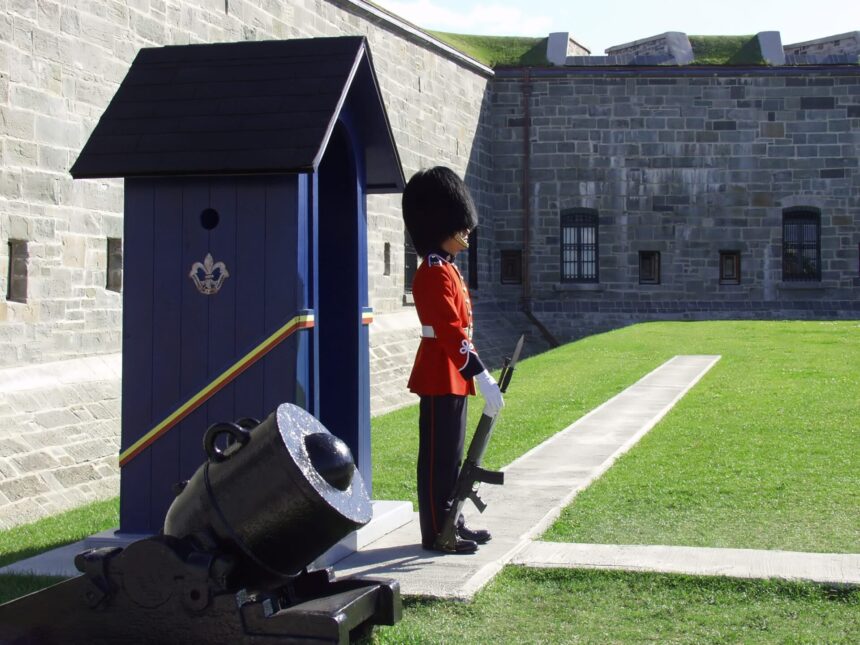
The Royal 22e Régiment Museum is the regimental museum of the French-speaking infantry regiment of the Canadian Armed Forces, located inside the walls of the Citadelle of Quebec. It occupies a set of restored stone buildings at the heart of the Citadelle complex and presents the history of the regiment alongside material on the broader story of French-Canadian military service. For visitors to Quebec City, it is a subject-matter complement to the Citadelle tour: where the tour introduces the fortification as a building, the museum introduces the unit that continues to call the Citadelle home.
The regiment and its place at the Citadelle
The Royal 22e was formed during the First World War, at a moment when Canada’s expeditionary army contained very few francophone battalions and when recruitment in Quebec had been hampered by the almost entirely English-language character of existing units. The new regiment was French-speaking from its officers to its soldiers and served on the Western Front through the last years of the war. It has since served in the Second World War, in Korea, in peacekeeping missions, and in the deployment to Afghanistan in the 2000s. The regiment’s permanent base since 1920 has been the Citadelle of Quebec, and the Citadelle is also one of the two official residences of the Governor General of Canada, a fact reflected in the ceremonial programming of the site.
What is on display
The museum’s permanent collection is organised chronologically, from the regiment’s formation through the present day. Uniforms, small arms, regimental colours, medals, archival photographs, and personal effects of soldiers and officers are grouped by era. The First World War sections are particularly strong, drawing on material donated by families of veterans over the past century. The Second World War and Korean War rooms cover specific engagements in detail, including the regiment’s role in the Italian campaign and in the battles of the Korean front. More recent exhibits cover Canada’s post-Cold-War deployments and the regiment’s contribution to them.
A small auxiliary gallery presents the broader context of French-Canadian military service, including the militia units of the French régime and the period of British rule during which French-speaking Canadians served in varying and sometimes uneasy relationships with the imperial military. The interpretive signage is available in French and English throughout.
Visiting the museum
The museum is accessed through the Citadelle’s main entrance on the Côte de la Citadelle. A single ticket covers admission to the Citadelle grounds, the guided tour of the fortification, and entry to the regimental museum. The guided tour is the only way to see most of the fortification’s interior, since the Citadelle remains an active military installation; the museum visit can be done on a self-guided basis before or after the tour. Allow roughly an hour for the museum alone, and roughly two to two and a half hours for the Citadelle plus the museum together.
Opening hours change by season, with the site generally open daily in the summer and on reduced schedules from late autumn through early spring. The changing of the guard ceremony, held on the Citadelle’s parade square during the summer season, is included with a standard ticket; it attracts a crowd on clear mornings, and visitors who plan to attend the ceremony should arrive on the hour before to find a good viewing position. Visits during the winter months are quieter, and the museum’s indoor exhibits are particularly welcome on a cold afternoon.
What to look for
Several specific pieces are worth seeking out. The regimental colours carried during the First World War are displayed in a climate-controlled case and remain one of the museum’s most evocative objects: the silk is patched and faded but has been stabilised for display without being restored in a way that would erase its service history. A reconstructed trench dugout, with an authentic soldier’s kit laid out on the bench, sits in the centre of the First World War gallery. The medals displays include a Victoria Cross awarded to a regimental member and a set of campaign medals from later conflicts, each accompanied by short biographical notes on the recipient.
For visitors with a family connection to the regiment, the archive staff can help with research requests made in advance by email; the museum retains records that complement those held by Library and Archives Canada in Ottawa, and a descendant seeking information on a specific soldier is often best served by contacting the museum directly before visiting.
Where it fits an itinerary
The Citadelle and its museum pair naturally with a morning visit to the Plains of Abraham and an afternoon walk along the ramparts. A visitor with a single day in Quebec City who wants to understand the military layer of the city’s history can spend two and a half hours at the Citadelle and move on to the Plains battlefield or to the Artillery Park without exhausting the subject. Two days allows a more thorough exploration, with the Morrin Centre and the Plains Museum added to the circuit.