



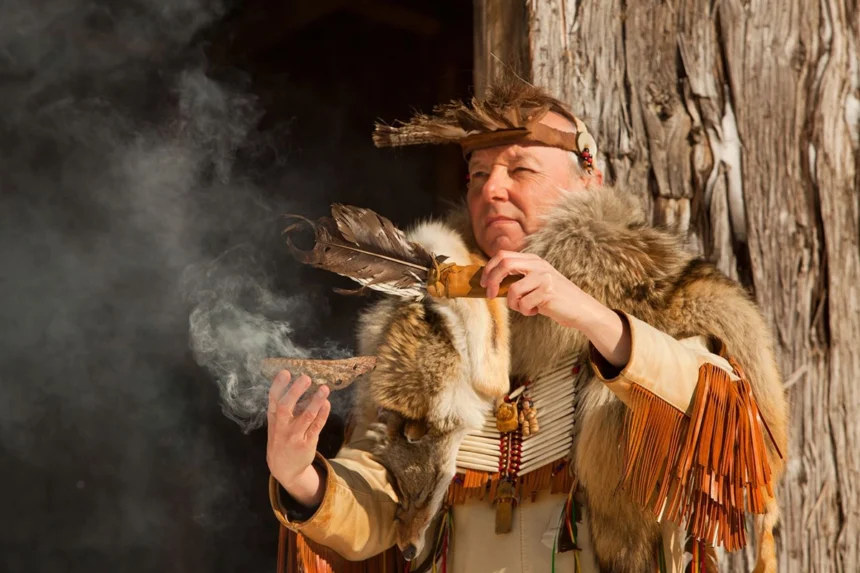
Onhoüa Chetek8e is a reconstructed Wendat village on the banks of the Akiawenhrahk (the Saint-Charles River) in Wendake, a fifteen-minute drive north of downtown Quebec City. The site opened to the public in 1990 and is operated by the Huron-Wendat Nation. Its purpose is straightforward: to present the material culture and daily life of the Wendat people to a general audience through a guided visit of a longhouse-based village, an adjacent museum space, and a small craft shop. The name is rendered several ways in print and on signage; the spelling with the numeral “8” preserves a sound that older French orthographies represented with a ligature.
What you see on a visit
A typical guided visit lasts about an hour. It begins at the reception pavilion, where visitors meet their guide, and moves out to the village proper. The central structure is a long cedar-bark longhouse that has been reconstructed according to archaeological and ethnographic sources. Inside, the platforms, hearths, and storage spaces show how a multi-family clan group would have organised shared living quarters. Guides explain how the smoke holes were managed, how the corn, beans, and squash were prepared and stored, and how winter provisions supported a community that moved between summer fishing camps and fortified year-round villages.
The grounds also include a sweat lodge, a drying rack for fish and game, a reproduction of a canoe builder’s station, and a section of palisade that shows how the outer defensive wall of a larger village would have been constructed. Tours are bilingual by default in French and English, and English-language visitors should confirm availability at the ticket desk if they want a fully English session; capacity on a given day depends on the guides working.
Food, craft, and the traditional kitchen
A restaurant on the site, La Traite in the neighbouring hotel complex operated by the Huron-Wendat Nation, offers a modernised version of Indigenous cuisine drawing on game meats, corn, wild herbs, and berries. The craft shop at Onhoüa Chetek8e carries pieces produced by Wendat artisans and by other First Nations, including moccasins, beadwork, quillwork, drums, and smaller items suitable as souvenirs. Prices reflect the labour involved in the traditional methods and are posted on each piece; the staff will describe the provenance of any item on request.
Getting there
From downtown Quebec City the drive is about fifteen kilometres via Highway 73 north and the Wendake exit, and takes roughly twenty minutes outside of peak hours. Public transit is limited; RTC bus service reaches the edge of Wendake but does not stop at the site, and a taxi or rideshare for the last kilometre is the most straightforward option for visitors without a car. Many Quebec City hotels also arrange half-day tour packages that include the guided visit, transport, and, in some cases, a meal at La Traite. These are worth comparing with the à-la-carte option if you are staying for a short visit and prefer not to drive.
When to go
The site operates year-round, and each season offers a different experience. Summer brings the full suite of demonstrations and the highest number of daily tours; booking ahead is sensible, particularly on weekends and on the long weekend around Canada Day. Autumn is quieter and the setting along the river is at its best in late September. Winter visits include demonstrations adapted to the cold: snowshoe-making, preparation of winter foods, and the longhouse interior lit with the hearth’s low light. Spring is the shortest season on site, with periodic interruptions during thaw conditions, and is worth checking the schedule for before setting out.
Practical notes
Tickets are sold at the reception pavilion and online in advance. A reduced rate applies to children, students, and seniors, and a family rate is available. The main grounds include uneven surfaces and a short wooden boardwalk, but the principal longhouse and museum space are reached without stairs. Photography is permitted in most areas; some ceremonial objects are identified with signage asking visitors to refrain from photographing them, and it is appropriate to honour those requests. Plan on at least ninety minutes for the visit if you intend to include the craft shop and a quick look at the river, and longer if you pair the visit with lunch at La Traite.








