Québec City’s food scene is smaller than Montréal’s but more coherent. The city has perhaps a dozen serious fine-dining restaurants, a hundred competent mid-range rooms, and an unusually strong supporting cast of bakeries, fromageries, épiceries fines, and small producers working out of market stalls. For a visitor with three or four days, the useful approach is not a checklist of starred destinations but a rotation through different categories that together sketch the local food culture.
What to order
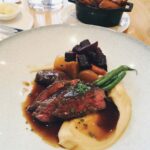
At the high end, three restaurants set the standard. La Tanière³ in the Lower Town runs the city’s most ambitious tasting-menu format, with prices from $175 to $325 depending on the seating. Légende, two blocks away in the Place-Royale area, works a more concise tasting menu ($125 for seven courses) with a strong focus on foraged and wild ingredients. Chez Boulay on Rue du Parloir anchors the middle of the fine-dining tier with a northern-cuisine approach at about $95 for a full tasting menu or $40 to $55 for à la carte mains.
The mid-range restaurant bench is where visitors find most of the memorable meals. Le Clocher Penché in Saint-Roch has been running since 2001 and is probably the most reliable neighbourhood bistro in the city. Mains run $28 to $38. Don Vegan on Rue Saint-Vallier Est is the most serious vegetarian kitchen, with an Italian-influenced menu at $24 to $32 per main. Sapristi! on Saint-Jean has been doing solid brasserie cooking for two decades and is the default where locals take out-of-town guests. L’Orygine on Rue Saint-Joseph is the natural-wine-focused sibling that has become a weeknight institution.
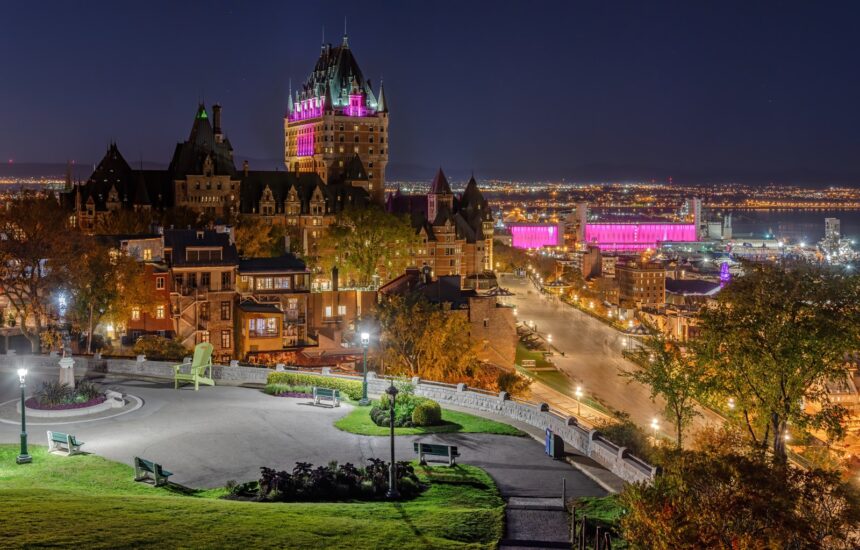
For regional Québécois cooking in a more traditional register, the options split between Aux Anciens Canadiens on Rue Saint-Louis (the oldest restaurant building in the city, built 1676, with a menu of tourtière, pâté chinois, and similar dishes for $35 to $45 per main) and the Restaurant Le Champlain at the Château Frontenac, which serves a refined version of the same tradition for roughly double the price.
Drinks and atmosphere
Brasseries and gastropubs have proliferated since the local craft-beer scene matured in the mid-2010s.
La Korrigane on Rue de Dorchester, La Souche in Limoilou, and Le Noctem on Rue Saint-Joseph are the reliable brewpub options. All three produce their own beer and pair it with straightforward but well-executed burgers, sausages, and shareable plates. Expect $18 to $28 for a main and $8 to $11 for a beer.
Vietnamese food is unusually strong in Québec City, clustered in Sainte-Foy around Rue Myrand and Avenue Maufils. Phở Tân Định, Le Piment Rouge, and Oriental Palace are the established options; newer arrivals like Bánh Mì Chez Nous on Chemin Sainte-Foy have extended the range. Bowls of phở run $14 to $18. The community of Vietnamese restaurateurs mostly dates to the 1975-1985 refugee wave and remains largely family-operated.
What sets it apart
Bakeries and pâtisseries are where Québec City competes directly with Montréal. Paillard on Rue Saint-Jean is the most commercial and most visible, with queues out the door at weekend mornings. Le Pain Grüel in Saint-Jean-Baptiste is the serious artisan option, with a rotating sourdough programme and a limited viennoiserie selection. Éric Borderon on Avenue Cartier handles the classic French register (baguette, pain au chocolat, mille-feuille) with consistency.
For cheese, the specialist shops include Fromagerie du Marché at the Grand Marché and the smaller Fromagerie des Grondines on Rue Saint-Jean. Québec has become a serious raw-milk cheese producer since regulatory changes in 2008, and local cheeses, the Louis d’Or from Warwick, the Sir Laurier d’Arthabaska, the Cendré des Prés, have become fixtures on restaurant boards across the province.
Markets are worth a dedicated morning. The Grand Marché on Avenue Wilfrid-Hamel in the Parc ExpoCité, opened in 2019, is the largest and has about sixty permanent stalls plus rotating seasonal vendors. The Marché du Vieux-Port at the Bassin Louise is smaller, more tourist-oriented, and weaker on produce but stronger on prepared foods. Both are open year-round, with reduced winter hours.
Coffee and atmosphere
Coffee has developed alongside the food. Nektar in Saint-Roch, Tandem in Limoilou, and Café Krieghoff on Avenue Cartier are the serious roasters. Filter is $4.50-$5.50, cappuccino $5-$6.
For a three-day food-focused visit, the useful structure is: one fine-dining dinner, one bistro or brasserie dinner, one casual Vietnamese or Middle Eastern lunch, one bakery and coffee morning, one market morning, and an afternoon cheese-and-charcuterie session at a wine bar. That covers the principal registers without exhausting the range.