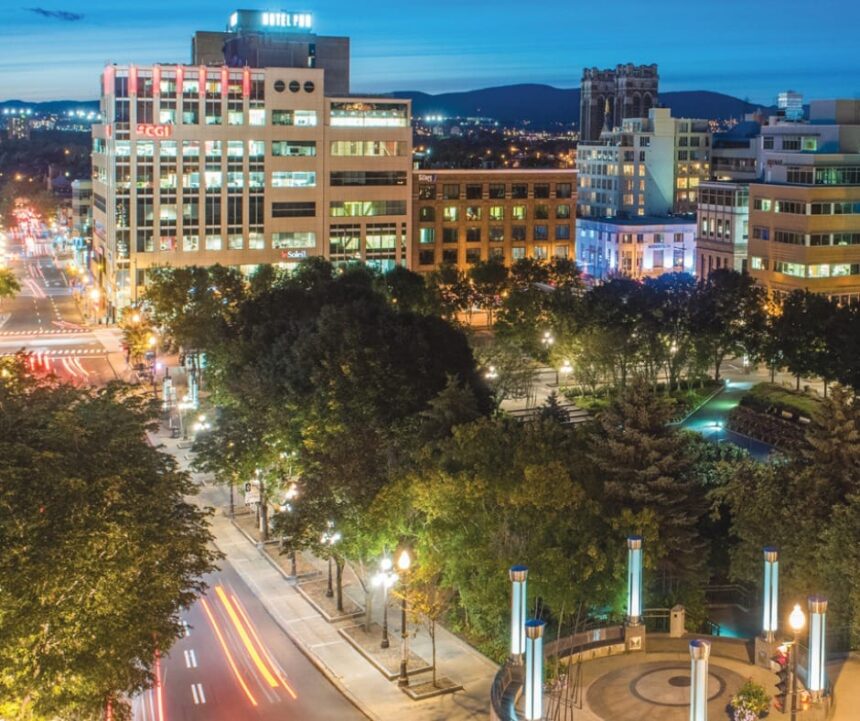
Saint-Roch‘s history ( from its origins as an industrial faubourg outside the walls of the Upper City in the early 19th century, through its peak as the manufacturing heart of Quebec City in the 1870s-1950s, its catastrophic post-industrial decline in the 1970s-1980s, and its remarkable creative economy revival from the 1990s through the present ) is the most dramatically arc-shaped neighbourhood narrative in Quebec City’s urban story. Understanding Saint-Roch’s history provides the context within which the neighbourhood’s contemporary character ( its creative energy, its social diversity, its blend of heritage industrial architecture and contemporary commercial development ) becomes fully legible.
Industrial Saint-Roch (1820s-1950s)
Saint-Roch’s industrial identity was established by the convergence of geographic advantages: the lower city location (below the cliff, where building materials and manufactured goods could be transported to and from the port without the grade penalty of the cliff), the Saint-Charles River (whose water power was harnessed for early mills), and the proximity to the immigrant labour force concentrated in the working-class neighbourhoods of the Lower Town. The shoemaking industry ( concentrated in Saint-Roch’s factories from the 1850s through the 1970s ) was the most significant: Quebec City was one of Canada’s primary shoe manufacturing centres, with factories producing hundreds of thousands of pairs annually for the North American market. The decline of the shoe industry (competition from lower-wage manufacturing in Asia beginning in the 1970s) hollowed out Saint-Roch’s industrial base within a single decade.
The Decline (1970s-1990s)
The post-industrial decline of Saint-Roch was visible and rapid: factory closures left large industrial buildings vacant, the working-class population that depended on manufacturing employment dispersed to the suburban arrondissements where service-sector employment was growing, and the commercial street of Rue Saint-Joseph ( once one of Quebec City’s most active retail corridors ) saw store closures that progressively hollowed out its commercial character. By the early 1990s, Saint-Roch had become the Lower Town zone that the rest of Quebec City avoided: high vacancy rates, social service concentration (food banks, shelters, and social housing clustered in the neighbourhood as real estate costs fell), and the physical deterioration that accompanies disinvestment. The contrast with the tourism economy of the Old City immediately above the cliff ( thriving throughout this period ) was as stark as the topographic divide between the two levels.
The Revival Strategy (1995-Present)
The revival of Saint-Roch was not accidental it was the product of deliberate public investment (the Ville de Québec’s Saint-Roch renewal program, which included streetscape improvements, building renovation subsidies, and the attraction of anchor cultural institutions), strategic cultural seeding (the Méduse cultural cooperative’s establishment in 1995 in the Îlot Fleurie complex was the decisive early catalyst), and the provincial government’s multimedia tax credit (which made Ubisoft’s 1997 establishment and subsequent growth financially viable). The combination produced a neighbourhood transformation that urban planners study internationally as a model for post-industrial creative economy revival: the physical heritage of the industrial era (large-format brick and stone factory buildings with the flexible floor plates that technology companies and cultural organisations need) repurposed for the knowledge economy workers of the 21st century.
Saint-Roch is one of several distinct quartiers, and the choice between them shapes a visit. Compare it with the rest in our guide to Québec City’s neighbourhoods.