Québec City is not a startup capital in the Silicon Valley sense, and nobody here pretends otherwise. What it offers instead is a smaller, cheaper, more stable ecosystem built around a handful of anchor institutions: Université Laval and its research centres, the provincial government as a procurement customer, Industrielle Alliance and Desjardins as corporate partners, and a local venture scene that prefers quiet capital efficiency to headline-grabbing burn.
Where the tech clusters are
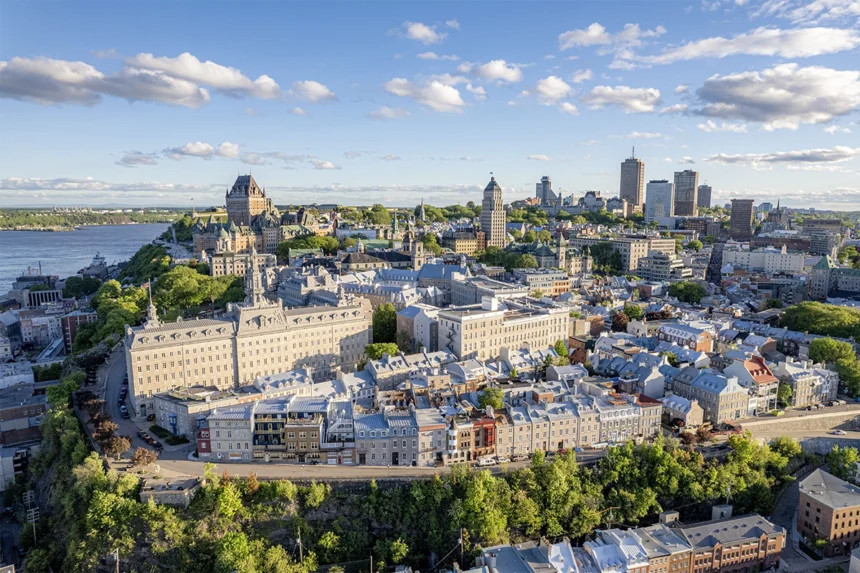
The geography matters. Most of the tech activity clusters in three pockets. The first is Sainte-Foy, along the Chemin des Quatre-Bourgeois and around the Université Laval campus, where research-adjacent companies and cybersecurity firms share buildings. The second is the Parc technologique du Québec métropolitain, a purpose-built park off Autoroute Henri-IV with serious life-sciences and optics-photonics tenants. The third is Saint-Roch in the Lower Town, the designated creative district where game studios, design agencies, and smaller software teams have taken over converted industrial space since the mid-2000s.
Gaming remains the most visible subsector. Ubisoft Québec, opened in 2005, employs more than six hundred people and has shipped several Assassin’s Creed titles from its Saint-Roch studio. Beenox, a Treyarch-affiliated outfit, works on Call of Duty ports from offices a few blocks away. Behaviour Interactive has opened a satellite here, and a long tail of indie studios, some with three or four staff, fill the smaller buildings along Boulevard Charest.
The neighbourhood
Optics and photonics are less famous but economically heavier. The cluster is coordinated through Optonique, the industry association, and draws on the Centre d’optique, photonique et laser at Université Laval, which has produced spinouts in telecommunications gear, medical imaging, and defence optics for four decades. INO, the Institut national d’optique, sits in the Parc technologique and contracts to both private clients and federal research programmes.
Cybersecurity has grown quickly since around 2018, pushed by the provincial government’s need for domestic suppliers after several public-sector data breaches. In Vivo, GoSecure, and Videns form the visible tier, with a dozen smaller firms working on specific niches: industrial control systems, post-quantum cryptography, and audit tooling for Québec’s public-sector clients.
Funding is modest by Toronto or Montréal standards. Real Ventures, Luge Capital, and Anges Québec Capital are the most active early-stage investors, usually writing cheques under two million dollars. Larger rounds typically require a Montréal or Toronto lead, which founders here tend to accept without much complaint. The Fonds de solidarité FTQ and Investissement Québec fill the growth-stage gap, though often on terms that look more like debt than equity.
The talent bottleneck
Talent is the bottleneck everyone admits. Université Laval graduates about eight hundred computer science and engineering students a year, and Ubisoft, Desjardins and IA hire first. Smaller startups compete on culture, short commutes, and the province’s generous R&D tax credits, which effectively subsidise salaries for qualifying technical roles. Remote hiring from Montréal and Sherbrooke has become common since 2021.
The support infrastructure is denser than you might expect. Québec International, the regional economic development agency, runs a soft-landing programme for foreign founders. LE CAMP, a startup accelerator operated out of Saint-Roch, hosts cohorts twice a year and is where most first-time founders in the city end up passing through. Espace-Inc in the Parc technologique handles later-stage coaching. Université Laval runs student competitions and a modest pre-seed fund.
What it costs
For a founder deciding between Québec City and elsewhere, the honest trade-off is this: lower cost base, deeper public-sector access, narrower talent pool, smaller domestic capital, and a longer flight to San Francisco. For companies whose first customers are government agencies, insurers, or industrial manufacturers, the arithmetic often works. For a pure consumer play chasing virality, it rarely does, and most such founders eventually move to Montréal or farther afield.
The English-speaking visitor exploring the tech scene can start at LE CAMP on Rue du Parvis, where the coworking floor is open to day passes, and continue to the Parc technologique off Boulevard de la Chaudière for a sense of the heavier research tenants. Networking events run in French more often than not, though most founders switch to English without being asked.