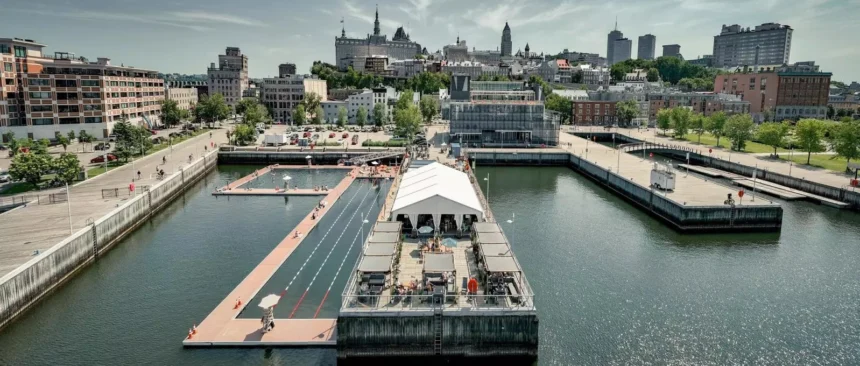
Quebec City’s relationship with the St. Lawrence River is foundational ( the city exists because of the river. Champlain’s choice of this site in 1608 was determined entirely by geography: the narrow point in the river (the word “Kebec” in Algonquin means “where the river narrows”), the deep natural harbour formed by the bay between the cliff and Île d’Orléans, and the defensive advantages of Cap Diamant above the riverbank. For 300 years after Champlain’s settlement, Quebec City was one of the most important ports in North America ) the gateway through which the fur trade, the fish trade, and eventually the timber trade flowed between the continent and Europe.
The Timber Trade
Quebec City’s 19th-century prosperity was built on timber ( specifically on the massive white pine and red pine forests of the Canadian Shield, cut and floated down the Ottawa and St. Lawrence rivers to Quebec City’s shipyards and lumber wharves. The timber trade made Quebec City one of the busiest ports in the British Empire at its peak in the 1840s-1860s. The shipbuilding tradition of the Saint-Roch neighbourhood (now the creative district) dates from this period ) the same wharves where La Barberie microbrewery now operates adjacent to Parc John Munn once housed the John Munn and Son shipyard.
The Old Port Today
The Old Port (Vieux-Port de Québec) ( the historic harbour district adjacent to Place Royale ) has been transformed from industrial waterfront to cultural and recreational destination, while retaining enough of its commercial character (the cruise ship terminal, the occasional container vessel, the grain elevators visible from the ferry) to remind visitors that Quebec City remains a working river city. The Musée de la Civilisation, the Marché du Vieux-Port, and the waterfront promenade occupy former warehouse and wharf sites.
The Lévis Ferry
The ferry service between Quebec City and Lévis ( operated by the Société des traversiers du Québec, running 24 hours daily ) is one of the oldest continuous ferry routes in North America. The 12-minute crossing serves thousands of daily commuters and provides the finest view of Old Quebec available from any vantage point. The STQ also operates longer ferry routes to the south shore from Trois-Pistoles and the Lower St. Lawrence. The ferry service is a living reminder that the St. Lawrence River, despite the bridges built upstream from Quebec City, remains a waterway that divides as well as connects.