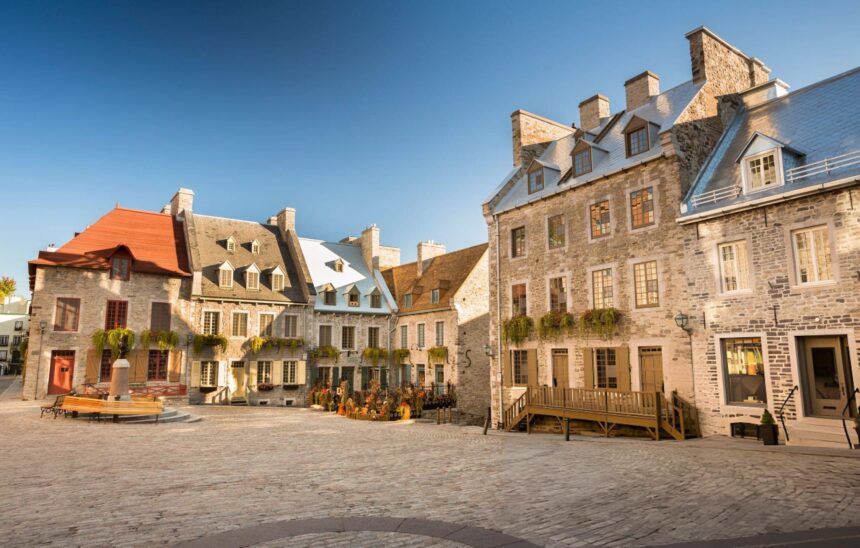
Place Royale is the small cobbled square at the foot of Cap Diamant where Samuel de Champlain built the first permanent habitation in 1608. The site has been continuously occupied ever since, which makes it the most historically layered address in French North America. The buildings around the square today are a mix of reconstruction, restoration, and original seventeenth- and eighteenth-century fabric. What you see is real, and also the product of decisions made in the 1960s and 1970s about what reality to preserve.
Before 1608
The point at Cap Diamant sat within the territory of the Iroquoian peoples Cartier had encountered at Stadacona in 1535. By the time Champlain arrived, those communities had dispersed, for reasons still debated by archaeologists and historians. The site he chose was strategic rather than accidental: a defensible elevation, a narrow channel in the river, access to the plateau above by a steep path that became the Côte de la Montagne.
The French century
Through the 1600s and into the 1700s, Place Royale developed as the commercial core of the colony. Merchants built stone houses with thick walls, steep roofs, and ground-floor shops opening onto the square. The parish church, Notre-Dame-des-Victoires, was built in 1687 and remains, improbably, the oldest stone church in North America. It survived the British bombardment of 1759, the fires of 1682 and 1759, and the subsequent centuries of neglect and restoration.
Decline and neglect
By the mid-twentieth century the square had slipped into decay. The lower town was industrial and boarded-up. The 1960s brought active demolition proposals, which went through public consultation before they were stopped.
The 1970s restoration
In 1971, the provincial government committed to a restoration programme rather than a demolition. Over the following two decades, Parks Canada and the Ministère de la Culture restored building after building to a chosen reference period, generally the early eighteenth century. Where original fabric survived, it was preserved. Where buildings had been demolished in the nineteenth or twentieth century, they were reconstructed, sometimes from archival drawings and archaeological excavation, sometimes with interpretive licence.
The result is neither a pure museum nor a pure reconstruction. It is a curated heritage district, and the curation is usually honest: interpretive plaques on individual buildings explain whether what you are seeing is original, restored, or rebuilt. Visitors who read the plaques will come away with a clearer sense of the square than visitors who do not.
What to see
Notre-Dame-des-Victoires is the anchor and the most important single building. Inside, the retable above the altar is a seventeenth-century work by the master sculptor Jean Baillargé, one of the earliest art objects made in New France that survives intact. The church interior is small and rewards a quiet visit; daily hours vary but generally run through midday and into the afternoon.
The Centre d’interprétation de Place-Royale, at 27 rue Notre-Dame, covers the archaeological and architectural history of the site across three floors. It is the best first stop for a visitor who wants context before walking the square. The Maison Chevalier, the Maison Picard, and the Maison Hazeur all have interpretive programming during the summer season.
How to approach a visit
Place Royale is best visited either very early in the morning or in the evening after the cruise-ship crowds have cleared. The square is small, and midday in summer it fills with tour groups. An hour is enough for a cursory look. Two to three hours, with the interpretive centre and Notre-Dame-des-Victoires, delivers a fuller picture. Combining the visit with a walk along rue Sous-le-Fort and up the Breakneck Stairs into the upper town gives a practical sense of how the colony was actually laid out in three dimensions.
Getting there
From the upper town, the funicular descends to the rue du Petit-Champlain within two minutes’ walk of the square. By foot, the Breakneck Stairs from Terrasse Dufferin are the atmospheric approach. By car, paid parking is available along boulevard Champlain; street parking in the lower town is limited and tightly enforced.
Place-Royale is a protected heritage site managed within the city’s patrimony programme; the Ville de Québec heritage record sets out its history and status.