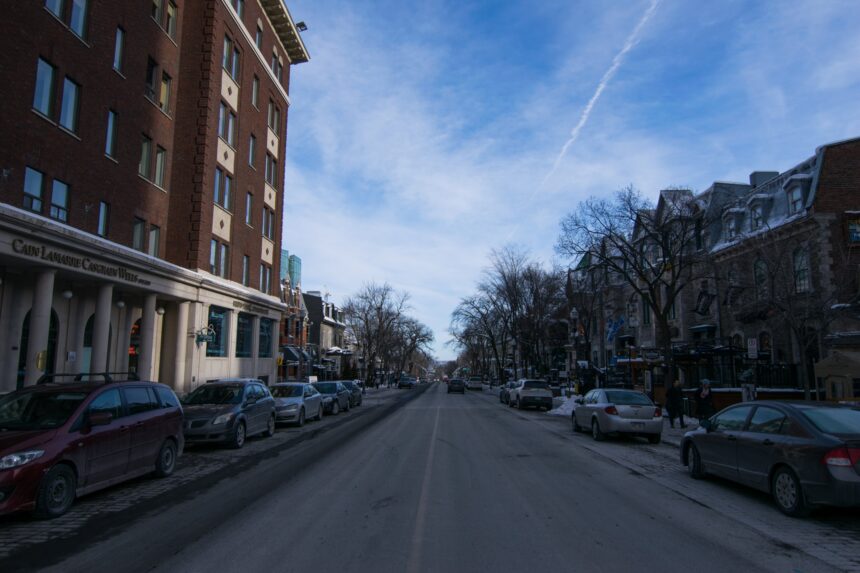
The Grande Allée ( the broad boulevard running west from Porte Saint-Louis along the southern edge of the Colline Parlementaire district ) is Quebec City’s most performative public street: the address of the National Assembly, several provincial government ministries, the Fontaine de Tourny, and the most densely concentrated terrasse restaurant and bar culture in the city, all within the same 500 metres of Victorian architecture and European-scale boulevard space. Sometimes called Quebec City’s “Champs-Élysées” ( a comparison that flatters the Grande Allée in scale but is not entirely unreasonable in social function ) the street is simultaneously a seat of power and a place of pleasure, a dual character that gives it an energy unlike any other street in Quebec City.
The Institutions
The Grande Allée’s institutional anchors define its formal character. The Hôtel du Parlement (the National Assembly, completed 1886) terminates the street’s eastern end with the most architecturally ambitious government building in Quebec. The Fontaine de Tourny (placed 2007, a gift from Bordeaux for the 400th anniversary) marks the formal entrance to the parliamentary precinct with the finest public fountain in Quebec City. The iA Financial Group (Industrial Alliance) headquarters complex ( one of the Grande Allée’s largest buildings and the most significant private-sector presence on the street ) anchors the financial services employment that complements the government employment. The Grand Théâtre de Québec (1971, Victor Prus) on the adjacent Boulevard René-Lévesque adds cultural institutional gravitas to the district.
The Terrasses
From May through October, the Grande Allée’s southern sidewalk transforms into one of Canada’s finest continuous terrasse dining environments: a succession of restaurant and bar terrasses occupying every available square metre of outdoor space, from simple wooden platforms to elaborate multi-level outdoor seating areas, drawing a crowd of government workers at lunch, tourists in the afternoon, and the city’s most enthusiastic nightlife participants in the evening. The terrasses function as a genuinely democratic social space the same stretch of sidewalk accommodates solo workers with laptops at noon and groups celebrating into the evening without the separation that indoor spaces impose. The combination of the boulevard’s architectural backdrop, the human energy of the terrasses, and the proximity of the Battlefields Park (which provides the natural counterpoint to the urban intensity) makes the Grande Allée in summer one of the finest urban experiences in Canada.
Fête Nationale & Major Events
The Grande Allée and the adjacent Battlefields Park are the setting for Quebec’s Fête nationale celebrations on June 23-24 the Saint-Jean-Baptiste Day holiday that is Quebec’s most emotionally significant national celebration. The June 23 evening concert on the Plains, broadcast live by Radio-Canada, draws hundreds of thousands of viewers and tens of thousands of in-person participants; the Grande Allée’s terrasses fill to capacity for pre-concert gatherings. The street also hosts the finishing metres of the Défi sportif altergo and various government-organised ceremonial events throughout the year. The combination of the Battlefields Park’s scale (103 hectares of urban green space immediately accessible from the street) with the Grande Allée’s urban intensity makes this the most versatile event corridor in Quebec City.