Just outside the western gate of the walled Old City, the ground opens up into a broad boulevard lined with ornate stone buildings, formal gardens, and a massive fountain. This is the Colline Parlementaire — Parliament Hill — where the province of Québec actually conducts its business of self-governance, and one of the most architecturally significant districts in Eastern Canada.
- Getting There
- Stop 1: Porte Saint-Louis
- Stop 2: The Fontaine de Tourny
- Stop 3: The National Assembly Building
- Stop 4: The Gardens and Statue Park
- Stop 5: The Observatory of the Capitale (Observatoire de la Capitale)
- Stop 6: Grande Allée East: The Restaurant Strip
- Stop 7: The Musée National des Beaux-Arts du Québec (MNBAQ)
- The Architectural Commentary
- The Political Angle
- Practical Tips
- FAQ
- Final Word
Most visitors walk through it without realizing what they’re seeing. The big ornate building with the copper towers? That’s not a museum. It’s the National Assembly of Québec, where 125 elected members debate and pass the laws that govern 8.5 million Québécois. The ordinary-looking buildings along the side streets? Those house the premier’s office, the leader of the opposition’s office, various government ministries, and much of the working infrastructure of provincial politics.
Understanding this district adds depth to an Old Québec visit. Here’s the walking tour.
Getting There
The Colline Parlementaire begins immediately west of Porte Saint-Louis, the western gate of the Old City. If you walk out of the gate onto Grande Allée, you’re already on Parliament Hill.
The district extends roughly one kilometre west, bounded by Boulevard René-Lévesque to the north and the Plains of Abraham to the south. The full tour takes about 90 minutes at a leisurely pace.
Stop 1: Porte Saint-Louis
Start at the gate itself. The current gate is a 1878 reconstruction of the older 1720s French gate, in a deliberately picturesque style. The British military originally wanted to demolish the gates for traffic flow in the 19th century; the Québec government insisted on preservation, and when the gates were rebuilt, they were built for visual effect as much as function.
Note the transition: you’ve just stepped from medieval-scale old city into broad Victorian-era civic space. The width of Grande Allée was a deliberate urban-planning decision around 1870 — Québec City wanted a formal approach to its legislature like European capitals had.
Stop 2: The Fontaine de Tourny
Walk 200 metres west. The elaborate fountain in the centre of the square is the Fontaine de Tourny, a 19th-century French fountain that was a gift to Québec City from the Simons department store family in 2007 to mark the city’s 400th anniversary.
The fountain’s history is wonderful: it was cast in France in 1857, won awards at the Paris World Fair, was installed in Bordeaux, was dismantled when Bordeaux modernized, sat disassembled in storage for decades, was purchased by a French antiques dealer, and was eventually acquired by Simons and donated to Québec. It’s now the visual centrepiece of the Parliament approach.
Stop 3: The National Assembly Building
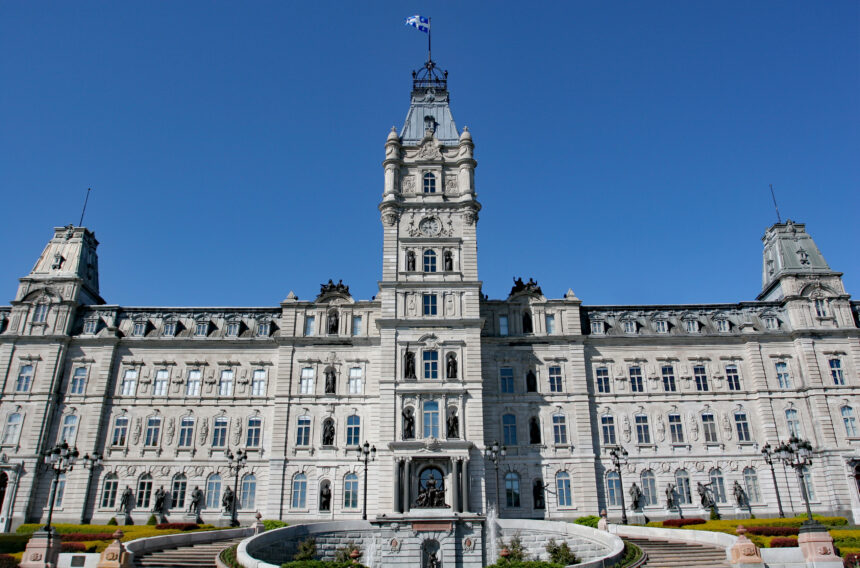
Just behind the fountain rises the Hôtel du Parlement, completed in 1886, designed by Eugène-Étienne Taché in what’s called Second Empire style. The facade features 26 bronze statues of historical figures — explorers, military commanders, politicians, religious leaders — who shaped Québec’s history. Each statue has a Latin inscription below it. These are worth reading (or at least photographing for later reference) — they tell the version of Québec history the 1880s government wanted to emphasize.
Take 15-20 minutes to circle the building and look at details.
Inside: The Free Guided Tours
One of Québec City’s best-kept secrets: the National Assembly offers free guided tours of its interior, including the chamber where the elected members debate. Tours run in both French and English, multiple times daily (when the Assembly isn’t sitting), and last about 45 minutes.
The interior is spectacular — gilded ceilings, stained glass windows, elaborate chambers, historical paintings. It’s one of the most ornate government buildings in Canada and most visitors never realize they can see it.
Tours require ID and a security check, but they’re free. Check the Assembly’s website for current schedules.
Stop 4: The Gardens and Statue Park
Surrounding the Parliament building are formal gardens with additional statuary honouring various figures from Québec history. These include:
- René Lévesque — the provincial premier who led the 1980 sovereignty referendum
- Maurice Duplessis — the controversial premier of the 1930s-1950s
- Jean Lesage — premier of the Quiet Revolution
- Honoré Mercier — late 19th-century premier
Walking through these statues gives you a chronological survey of Québec political history. Even brief attention rewards the visit.
Stop 5: The Observatory of the Capitale (Observatoire de la Capitale)
Just across from the Parliament, in the Marie-Guyart Building, is a 31st-floor observation deck offering panoramic views of Old Québec, the St. Lawrence, and the surrounding region. Around $15 admission.
Worth visiting for the panoramic perspective on what you’ve been seeing at street level. Especially good for first-time visitors who want to orient themselves visually.
Stop 6: Grande Allée East: The Restaurant Strip
Walking west from the Parliament, Grande Allée becomes a restaurant-dense boulevard. The street changes character from civic formality to commercial activity.
Notable stops:
- Le Saint-Amour restaurant — one of Québec’s most celebrated fine-dining establishments
- Le Cochon Dingue Grande Allée — reliable bistro
- Le Chic Shack — burger-focused mid-range
- Multiple Victorian-era mansions converted to restaurants
At night, Grande Allée is the heart of Québec City’s more mainstream nightlife — busier than quieter Montcalm district, louder than Old Québec.
Stop 7: The Musée National des Beaux-Arts du Québec (MNBAQ)
At the western end of the Plains of Abraham (walk south from Grande Allée to reach it), the MNBAQ is the province’s main art museum — rotating contemporary exhibitions, a substantial permanent collection of Québec and Canadian art, and a striking modernist building.
Worth a full visit (2-3 hours) if art interests you. Admission around $20.
The Architectural Commentary
Walking the Colline Parlementaire, you see multiple architectural eras in dialogue:
- The 1720s French gate style (Porte Saint-Louis)
- Victorian Second Empire (the Parliament building, 1880s)
- Gothic Revival in religious buildings (the Chalmers-Wesley United Church, 1852)
- Beaux-Arts in early 20th century mansions
- Modernist interventions in the mid-20th century government buildings
- Contemporary additions at museums and commercial properties
This architectural layering is deliberate. Québec City has been a political capital since 1608, and each era left its mark.
The Political Angle
If you’re interested in politics, note:
The Bunker — the informal name for the Premier’s Office — is a 1960s addition near the Parliament building.
The Edifice Honoré-Mercier houses various government ministries across multiple levels.
During legislative sessions (typically fall and spring, check dates), you can sometimes catch political movement around the buildings — cabinet ministers entering meetings, protests, ceremonial arrivals.
On Québec’s Fête nationale (June 24) and other significant dates, the Parliament grounds host public events and ceremonial activities.
Practical Tips
Best time for the walking tour: Late morning or early afternoon, when the light is good and the Parliament tours are running.
Time required: 90 minutes for the walking tour itself; add another hour for the Parliament interior tour; add 2+ hours if you include the MNBAQ.
Parking: Grande Allée parking is limited. Use Old City parking garages and walk out.
Food: Multiple restaurants on Grande Allée and nearby side streets for lunch or pre-tour coffee.
Weather: The district is more exposed than Old Québec. Dress appropriately for wind.
FAQ
Can I attend a session of the National Assembly?
Public galleries are open during sessions, though security clearance requirements apply. Check the Assembly’s website for schedules and requirements.
How often are the guided tours?
Multiple per day on most weekdays when the Assembly isn’t sitting. Less frequent during session weeks.
Are the gardens always open?
Yes, they’re public parkland, open 24/7.
Can I drive on the Parliament grounds?
No. Access is restricted to government vehicles.
What’s the best single thing to do on Parliament Hill?
The free interior tour of the National Assembly building, if you can time it with your visit. It’s one of the best free tours in Québec City.
Final Word
Colline Parlementaire is the district most visitors walk through without realizing they’re walking through one of the most architecturally and historically significant political districts in Canada. Taking a deliberate walking tour, ideally including the free interior Parliament tour, transforms a quick transit from the Old City to Grande Allée into a substantive experience. Plan 90 minutes. The history and architecture reward you.