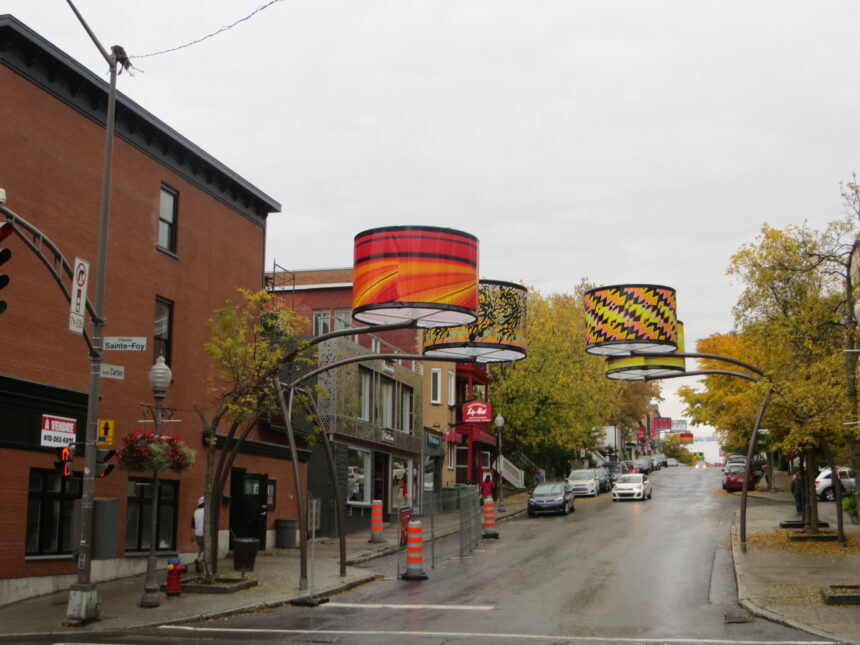
Montcalm ( the inner-city quartier of Quebec City’s Upper Town, running from the Battlefields Park’s southern edge to the Chemin Sainte-Foy, between the city walls to the east and the Saint-Sacrement quartier to the west ) is the city’s most prestigious residential address and its most institutionally complex neighbourhood: simultaneously a government district (the Grand Théâtre, the Hôtel du Parlement, and 24 ministerial buildings are within or adjacent to the quartier), a nightlife destination (the Grande Allée‘s terrasse strip), a food culture hub (Avenue Cartier), and a quiet residential enclave of Victorian and Edwardian houses whose tree-lined streets are among the finest in Quebec City.
The Residential Streets
Montcalm’s residential streets ( the north-south avenues (Avenue de Salaberry, Avenue de Bourgogne, Avenue de Mérici) and the east-west rues (Rue Fraser, Rue Crémazie, Rue Lavigueur) between the Grande Allée and the Chemin Sainte-Foy ) contain some of the finest Victorian and Edwardian residential architecture in Quebec City: detached and semi-detached houses of grey limestone and brick, with substantial front porches, bay windows, dormers, and the mature tree canopy that 100+ years of growth has established above streets of consistent architectural quality. These streets are the domain of government ministers (several ministerial residences are located in Montcalm), senior civil servants, lawyers (the Palais de justice and the legal district are immediately adjacent), and the university professionals who commute to Université Laval a professional class that sustains the neighbourhood’s high property values and its demand for the quality food and service retail that Avenue Cartier provides.
The Battlefields Park Edge
Montcalm’s southern boundary ( the edge where the residential streets meet the Battlefields Park’s open plateau ) provides the neighbourhood’s most extraordinary daily quality of life asset: the immediate adjacency to 103 hectares of maintained parkland, with the cliff edge and the St. Lawrence River panorama accessible within a 5-10 minute walk from most Montcalm residential addresses. This proximity ( to greenspace of a scale that most urban neighbourhoods can only aspire to ) is one of the primary drivers of Montcalm’s premium property values and the reason the neighbourhood consistently attracts the professional families who want inner-city character combined with outdoor access. The morning run on the Plains, the weekend afternoon on the terrasse at the Musée des plaines d’Abraham café, and the after-dinner walk along the cliff edge to the Dufferin Terrace are among the daily rituals that define Montcalm’s residential character.
Institutional Identity
Montcalm’s institutional identity ( the neighbourhood is as much a government district as a residential one ) is expressed most completely in the density of political and cultural life that animates its streets during the Assemblée nationale’s sitting periods. The concentration of ministry offices, the Grand Théâtre’s cultural programming, the iA Financial complex, and the lobbying and legal firms that serve the government sector create a neighbourhood that pulses with professional energy during the week and transforms into a quieter (though still active) residential and social scene on weekends and in summer recess. The political journalist can spend an entire workday in the neighbourhood without leaving it; the resident who works elsewhere in the city benefits from the same amenity concentration without the political intensity.