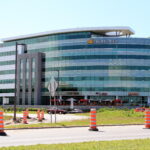
Sainte-Foy (the densely commercial and institutionally dominant zone of the Sainte-Foy–Sillery–Cap-Rouge arrondissement, running along the Boulevard Laurier corridor from the Old City boundary to the Université Laval campus) is simultaneously the most commercially intensive and the most pedestrian-hostile zone in Quebec City: a 4-kilometre arterial boulevard lined with three major shopping centres (Laurier Québec, Place Sainte-Foy, Place de la Cité), the Complexe Desjardins-Laval office towers, dozens of hotels, hundreds of restaurants and service businesses, and the dominant commercial infrastructure of the entire Quebec City metropolitan area. Sainte-Foy’s Boulevard Laurier is the axis along which the city’s consumer economy is organised; understanding it is essential to understanding how Quebec City’s non-tourist commercial life functions.
The Boulevard Laurier Commercial Strip
Boulevard Laurier (Route 175) (the primary arterial running through Sainte-Foy) carries approximately 70,000 vehicles daily, making it one of the most heavily trafficked roads in the Quebec City region. The commercial intensity along the boulevard reflects both the vehicle traffic that serves the adjacent malls and the walking and transit traffic generated by the Université Laval campus at the western end of the corridor. The three major malls (Laurier Québec at 350,000 square metres, Place Sainte-Foy at approximately 120,000 square metres, and Place de la Cité at approximately 100,000 square metres) anchor a commercial development that extends well beyond the mall properties to the service retail, hotels, restaurants, and office buildings that line the boulevard between the mall anchors. The TramCité project’s Boulevard Laurier stations (currently in detailed design) will provide the first high-frequency transit alternative to the automobile for this corridor when the system opens in 2033.
Université Laval: The Western Anchor
The Université Laval campus (at the western end of the Sainte-Foy commercial corridor, covering approximately 1.7 square kilometres of the arrondissement’s territory) functions as both the cultural and economic anchor of the Sainte-Foy zone and as its most significant generator of daily pedestrian and transit activity. The 47,000+ students, 10,000+ faculty and staff, and the visitors drawn by the PEPS sports complex, the Cafés Laval, and the campus’s various public facilities create a demand for housing (in the surrounding rental market), food service (hundreds of restaurants within a kilometre of the campus’s main gates), retail, and transit that makes the campus zone the most economically productive non-mall commercial area in Sainte-Foy. The campus’s internal transit hub (the terminus of the 800 Métrobus and several other RTC routes) and its pedestrian-friendly internal streets provide a micro-environment of livability that the surrounding auto-oriented commercial strips cannot match.
The Housing Market
Sainte-Foy’s housing market (driven primarily by student demand in the blocks immediately adjacent to the Université Laval campus) is one of the most active rental markets in Quebec City: high turnover (most student tenants leave after 4-5 years of studies), consistent demand (the student population is relatively stable year over year), and the particular demand for furnished or semi-furnished units that students arriving from outside the region generate. The residential streets of Sainte-Foy adjacent to the campus (Rue de la Terrasse, Rue des Augustins, and the surrounding streets) are among the most densely occupied rental corridors in the city; their physical character (primarily 1960s-1980s low-rise apartments with some newer construction) is entirely oriented toward the student rental market rather than the owner-occupant market that characterises the more heritage-focused inner-city quartiers.