



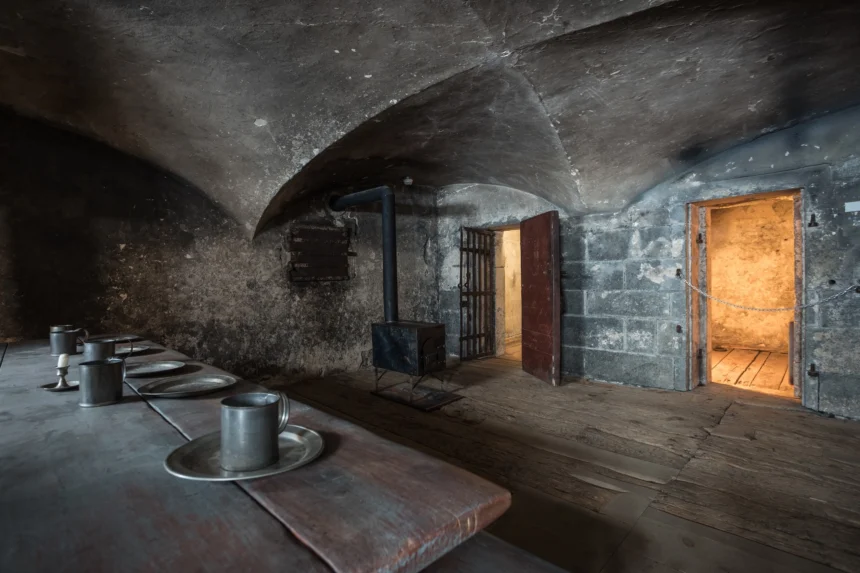
The Morrin Centre occupies one of the oldest purpose-built stone buildings in Quebec City, on Chaussée des Écossais in the Upper Town. The address has passed through three lives. First it was a prison, from 1813 to 1868, built to the plans of François Baillairgé and later extended. Then it was Morrin College, an affiliated college of McGill University, from 1868 to 1902. For more than a century after that it was the home of the Literary and Historical Society of Quebec, the oldest learned society in Canada, founded in 1824 by Lord Dalhousie. Today the building holds all three layers in a sense: parts of the old prison cells are preserved and open to visitors, the library that Morrin College assembled remains intact on the upper floors, and the Literary and Historical Society still meets in the reading room it has used since 1868.
The building
The prison phase matters because executions took place in front of the building. Sixteen men were hanged on gallows erected on Chaussée des Écossais between 1813 and 1864, including prisoners implicated in the Patriote rebellions. The basement cells are cramped, low-ceilinged, and cold. Staff at the Morrin Centre run guided tours of the prison on most afternoons, and the tour is the only part of the building that requires paid admission. English-language tours run at fixed hours; French tours alternate with them. The pricing sits in the standard range for Quebec heritage sites, which is to say modest, and tickets can be booked at the door or through the centre’s website.
The library on the upper floors is the surprise. It holds roughly 30,000 volumes, many of them nineteenth-century, catalogued in a system that pre-dates Dewey Decimal. The reading room, with its iron columns, cast-iron balcony, and wooden shelving, has not been substantially altered since Morrin College furnished it in the 1860s. Members of the Literary and Historical Society can borrow books; visitors can consult them on site. Photographers cite the reading room as one of the most-photographed interiors in the city, and film productions have used it as a stand-in for nineteenth-century Europe.
History and origins
Programming is what sets the Morrin Centre apart from other heritage sites. The organisation hosts literary readings, lectures on local history, book clubs in English, and an annual Bloomsday celebration each June attended by a loyal crowd of members and visiting academics. The English-language programming is deliberate. Quebec City has fewer than 10,000 anglophones, and the Morrin Centre operates as one of the community’s institutional anchors, along with the Anglican cathedral and the few remaining English-language schools in the city. Membership is open to anyone, francophone or anglophone, and costs less than a theatre subscription. Members gain borrowing privileges, discounts on events, and access to a monthly newsletter that doubles as a reading list for the season.
Practical visitor notes. The entrance is on Chaussée des Écossais, a short walk from Rue Saint-Jean inside the walls. Wheelchair access to the ground floor is available; the upper-floor library requires stairs. Opening hours shift between summer and winter, and the centre closes on some Mondays. Check the Morrin Centre website before a visit, particularly for tour times, which depend on staffing. The gift shop at the entrance stocks books on Quebec history in English, a rarer find in the city than one might expect, and the selection is curated rather than comprehensive.
For first-time visitors
For a traveller who has already done the Château Frontenac and the Plains of Abraham, the Morrin Centre sits in the second tier of Upper Town sites: smaller, quieter, and easier to miss than the Citadelle or the Musée de la civilisation. The payoff is concentrated. Ninety minutes in the building covers 210 years of local English-speaking life, from the prison through the college to the reading room, and the tour guides know the material well. Visitors interested in Quebec history beyond the New France story, and in the layer that British institutions left on the city, will find more here than in most of the standard stops on the Upper Town circuit.
One further note on access. The Morrin Centre lies about 300 metres from the Château Frontenac and five minutes on foot from Porte Saint-Jean. Visitors combining a Musée de la civilisation morning with a Morrin afternoon can walk between the two in about fifteen minutes through Côte de la Fabrique.








