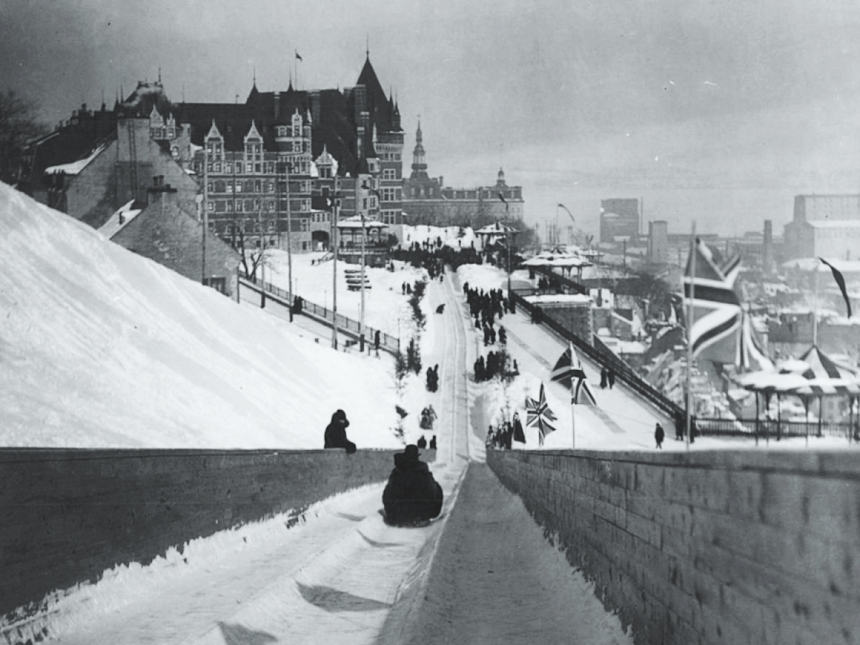
The Terrasse Dufferin (the broad wooden boardwalk extending 670 metres along the edge of the Cap Diamant cliff behind the Château Frontenac, inaugurated on June 2, 1879, in its current form) is Quebec City’s most iconic public space and one of the most photographed promenades in the world. The Terrace’s position (53 metres above the Lower Town and the St. Lawrence River, with an unobstructed panorama of the river, the Lévis shore, the Île d’Orléans, and the Laurentian mountains beyond) provides the finest urban waterscape view available from any public space in Canada, and the combination of this extraordinary natural setting with the Château Frontenac’s copper-roofed silhouette rising above creates a composition of concentrated visual power that has been reproduced in photographs, paintings, and prints since the late 19th century.
The History: Lord Dufferin’s Gift
The Dufferin Terrace (named for Governor General Lord Dufferin (Frederick Hamilton-Temple-Blackwood, 1st Marquess of Dufferin and Ava, Governor General 1872-1878)) was built during Dufferin’s tenure as the most visible expression of his commitment to the preservation and enhancement of Quebec City’s heritage character. Dufferin, who had saved the Old City’s fortification walls from demolition (they were considered obsolete and anti-modern in the 1870s), commissioned the architect Charles Baillairgé to design the replacement terrace structure for the deteriorating wooden boardwalk that had existed at this location since the early 19th century. Baillairgé’s design (a wood-framed structure cantilevered from the cliff face, with Victorian kiosques (pavilions) at intervals providing shelter and views) was inaugurated by Dufferin’s successor as Governor General in 1879, after Dufferin’s term had ended.
The Winter Toboggan Slides
The Dufferin Terrace’s winter toboggan slides (three wooden chute slides descending from the Terrace level to the Lower Town below, carrying riders at speeds reaching 70 km/h) are the most dramatic of the Carnaval-period activities available in the Old City and one of Quebec City’s most enduring winter traditions. Slides of various forms have existed on the Terrace’s cliff face since at least the 1880s; the current three-lane structure is a relatively modern incarnation of an ancient pleasure. The slides operate from December through February (weather and conditions permitting); admission is charged per ride, with packages available for multiple runs. The queue on busy Carnaval weekends can be significant (arrive early or on weekday afternoons for the shortest waits. The slide experience: 90 seconds of gravity-assisted acceleration culminating in a flat braking section at the Lower Town level, with the Old City cliff face, the Château Frontenac, and the winter sky providing the most dramatic backdrop for any toboggan run in Canada.
The Kiosques & Year-Round Use
The Terrace’s Victorian kiosques) the covered pavilion structures at intervals along the 670-metre length, originally designed to provide shelter from the wind that is persistent at this cliff-edge location (now serve as the infrastructure for various seasonal commercial operations: a café in summer, a hot chocolate stand in winter, and the ticket booth for the toboggan slides during the winter season. Year-round, the Terrace is one of the most heavily trafficked public spaces in Quebec City) the combination of the view, the proximity to the Château Frontenac, and the connection at the Terrace’s southern end to the Promenade des Gouverneurs (the cliff-face walkway to the Citadelle) makes it the default orientation point for virtually every first-time visitor to Quebec City. The Terrace is at its most rewarding at dawn (before the crowds arrive), at golden hour (when the St. Lawrence and the Lévis shore are lit with the low afternoon sun), and in winter (when the toboggan slides operate and the frost on the wooden boards creates a particular atmosphere of Quebec winter culture).