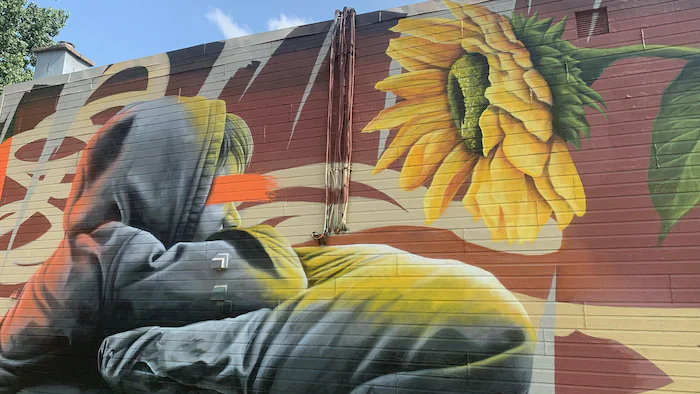
Quebec City’s public art collection (the sculptures, murals, installations, and permanent artworks distributed through the city’s public spaces, buildings, and parks) is one of the richest and most varied in Canada, reflecting both the city’s heritage of monumental public sculpture (the commemorative statues and reliefs that mark the political and cultural history of the capital) and the contemporary public art investment of the Ville de Québec’s percent-for-art program (which requires that a percentage of the capital budget for major public construction projects be allocated to artwork). The result is a city where serious art is distributed through the urban fabric at a density that rewards the attentive pedestrian with a continuous series of encounters (some monumental, some intimate, some historical, and some freshly commissioned.
The Major Works
The defining public artworks of Quebec City: the Jordi Bonet mural at the Grand Théâtre de Québec (800 square metres of cast concrete relief, 1971) the most ambitious single public artwork in Quebec City’s history and one of the most significant in Canada); the Fontaine de Tourny (the 1855 Mathurin Moreau bronze fountain gifted by Bordeaux for the 2008 anniversary (not original to Quebec City but among its finest public sculptures); the Wolfe-Montcalm obelisk in the Governors’ Garden (the world’s unique monument to both a battle’s victor and its loser); the Samuel de Champlain statue on the Dufferin Terrace (Louis-Philippe Hébert, 1898) the most immediately recognized heritage monument in Quebec City); and the Louis Hébert-Marie Rollet-Guillaume Couillard monument in the Governors’ Garden (1918, the founders’ monument that frames the Château Frontenac approach).
The Trompe-l’Oeil Murals
Quebec City’s trompe-l’oeil mural tradition (large-scale realistic paintings on building facades that create the illusion of architectural features, street scenes, or historical events) has produced some of the most widely photographed public art in the city. The most celebrated: the Fresque des Québécois (12 Rue Notre-Dame, Lower Town (a 420-square-metre mural depicting 400 years of Quebec City history through a parade of historical figures in a three-dimensional architectural trompe-l’oeil framework, commissioned for the 1999 celebrations of Quebec City’s 391st anniversary); and the Fresque du Petit-Champlain (the painted facades of the Rue du Petit-Champlain commercial district that have become as photographed as the heritage stone buildings they decorate). The trompe-l’oeil tradition continues with contemporary murals in Saint-Roch and Limoilou that address the inner-city quartiers’ more recent histories.
Contemporary Public Art
The Ville de Québec’s percent-for-art program) implemented in conjunction with major capital projects, has produced a growing collection of contemporary public artworks distributed through the city’s infrastructure. The TramCité project (construction beginning 2027) includes an ambitious public art program that will commission artworks for each of the 29 stations along the 19.3-kilometre corridor, potentially creating the most significant single public art investment in Quebec City’s history. The Promenade Samuel-de-Champlain’s permanent artworks (commissioned for the waterfront park’s various phases) and the artworks within the Centre Vidéotron’s public spaces document the contemporary public art program’s ambition to create a lasting cultural legacy alongside the functional infrastructure investment.