



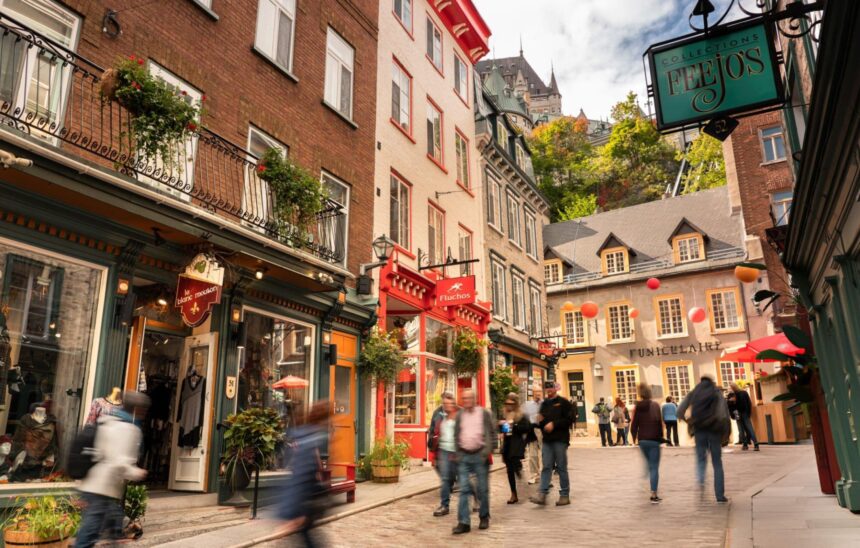
There are certain streets in the world that manage to photograph well in every single season, at every single hour, from every single angle. Charleston’s Rainbow Row. Lisbon’s Rua da Bica. Cinque Terre’s Via Colombo. Québec City has exactly one of those streets, and it’s Rue du Petit-Champlain.
If you’ve ever seen a winter postcard of Québec City with cobblestones, snow, stone houses, warm lit windows, and Christmas garlands strung overhead, you’ve seen Petit-Champlain. If you’ve seen a summer photo of flower boxes, outdoor café tables, and hanging ivy against 300-year-old stone walls, again, Petit-Champlain. The street is about 400 metres long. It’s not enormous. But it punches well above its weight in the Québec tourism imagination.
Here’s everything you need to know about visiting it — and, more usefully, everything that isn’t in the brochures.
The Basics: Where It Is, What It Looks Like
Petit-Champlain is in the Lower Town (Basse-Ville) of Old Québec, at the foot of Cap Diamant, the cliff on top of which sits the Château Frontenac. You reach it in one of three ways:
- The Funicular du Vieux-Québec — a quick diagonal ride from the Dufferin Terrace down the cliff face. Around $5 each way.
- Breakneck Stairs (Escalier Casse-Cou) — a wooden staircase connecting Upper Town to Lower Town. Picturesque; also accurately named.
- Walking along the base of the cliff — follow Rue Champlain from the ferry terminal or the Old Port and it curves into Petit-Champlain.
The street itself is almost entirely pedestrian, with a couple of short vehicle-permitted exceptions for delivery access. Cobblestones run wall-to-wall, which is beautiful but worth noting if you’re pushing a stroller or have mobility issues.
A Brief History (Worth Reading)
Petit-Champlain isn’t famous because it’s old — plenty of Québec streets are older. It’s famous because it’s the oldest commercial district in North America. Merchants, traders, and artisans have been selling goods on this strip since the early 1600s. Samuel de Champlain’s first settlement was a short walk away at Place Royale. The Lower Town was where the working economy of New France actually happened — the docks, the warehouses, the craftspeople, the taverns.
By the 19th century it was predominantly Irish, home to dockworkers and the families who worked the shipping industry on the St. Lawrence. By the early 20th century it had declined into near-slum conditions, and for decades the street was shabby and largely abandoned. The turn came in the 1980s, when a group of artisans, shopkeepers, and restoration experts formed a cooperative to restore and reactivate the district. That cooperative — the Société de développement commercial du Vieux-Québec arm for Petit-Champlain — still owns and manages most of the commercial properties today. It’s why you don’t see big chains here: ownership structure quite literally keeps them out.
The result is a preserved and functioning streetscape that doubles as one of the most successful urban restoration projects in North America. Not a museum. A working neighbourhood.
What’s Actually Good to Do There
Shopping (With an Opinionated Filter)
The commercial mix on Petit-Champlain skews toward Québec-made and artisan-produced goods. The co-op’s leasing policy favours independent retailers and makers. Some recommendations from repeat visits:
- Chocolaterie de l’Opéra — small, serious, handmade chocolates with strong Québec character. Worth the stop.
- Boutique de Noël de Québec — open year-round, absolutely chaotic and wonderful in December, a little odd in July. Good souvenir stop for Christmas ornament collectors.
- La Petite Cabane à Sucre — maple everything. Yes, it’s touristy. Yes, the maple butter is genuinely excellent.
- Oclan and other Québec-designer clothing shops — the street has several boutique fashion shops featuring Québec designers, ranging from quirky to properly high-end.
- Galerie d’art Le Portal — one of several small galleries showing Québec artists, with work generally priced for real collectors but welcoming to browsers.
Eating and Drinking
The restaurant density on Petit-Champlain is among the highest in Old Québec. Quality varies. General principles that hold up:
- Le Cochon Dingue — a local chain with multiple Québec locations, reliable French bistro fare, good for groups, usable in most weather.
- Le Lapin Sauté — rabbit specialties in a rustic stone interior, a little more ambitious than its neighbours, reservations recommended in summer.
- Buvette Scott — just off the main street, excellent natural wine selection and small plates, skews local/industry.
- Pain d’Été (in season) and various small cafés for espresso and pastries throughout the day.
The general warning: the tourist-density restaurants facing the main street can be overpriced and underwhelming. If the menu has pictures and hostess is standing outside trying to recruit passersby, keep walking. The better establishments are confident enough to rely on their reputation.
Photography
Petit-Champlain is one of the easiest streets in Québec to photograph beautifully, which is why every photo looks somewhat the same. To get something distinctive:
- Go at dawn. In summer, arrive before 7 AM; in winter, before 8:30 AM. You’ll have the street almost entirely to yourself, and the morning light is soft and angular.
- Go during an early snowfall. The first or second week of December, when fresh snow is still on the cobblestones but the street lights are on, is the canonical shot.
- Shoot from Breakneck Stairs. The elevated angle from halfway up the staircase shows the street’s full curve and depth.
- Look up. The cross-street garlands, the stone chimneys, the wrought-iron signs — most people aim their cameras horizontally and miss what’s overhead.
The Murals and the Fresco
On the Rue Notre-Dame side, just off the main pedestrian strip, is one of the most impressive trompe-l’œil murals in North America: the Fresque des Québécois. It covers the entire side of a four-storey building and depicts 400 years of Québec history, with 15 historical figures painted at scale, plus fictional elements, windows, doors, and architectural details that read as three-dimensional from across the street. It was painted in 1999 by a team of French and Québec muralists and remains one of the city’s most-photographed attractions outside of the Château itself.
Take the time to read the interpretive panels. The figures include Samuel de Champlain, Jacques Cartier, Jean Talon, and a range of Québec political and cultural figures spanning centuries. It’s not just a pretty wall — it’s a narrative.
Nearby is the Fresque du Petit-Champlain, a second smaller mural focused on the history of the Lower Town neighbourhood specifically. Shorter but worth finding.
Seasonal Character (The Underrated Part)
Petit-Champlain photographs best in winter — specifically December, when the Christmas decorations go up and the snow arrives in earnest. The lights strung across the street, the tree at the end near the funicular, the steaming breath of shoppers, the glow of lit windows through dusk — this is the postcard season, and it deserves its reputation.
Summer is the busiest and hottest. Flower boxes, cafés, lineups for ice cream. Pretty, but crowded.
Spring and fall are the insider favourites. Quieter, cooler, with that distinct Québec light that photographers chase — high and clean in spring, low and golden in autumn. The street is arguably at its most livable and photogenic in late September and early October.
How Long to Spend There
If you’re walking through as part of a broader Old Québec visit, 45 minutes to an hour covers it. If you’re committed to shopping, galleries, and a proper meal, two to three hours is well-spent. Don’t try to make it an all-day destination — it isn’t large enough, and the rest of the Old City has too much else worth seeing.
Getting There and Practical Logistics
Parking: Not realistic for Petit-Champlain itself. Use one of the Old Québec structures (Place d’Youville, Dalhousie, or the port area) and walk in.
Accessibility: Cobblestones throughout. The funicular is accessible. Wheelchair users or visitors with limited mobility will find the street manageable but demanding — rubber-soled shoes and patience help.
With kids: Pedestrian, manageable scale, lots of visual interest. Strollers work but expect a bumpy ride. The Fresque des Québécois is a good engagement point for older kids.
Washrooms: Public facilities at the funicular building and at the nearby Place Royale visitor centre.
FAQ
Is Petit-Champlain open year-round?
Yes. The street and its shops operate all four seasons, though individual café terraces shut down for winter.
Is it expensive?
The shopping ranges from affordable souvenirs to serious art pieces. Food is generally priced for tourists (10-20% above equivalent Upper Town restaurants) but not exorbitant.
What time do shops open and close?
Most open around 10 AM and close by 6 PM in off-season, extending to 9 PM or later in summer. Restaurants stay open later.
Is there anything worth visiting on side streets?
Yes — specifically, the Escalier Casse-Cou viewpoint, the small alleyways between Petit-Champlain and Rue Notre-Dame, and the path along Rue Sous-le-Fort toward Place Royale.
How does Petit-Champlain compare to other Old Québec districts?
It’s the single most concentrated and walkable district, at the expense of being the most tourist-oriented. For a more local feel, Rue Saint-Jean inside the walls or the Saint-Roch neighbourhood below the cliff offer different Québec experiences.
Final Word
Petit-Champlain earns its postcards. The visual appeal is real. But the deeper pleasure of the street — once you get past the urge to photograph it and settle in — is that it still functions as an actual neighbourhood, run by people who care about its character and have spent 40 years protecting it from becoming something worse. You can eat well, shop meaningfully, and spend a pleasant hour watching other travellers discover it for themselves. That’s more than most famous streets deliver. Enjoy.
Deciding between this lane and the rest of the old city? Compare it with Place Royale, rue Saint-Louis and rue Saint-Jean in our guide to which Old Québec street to walk.








