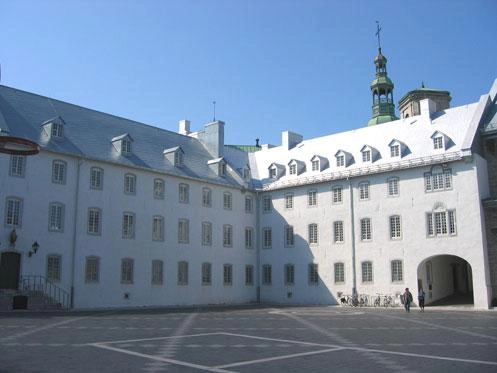
Université Laval ( founded in 1663 by Bishop François de Laval as the Séminaire de Québec (the educational institution that eventually became the university), granted a Royal Charter by Queen Victoria in 1852 that constituted the first university charter in Canada, and now operating from a 1.7 square kilometre campus in the Sainte-Foy arrondissement with 47,000+ students, 10,000+ faculty and staff, and an annual research budget exceeding $500 million ) is simultaneously Canada’s oldest university, Quebec City’s largest employer, and the primary institution through which the capital’s economy engages with the knowledge economy of the 21st century. The university’s founding identity as a French-language Catholic institution (the Charter was granted specifically to create a French-language alternative to the English-language McGill University that had been operating in Montreal since 1821) gives it a cultural significance in the Quebec francophone community that transcends its operational role as an educational institution.
The Campus
The Université Laval campus ( developed primarily in the 1950s-1980s on the Sainte-Foy plateau, with subsequent additions through the 2000s-2020s ) is organised around a central pedestrian promenade (the Allée des Bibliothèques) and a series of faculty buildings distributed across the 1.7 km² site. The campus architecture is primarily institutional modernism from the 1960s-1970s (reflecting the Quiet Revolution’s ambition to build a university campus equal to the moment’s political aspirations), with more recent buildings (including the PEPS sports complex, the Bibliothèque des sciences humaines et sociales, and the faculty of music’s recently renovated facilities) representing the contemporary design sensibility. The campus’s most distinctive public amenity is the PEPS (Pavillon de l’éducation physique et des sports) one of the largest university sports complexes in Canada, with a 50-metre Olympic swimming pool, ice rinks, fitness facilities, and court spaces accessible to the general public during designated public periods.
Research & Innovation
Université Laval’s research enterprise ( with particular strengths in forestry and wood science (the Faculté de foresterie’s research programs are internationally recognised), food and agricultural sciences (the Institut sur la nutrition et les aliments fonctionnels), computer science and AI (the Institut intelligence et données, established 2019), optics-photonics (the Centre d’optique, photonique et laser, one of the world’s leading optics research centres), and health research (through the CHU de Québec-UL partnership) ) produces approximately $500 million in annual research revenue and supports approximately 3,000 graduate students in thesis research programs. The research enterprise’s connection to Quebec City’s economy is strongest in the technology transfer programs that convert university research into commercial products and the startup incubation activities that the Laval University Research Institute and the adjacent Parc technologique du Québec métropolitain support.
Student Life
The 47,000+ students who attend Université Laval represent approximately 5% of Quebec City’s total metropolitan population a proportion that makes the university community a more significant social force in Quebec City than in any other major Canadian university city outside Kingston (Queen’s University) or Waterloo. The student population’s concentration in the Sainte-Foy zone (the campus neighbourhood and the surrounding rental market) and its daily penetration into the inner city (via the 800 Métrobus network and the cycling infrastructure of the Boulevard Laurier corridor) shapes the city’s demographics, its housing market, and its food and cultural services demand in ways that the university’s physical location in the suburban Sainte-Foy zone belies. The student unions (the Confédération des associations d’étudiants et étudiantes de l’Université Laval, CADEUL, the primary undergraduate student federation) coordinate the cultural and advocacy activities of the student community.