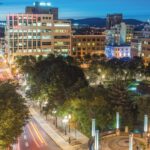
René Lévesque (1922-1987) ( journalist, Korean War correspondent, television star, Quiet Revolution minister, founder and leader of the Parti Québécois, Premier of Quebec (1976-1985), and the most consequential political figure in modern Quebec history ) is inextricably connected to Quebec City: the city where he served as Natural Resources minister in the Lesage government (1960-1966), where he founded the PQ (1968), where he led two provincial governments from the Premier’s office on the Colline Parlementaire (1976-1981, 1981-1985), and where the Boulevard René-Lévesque (formerly the Grande Allée Est, renamed in his honour following his 1987 death) bears his name along the most politically significant boulevard in Quebec. No street renaming in Quebec City’s history has been more appropriate: the boulevard that fronts the National Assembly and the Grand Théâtre is named for the man who both transformed the National Assembly’s role in Quebec society and whose government funded the Grand Théâtre’s construction.
The Journalist & the Nationalization
René Lévesque’s path to politics ran through the CBC’s Quebec City television studios, where his program “Point de mire” (1956-1959) made him one of the most recognisable and most trusted public intellectuals in Quebec ( a journalist whose combination of clarity, passion, and the physical intensity of his on-screen presence created a television personality of extraordinary persuasive power. When Lévesque entered politics in 1960 as the Lesage government’s Natural Resources minister, he brought both the media skills and the nationalist conviction that made him the driving force behind the electricity nationalization of 1963. His campaign speech ) “Maîtres chez nous” (Masters in our own house) is the most quoted phrase in Quebec’s political history, capturing in four words the nationalist aspiration that the Quiet Revolution gave institutional form.
The Founding of the PQ
Lévesque’s founding of the Parti Québécois in 1968 ( after his break with the Liberal Party over the sovereignty question (he had proposed “souveraineté-association” as a Liberal policy option and been rejected) ) was the most consequential single act of party creation in Canadian political history: the PQ’s subsequent electoral success (first provincial government in 1976, 41% of the popular vote), its adoption of the Charter of the French Language (Bill 101, 1977), and its organisation of the first Quebec sovereignty referendum (1980, 40% Yes vs. 60% No) transformed Quebec’s political landscape in ways that Canadian politics has not fully absorbed 50 years later. The PQ’s founding assembly (October 1968) was held in Quebec City; the party’s identity as the political expression of francophone Quebec nationalist aspirations was shaped by Lévesque’s intellectual leadership through the formative decade.
The Legacy on the Boulevard
The Boulevard René-Lévesque ( the former Grande Allée Est section of the main boulevard running from the Old City through the Colline Parlementaire to the Sainte-Foy commercial zone ) bears Lévesque’s name in the most politically charged street corridor in Quebec. Walking from the Porte Saint-Louis eastward along the boulevard toward the Hôtel du Parlement, the pedestrian passes the buildings that Lévesque’s two governments occupied (the ministerial offices, the National Assembly itself) and the Grand Théâtre whose construction Lévesque’s government supported. The association between the man and the boulevard is appropriate at the deepest level: both the person and the street are defined by the Quiet Revolution’s transformation of Quebec from a conservative Catholic society to the modern secular nation-state whose political aspirations the National Assembly at the boulevard’s eastern end embodies.