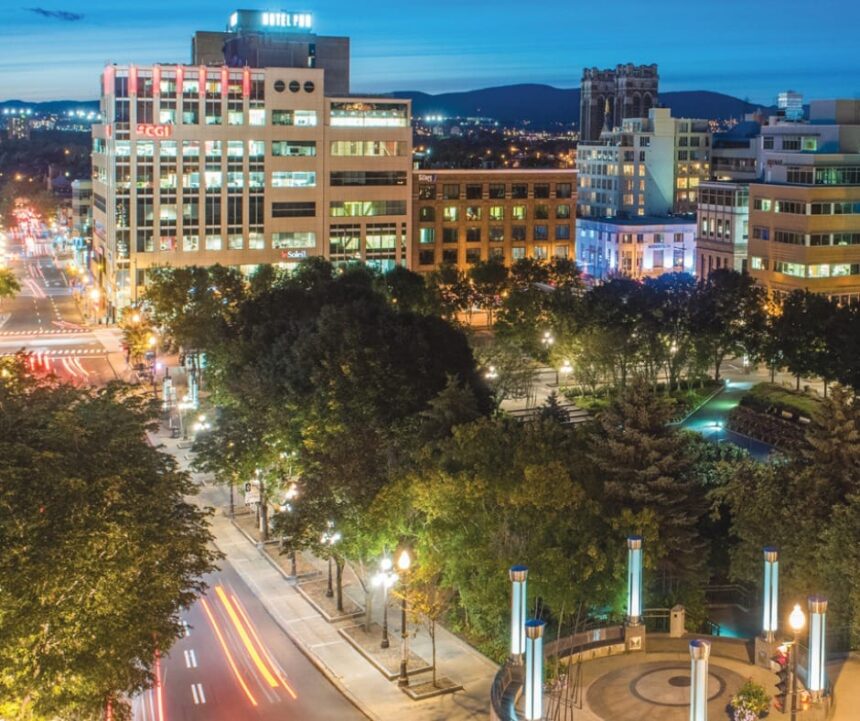
Saint-Roch‘s transformation is the clearest example of urban renewal in Québec City’s recent history. The neighbourhood lost most of its commercial tenants between 1970 and 1990 as department stores relocated to suburban malls and the Mail Saint-Roch, a covered pedestrian street built in the 1970s to save the district, emptied out. Starting in 1996, under Mayor Jean-Paul L’Allier, the city dismantled the mall, reopened the streets, and rebuilt the public infrastructure. A quarter-century later, Saint-Roch is the densest concentration of creative and tech firms in the region.
The starting point
In 1995, Saint-Roch had a vacancy rate above 40 per cent in its main commercial strips. Rue Saint-Joseph, once the largest commercial street in eastern Québec, had more boarded storefronts than active ones. The population was older than the city average, employment in the district had fallen by half since 1970, and the Mail Saint-Roch, meant to compete with suburban shopping, had instead accelerated the decline by removing street life and consolidating leases with a small group of struggling anchor tenants.
The L’Allier administration’s 1996 master plan rejected further retail-led strategies. Instead, it targeted cultural and educational anchor institutions: a new Institut national d’optique de Québec laboratory, the transfer of Université Laval programmes into Saint-Roch buildings, and incentives for artistic production in vacant industrial space. The idea was that creators and researchers would generate the population density and commercial activity that the mall had failed to produce.
The anchor institutions
Université Laval opened its École d’arts visuels in Saint-Roch in 1999, followed by programmes in urbanism, communication and design. The Cégep Limoilou opened a campus annex. The Ubisoft Québec studio, founded in 2005, took a former industrial building on Rue du Roi and grew to over 500 employees by 2020. La Maison pour la danse and the Coopérative de solidarité des Jardins de Saint-Roch opened community-facing cultural spaces.
The combined effect was a resident population that grew by roughly 30 per cent between 2000 and 2020, concentrated in studios, lofts and mid-rise condominium buildings. The neighbourhood’s median age dropped. Rents rose. The retail mix shifted: fewer dollar stores and pawn shops, more independent cafés, boutiques, and the kind of service businesses that cluster around creative workforces.
The current cluster
Saint-Roch today is home to over 200 creative-industry firms. Software studios, design agencies, animation and post-production houses, architectural offices and communication consultancies dominate the tenant mix. Average office rents run 30 to 40 per cent below comparable Montréal neighbourhoods, which has attracted branch offices from larger firms and some head offices that might otherwise have chosen Montréal or Toronto.
Employment in the creative and tech sectors in Saint-Roch is estimated at around 8,000 full-time jobs. Video-game production alone, centred on Ubisoft but including Beenox, Sarbakan and smaller studios, accounts for close to 2,000 of those jobs. The district’s concentration of skills in 3D animation, interactive design and software engineering has, in turn, drawn adjacent industries: commercial photography, sound engineering, virtual-reality production and a small but growing AI-research presence.
Housing and displacement
The renewal has produced displacement pressures. Long-time tenants, particularly older residents in subsidised units, have faced rising rents and, in some buildings, eviction applications for repossession or major renovations. The Comité populaire Saint-Jean-Baptiste and the Table de concertation Saint-Roch have documented these pressures and lobbied for stronger rent protections.
The city has responded with mixed results. Some affordable-housing projects have been built, notably the Îlot des Palais and several co-operative buildings. Overall, Saint-Roch’s median rent has risen faster than the city average every year since 2015. The neighbourhood’s success has become, in that specific sense, a problem to manage rather than simply a model to celebrate.
What the renewal teaches
Saint-Roch demonstrates that urban renewal can work when anchor institutions arrive before market-rate tenants, when public infrastructure is rebuilt to pedestrian scale, and when the city commits to sustained investment over two decades rather than a single political term. It also demonstrates that success carries displacement risk. Both lessons are visible on any afternoon walk through the district: a student reading in a café on Rue Saint-Joseph, a tenant-rights flyer on the lamppost outside.