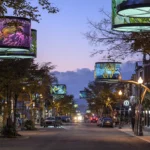
The Plateau commercial and industrial zone ( the territory north of the Autoroute 40 in the Les Rivières arrondissement, between the Boulevard Lebourgneuf to the west and the Charlesbourg arrondissement boundary to the east ) is one of Quebec City’s most actively developing commercial territories: a mixed-use zone of light industrial, office park, technology company, and residential development that has expanded significantly since 2010 as the metropolitan area’s commercial real estate market has pushed development northward from the more established Boulevard Laurier and Boulevard Henri-Bourassa corridors. The zone’s combination of highway access (Autoroutes 40 and 73 both border or intersect the territory), available land, and the proximity to the La Haute-Saint-Charles arrondissement’s residential communities has attracted the categories of commercial development that require larger footprints than the inner-city corridors can accommodate.
Technology & Office Development
The Plateau zone’s technology and office development ( the modern office buildings and campus-format facilities that house Quebec City’s technology and professional services companies requiring space beyond what the inner-city corridors provide ) has established the territory as a secondary technology cluster alongside the Parc technologique du Québec métropolitain in Sainte-Foy. Several Quebec City-headquartered technology companies (including firms in the defence electronics, geomatics, and IT services sectors) have established in the Plateau zone’s modern office park format; the facilities’ accessibility by car (the highway proximity), their lower costs than the established technology park in Sainte-Foy, and the availability of large-format facilities that growing companies require have made the zone attractive to the second tier of Quebec City’s technology employer base.
Light Industrial & Logistics
The Plateau zone’s light industrial and logistics development ( warehousing, distribution centres, and the supporting light manufacturing operations that the metropolitan area’s commercial economy requires ) provides the most significant employment in the territory’s commercial mix. The logistics sector’s growth (driven by the e-commerce expansion that has dramatically increased warehouse space demand across North America) has produced several major distribution centre developments in the Plateau zone since 2018: the scale of the facilities (50,000-150,000 square metres of single-storey warehouse space with extensive loading dock infrastructure), the highway accessibility requirement, and the availability of large-format lots have made the Plateau zone the most appropriate location for the categories of logistics development that could not be accommodated in the more constrained inner-city commercial zones.
Residential Development
The residential development component of the Plateau zone’s growth ( the apartment buildings and condominium projects that have been attracted by the zone’s highway access, the relative affordability compared to inner-city locations, and the proximity to the Charlesbourg commercial infrastructure ) represents a more recent development category than the commercial uses that initially defined the zone’s character. The residential projects (primarily 4-8 storey apartment buildings targeting the workforce that the zone’s commercial employers require and the families seeking affordable access to Quebec City’s outer arrondissements) have added a population of several thousand residents to what was previously an exclusively commercial territory; the evolution toward mixed-use character, while incomplete, represents the beginning of a neighbourhood formation process that the TramCité’s improved transit access (the Charlesbourg terminus station is relatively proximate) will accelerate from 2033 onward.