Three architectural dynasties shaped the physical fabric of Québec City more than any others: the Baillairgé family, who built its churches and public institutions from 1759 to 1906; Bruce Price, the American who gave it the Château Frontenac in 1893 and set the template for the Canadian château style that followed; and Victor Prus, the Polish émigré who designed the main provincial government buildings of the 1970s and 1980s. Between them, they are responsible for roughly half of what a visitor today notices at eye level in the old city and the Colline parlementaire.
History and origins
The Baillairgés were four generations of architects and sculptors, starting with Jean Baillairgé who arrived from Normandy in 1741 and ending with Charles Baillairgé who died in 1906. Jean built the choir screen of the original Notre-Dame de Québec basilica, destroyed in the Conquest bombardment and rebuilt by his son François. François extended the tradition into civic architecture, designing the Palais de Justice that stood on Place d’Armes until 1883. François’s son Thomas is the family member whose work is most visible today: he designed the interior of the current Notre-Dame basilica in 1843, the Hôtel-Dieu chapel on Rue Saint-Jean, and the façade of Saint-Patrick’s Church. Thomas’s nephew Charles finished the line, producing engineering work, neo-gothic churches, and a reputation in the late nineteenth century for pragmatic modernisation of older fabrics.
The Baillairgé style was French-Canadian classical: proportional façades, restrained ornament, clear hierarchies of window sizes, sober cornices. It drew on the Parisian academic tradition as interpreted through the engravings and copybooks that circulated in colonial North America. What makes the Baillairgé buildings legible as a body of work is the consistency of detail. The same profile of cornice moulding appears on buildings fifty years apart.
Bruce Price, working from New York, represents the other pole. He was hired by William Van Horne of the Canadian Pacific Railway in 1889 to design a prestige hotel on the Cap Diamant bluff, and the Château Frontenac that resulted, opened in 1893, established a style that Canadian railway hotels would follow for sixty years. The château style, with its steep copper roofs, corner turrets, and rough-faced limestone base, was itself a composite drawn from French Loire Valley châteaux, Scottish baronial, and American Richardsonian romanesque. Price’s design influenced the Banff Springs, the Empress in Victoria, the Chateau Laurier in Ottawa, and a dozen other hotels, but it began here.
What it costs
Price died in 1903, before the Frontenac’s central tower was added. That tower, completed in 1924 by the Ontario architect William Sutherland Maxwell and his brother Edward, is the element that most visitors photograph. The resulting building is, for all practical purposes, the symbol of the city.
Victor Prus arrived in Québec in 1960, aged 43, already a trained architect from pre-war Warsaw and a veteran of the Polish Home Army. He taught at Université Laval and ran a practice from Saint-Roch until his death in 2008. Prus’s major work is the Complexe G, later renamed the Complexe Marie-Guyart, the 32-storey provincial government tower completed in 1972 that remains the tallest building in Québec. He also designed the Grand Théâtre de Québec, opened in 1971, whose heavy cast-concrete form and interior Jordi Bonet murals are among the better examples of late Canadian brutalism. His third major work is the Centre d’accueil at the Île d’Orléans bridge toll plaza, now demolished.
Prus’s style was not loved in its era and remains controversial today. The Complexe G is routinely criticised for its scale and for the way it interrupts the view lines between the old city and the Colline parlementaire. The Grand Théâtre has aged better and is now respected as a serious piece of late-modernist civic architecture.
The building
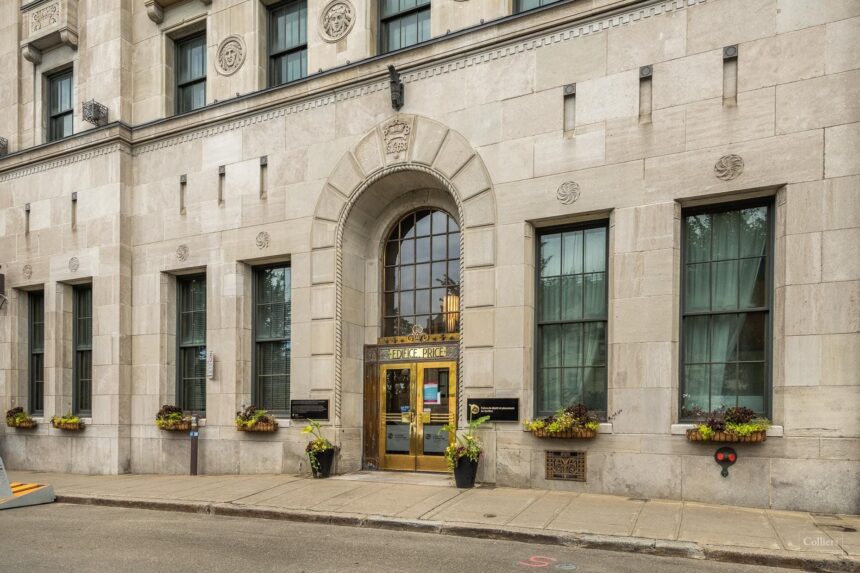
Lesser figures fill in around these three. David Ouellet designed most of the neo-gothic churches of the late nineteenth century. Eugène Taché, as provincial architect from 1870 to 1891, gave the Hôtel du Parlement its silhouette and the motto “Je me souviens” carved above its main door. Raoul Chênevert produced the Édifice Price in 1931, the first skyscraper in the old city and a rare art-deco intrusion into a largely nineteenth-century streetscape.
For a visitor interested in following this thread, a walking morning from the Basilique-Cathédrale down to the Grand Théâtre takes in Baillairgé, Price, and Prus in about ninety minutes. The Musée du Monastère des Augustines and the Musée de la civilisation both hold architectural drawings and tools that fill in the workshop side of the story. Most architectural details repay a second look from the opposite side of the street.