If you asked ten random visitors to Québec City where they’d recommend a tourist spend three hours on a rainy afternoon, most would probably say the Château Frontenac, Petit-Champlain, or the Citadelle. Which is fine. Those are all genuinely good choices. But the Musée de la Civilisation deserves to be on that same list, and rarely is, and that’s a consistent miscalibration in how this city gets presented to visitors.
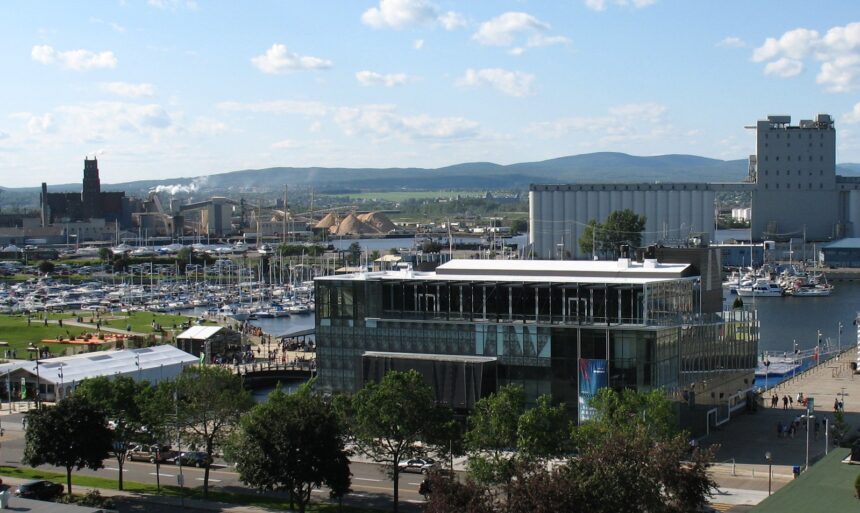
Because here’s what the Musée de la Civilisation actually is: one of the best public museums in Canada, internationally recognized for the ambition of its exhibitions, housed in a striking late-1980s modernist building by Moshe Safdie (architect of Habitat 67 in Montréal), and located three minutes from Place Royale — the founding site of French Canada. It also consistently ranks among the most-visited museums in Québec, which tells you something about how residents feel about it even if the tourist marketing doesn’t quite capture it.
Here’s what to know, what to see, and how to actually use your time there.
What Kind of Museum Is This, Actually?
This is the first thing to understand, because the name is slightly misleading: the Musée de la Civilisation is not a history museum. It’s not primarily about Québec history, though Québec history is part of what it covers. It’s not an art museum, though it has significant art. It’s not an ethnographic museum, though ethnography is part of its mission.
It’s a civilization museum in the broadest sense — organized around big questions about human life (how we live, what we believe, what we make, how we connect). The permanent exhibitions rotate and evolve over time, and the temporary exhibitions take on everything from video game design to Indigenous justice to the history of emotions to climate change.
This makes it less predictable than a conventional history museum, and better. You go in expecting to learn about Québec and you come out having thought about much larger questions.
The Building
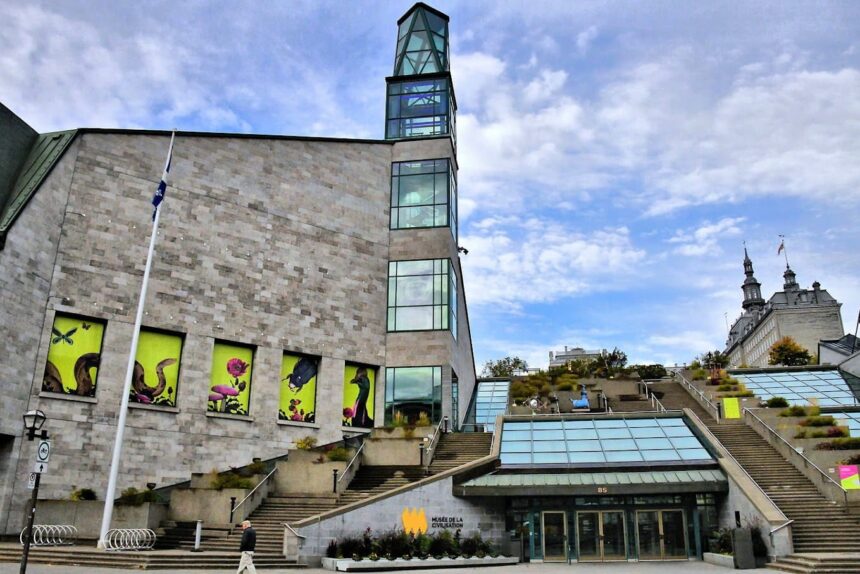
The museum building itself is worth paying attention to. Designed by Moshe Safdie and opened in 1988, the structure incorporates the Maison Estèbe, a merchant ’s house built in 1751, along with archaeological remains of the old port quarter, both visible inside the modern architecture. Champlain’s 1608 Habitation stood nearby at Place-Royale rather than under the museum, a distinction worth keeping straight.
The main building uses Québec fieldstone, zinc, and glass to create a space that feels contemporary without being sterile. The central atrium with its dramatic staircase and ceiling is impressive on its own. The integration of the historic Estèbe house is particularly well done — the 18th-century warehouse appears within the modern structure like a preserved artifact, which in a sense it is.
If you’re at all interested in museum architecture, allocate 15 minutes to just walk around the entry and atrium spaces before heading to the exhibitions.
The Permanent Exhibitions
People of Québec… Then and Now
The museum’s largest permanent exhibition tells the story of Québec’s peoples — from the pre-contact Indigenous nations through 400 years of French, British, and global immigration to contemporary Québec. It’s organized thematically rather than strictly chronologically, which works better than you’d expect.
Highlights include a recreated 19th-century Québec kitchen, a section on the Quiet Revolution and its cultural transformations, and exhibits on immigration that address both early waves (Irish, Scottish) and more recent ones (Haitian, North African, Asian) with genuine respect and depth.
Budget 90 minutes for this exhibition alone if you’re going to give it proper attention.
This Is Our Story: First Peoples
A permanent exhibition on the eleven First Nations and the Inuit nation recognized in Québec — their histories, contemporary lives, and cultural distinctiveness. Developed in close collaboration with Indigenous communities, it’s notably free of the patronizing tone that afflicts some museum exhibitions about Indigenous peoples. The objects are significant, the interpretations are authoritative, and the contemporary-life sections are as prominent as the historical sections.
Budget 60-75 minutes.
The Underground Archaeology
Beneath the modern museum, visitors can walk through the preserved foundations of Champlain’s 1608 Habitation — the original fortified trading post that founded the colony of Québec. It’s a quiet, understated space with interpretive panels and lighting designed to let you understand what you’re seeing without overexplaining it.
This is one of the most archaeologically significant sites in North America, and you can walk through it in about 20 minutes. Do not skip this section.
The Temporary Exhibitions
The museum typically runs 3-5 major temporary exhibitions at any given time, rotating quarterly. These are where the museum’s ambition really shows. Recent and past exhibitions have explored topics ranging from:
- The cultural history of video games
- World-class traveling exhibitions from major international museums
- Contemporary Québec art movements
- Global conflict and refugee experiences
- Environmental issues and Indigenous responses
- The history of happiness as a cultural concept
- Fashion and textile design across cultures
Check the museum’s website before your visit to see what’s currently running. A strong temporary exhibition can easily justify a 2-3 hour visit on its own.
How to Plan Your Visit
Timing and Duration
At a minimum, give the museum 2 hours. A comprehensive visit takes closer to 4 hours. Most visitors end up somewhere in the 2-3 hour range.
Best times to visit: weekday mornings, when it’s quietest. Late afternoons on weekends can be surprisingly busy, especially in summer or during major temporary exhibitions. Winter weekdays are genuinely empty.
Admission
There is no single adult price. The museum’s published grid bands admission by age: $22 from 18 to 34, $27 from 35 to 64 and $26 at 65 and over, with $10 for 12 to 17 and $6 for 6 to 11. Budget for the band you are actually in — most adult visitors pay $27, not the $22 that gets quoted.
Do not plan a visit around a free Sunday here. The museum states plainly that the first-Sunday free-admission measure is no longer in force, and its rates page lists no free Sunday at all. The history is short: in 2025 the province kept its museum first-Sunday measure only for people under 20, and this museum then extended free admission to Québec families from 6 April 2025, announced for one year. That extension has lapsed. What remains on the first Sunday is enhanced family programming — richer activities that day, at the usual admission price.
Combined tickets covering the museum and its related sites (Musée de l’Amérique francophone, Maison Chevalier) are available and represent decent value if you’re going to do multiple.
Guided vs. Self-Guided
The self-guided experience is well-supported — excellent interpretive text in French and English, audio guides available, multimedia installations throughout. Guided tours are available and useful if you have a specific interest (architectural, archaeological, or particular exhibition deep-dives).
Getting There
The museum is at 85 Rue Dalhousie in the Lower Town, two blocks from Place Royale. Most visitors walk in via the funicular from the Upper Town or along the Old Port waterfront. Street parking and garage parking are both available nearby.
The Experience With Kids
Unexpectedly good for families. The museum has strong children’s programming, including dedicated kid zones in several exhibitions, family-oriented guided tours, and programming that adjusts by age group. The archaeological site under the main building is particularly kid-engaging because it’s essentially a walk through a real archaeological dig.
Children are cheap rather than free: $6 from 6 to 11, $10 from 12 to 17, and free only at 5 and under. The all-in family ticket, two adults and up to five children, is better value than separate tickets for a group of four or more. The museum has a comfortable café and restrooms with changing facilities, making extended visits practical.
What Else Is in the Neighborhood
The museum sits in the Lower Town, so you can combine it well with:
- Place Royale (2 minute walk)
- Petit-Champlain (5 minute walk)
- Notre-Dame-des-Victoires Church
- The Old Port (5 minute walk)
- Musée de l’Amérique Francophone (part of the same network, smaller and focused on Francophone North America)
A well-paced half-day: Museum in the morning → lunch at a Lower Town restaurant → walk through Place Royale and Petit-Champlain in the afternoon. The museum gives you the intellectual framework; Place Royale and the surrounding area let you see it in three dimensions.
FAQ
Is the museum accessible?
Yes. All levels are wheelchair accessible. Audio guides and large-print guides are available. Sign language tours can be arranged with advance notice.
How French-centric is it?
All permanent exhibitions and most temporary exhibitions have full English interpretation. Audio guides are available in multiple languages.
Are there restrictions on photography?
Generally allowed without flash in permanent exhibitions. Some temporary exhibitions have restrictions due to loan agreements. Staff will indicate.
Is there a café or restaurant?
Yes. A café for quick meals and coffee. For a real meal, walk to one of the nearby Lower Town restaurants.
Is it worth it on a sunny day when I could be outside?
Yes — pair a 2-3 hour museum visit with a walking tour of the surrounding Lower Town. You’ll use the museum visit to contextualize what you’re seeing outside.
Final Word
The Musée de la Civilisation is the museum that Québec City genuinely deserves — ambitious, well-curated, internationally respected, and actively engaged with contemporary questions rather than just archiving the past. It’s the place in the city where you go to think hardest about what you’re seeing elsewhere. If you have any interest in history, culture, art, or ideas, it is one of the two or three most valuable stops in the entire city. Don’t miss it.