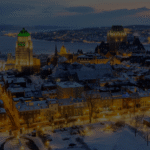
Vieux-Québec was designated a UNESCO World Heritage Site in 1985, the first urban heritage designation in North America and one of the earliest in the Americas more generally. Most visitors see the plaque, file the fact, and move on. The designation is worth a longer look, because it has shaped what Québec City has done and not done with its historic fabric over the subsequent four decades.
What the designation covers
The World Heritage boundary encompasses the walled upper town of Québec, the lower town extending from the cliff base to the Saint-Laurent, and the fortifications themselves. The designation area is approximately 135 hectares and includes more than 1,400 buildings. A surrounding buffer zone, adopted later, covers adjacent streets and the immediate visual approaches to the walled city.
UNESCO’s original justification for the inscription cited two criteria: the site’s outstanding example of a fortified colonial city and its role as the most significant French-American urban and architectural cluster that has survived continuously. Subsequent periodic reviews have reaffirmed both justifications.
What the designation actually requires
Contrary to a common misconception, UNESCO does not itself control what happens within a World Heritage site. The designation commits the national government (in this case Canada) to implementing protective measures at the federal, provincial, and municipal level. In practice, Québec’s heritage protection layers on top of provincial legislation (the Loi sur le patrimoine culturel) and municipal zoning and permitting bylaws. UNESCO periodically reviews compliance and can place a site on its “in danger” list, or in extreme cases remove it, but the day-to-day enforcement is Canadian.
The practical effect is that any alteration to a building within the designated area requires permits beyond those for a comparable building outside the area. Demolition is strictly limited, façades are closely regulated, signage and colour choices are subject to review, and new construction must meet guidelines that specify height, setback, and materials.
Where it has made a visible difference
The most important effect has been preservation of the skyline and the overall urban grain. Proposals for taller buildings in the lower town, including a 1990s proposal near the Bassin Louise for a structure that would have exceeded the height of the Château Frontenac, were rejected on heritage grounds. Signage has been regulated: large backlit corporate signs, familiar from commercial streets elsewhere in the city, are absent from Vieux-Québec. Building restoration has been supported by municipal and provincial grant programmes available only within the designated area.
Where the tension has been
The designation has also created friction. Residents of Vieux-Québec complain about the costs of heritage-compliant renovation, which run considerably higher than equivalent work outside the designated area. Small commercial operators have found the signage rules restrictive. And the preservation of the streetscape, combined with tourism pressure, has accelerated the conversion of residential buildings into short-term rentals and retail, thinning the resident population of the old city.
The resident-population decline is the most persistent critique. Vieux-Québec had roughly 8,000 residents in 1985 and fewer than 5,000 today. Municipal policy has responded with restrictions on short-term-rental conversion and with incentives for long-term residential occupancy, but the trend has proved difficult to reverse in a city where the heritage fabric itself is the primary tourism product.
UNESCO and tourism
The designation has been broadly positive for the city’s international profile. Québec City’s inclusion in World Heritage marketing, travel-industry listings, and cultural-tourism circuits has driven visitor numbers up substantially since 1985. The challenge, familiar to many heritage destinations, is managing the volume without degrading the very resource that attracts it. Cruise-ship tourism in particular has been a focal point of local debate, with day-visitor volumes in peak summer exceeding the sustainable capacity of the walled city’s narrow streets.
How to experience it
For visitors interested in the designation itself, the best first stop is the Centre d’interprétation de Place-Royale, which covers both the physical heritage and the interpretive choices made since the 1970s. Parks Canada’s guided ramparts walk, available in summer, provides the fortifications-focused context. For visitors with a longer interest, the Morrin Centre on rue Chaussée des Écossais carries periodic lectures on heritage policy and preservation, which give a window into the ongoing debates.
Walking Vieux-Québec with an awareness of the designation changes what you notice. The absence of certain things (chain-store signage, glass-curtain façades, modern street furniture) becomes visible. The choices that have been made, and the ones that have been refused, become part of the texture of the city.