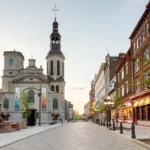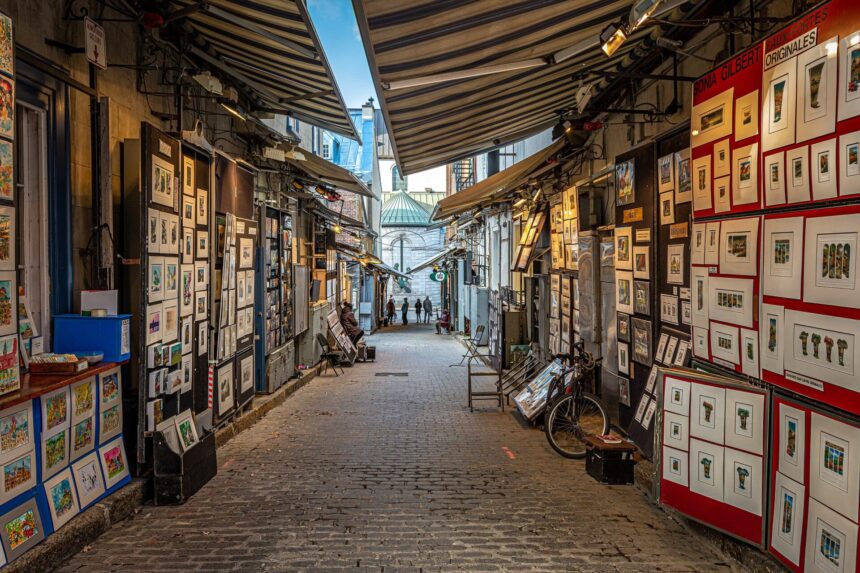
Rue du Trésor is a narrow pedestrian alley that connects Rue Sainte-Anne to Rue de Buade, directly across from Notre-Dame-de-Québec cathedral. It has hosted an outdoor artist cooperative continuously since 1968, when seven Université Laval art students asked the city for permission to hang their work on the lane’s stone walls. The city granted it, the arrangement formalised, and the cooperative has operated under annual permit ever since. Today roughly 30 artists display on the street between May and October.
The origins
The student founders were Jocelyn Sylvestre, Hélène Matte and five others who had been showing their work on sidewalks along Rue du Petit-Champlain and being moved along repeatedly by municipal inspectors. Rue du Trésor, a quieter street without commercial tenants at the time, offered a permanent display surface and escape from the traffic of the lower town.
The first summer, 1968, operated informally. Artists hung paintings on nails driven into the mortar between stones. By 1970, the cooperative had incorporated as a non-profit association, signed a multi-year agreement with the city, and begun accepting applications from artists beyond the founding group. Membership criteria, including a jury process, were in place by 1975, and the first formal exhibition catalogue appeared the following year.
The jury system
Joining the Rue du Trésor cooperative is not automatic. Candidates submit a portfolio to the association’s jury, composed of current members and occasionally external judges from the provincial arts community. The jury evaluates technical quality, originality, and compatibility with the street’s existing mix. Acceptance rates run at roughly 20 per cent of applications.
Once accepted, artists pay an annual fee that covers administration, municipal permits and insurance. Each member is assigned a section of wall and is expected to be present at the display during open hours. The association’s bylaws require daily attendance during the summer season, subject to allowances for weather and family emergencies. The rule is enforced; members who fail to attend face fines and eventually loss of their wall space.
What sells
The street’s commercial character has evolved over five decades. In the 1970s and 1980s, small-scale original oils and watercolours dominated. The subject matter skewed toward Old Québec landmarks: the Château Frontenac, the Place d’Armes, the city gates. Buyers were mostly North American tourists looking for an affordable souvenir from a recognised artist.
Today the mix is broader. Photography, digital prints, mixed media and sculpture have joined painting. Tourist-friendly subject matter continues to sell best, but several members now work in more personal or abstract directions and find their market among regional collectors rather than visitors. Prices range widely: a small print can cost C$25, while a serious oil by a mid-career member can approach C$3,000.
The artists
Current members include painters, photographers and printmakers. Some have been on the street for over three decades. Others join for a few summers and move on, either to gallery representation or to other careers. The cooperative publishes a directory on its website with short biographies and portfolio links; several members also keep studios elsewhere in the city and invite serious buyers to visit.
Recognition within the broader Québec art scene is mixed. Critics sometimes dismiss the street as a tourist operation rather than a serious artistic venue. Members counter that the commercial pressure of daily sales has kept certain craft traditions alive and provided a working income for artists who might otherwise have left the profession.
Practical notes
The street is open daily from May through October, roughly 10h to 21h depending on weather and member rotation. November through April, the walls are empty and the street is a quiet shortcut between Rue de Buade and Sainte-Anne. Photography is welcome; flash photography of the artwork is not. Prices are generally fixed but the cooperative leaves individual negotiation to the member concerned. Most members accept credit cards; some still prefer cash for smaller purchases.
For buyers considering a serious purchase, a second visit after lunch is a good practice. Daylight conditions change through the day, and a piece that reads well at 11h may look different in the softer late-afternoon light. Members are typically happy to hold a work for an hour while a buyer returns to confirm.