The Chemin du Roy, opened in 1737, was the first continuous road between Québec City and Montréal and the oldest carriage road in Canada. Two hundred and eighty kilometres long, it ran along the north bank of the St. Lawrence and passed through 37 parishes, each one responsible for maintaining its own stretch under a royal ordinance of 1706. The modern Route 138 follows most of the original alignment, and about ninety percent of the old Chemin du Roy can still be driven today, though rarely as the fastest way to get anywhere.
Seasonal character
Before the road existed, the river was the highway. Canoes in summer and sleighs on the ice in winter carried people and goods between the colony’s two main towns in three or four days. The problem was the shoulder seasons. October through December, when the river was neither navigable nor frozen, effectively isolated the colony’s interior. The road was commissioned to fix that, and Pierre Robineau de Bécancour, the Grand Voyer of New France from 1657 to 1729, spent most of his career negotiating the route with the seigneurs whose land it crossed.
The construction standard was modest. Eight metres wide, drained on both sides, with a gravel surface laid over hand-cleared forest. Bridges at the smaller rivers; ferries at the Jacques-Cartier, Batiscan, Sainte-Anne, and Saint-Maurice. Parish curés were expected to report any failures to the royal authorities, and chronic delinquency on the maintenance corvée could result in fines. In practice the road was passable to a wheeled cart from about May through November and to sleighs in midwinter.
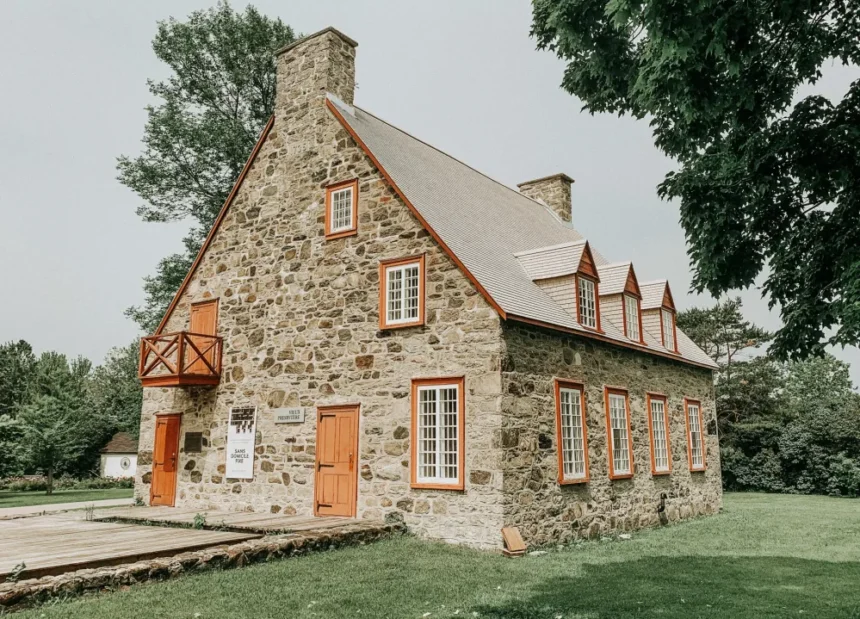
Post offices were established at regular intervals beginning in 1763. The trip from Québec to Montréal in the 1780s took three days in summer with a good horse and decent weather, and four or five in poor conditions. Inns at the end of each day’s stage were crude, offered pea soup and salt pork, and charged about a shilling for bed and board. A number of those buildings survive. The Auberge Baker in Château-Richer, the Auberge du Faubourg at Saint-Jean-Port-Joli, and the Maison Drouin on the Île d’Orléans all date, in part, from the eighteenth century.
Family considerations
The road’s commercial importance peaked between 1780 and 1840. After that, the Grand Trunk Railway’s south-shore line and then the Canadian Pacific’s north-shore line, completed in 1879, absorbed the long-distance freight and passenger traffic. The Chemin du Roy became a local road, used for church, market, and family visits within a day’s drive of any given village. That demotion preserved it. The road kept its modest alignment, its tree lines, and most of its original buildings, while Highway 40, which took over intercity traffic in the 1960s, was built a few kilometres inland on a faster, wider track.
Driven today, the Chemin du Roy is best tackled in segments. From Québec City, the first worthwhile stretch runs 55 kilometres west to Portneuf, passing through Cap-Rouge, Neuville, Donnacona, and Deschambault. Neuville has the highest concentration of pre-1800 stone houses in the province, about twenty-five of them still standing on the main street. Deschambault’s presbytery, built in 1818, operates as a small museum. Cap Santé’s church of 1754 is worth a stop.
Beyond Portneuf, the road continues through Trois-Rivières, the halfway point, and then through Louiseville, Berthierville, and Repentigny to the eastern approaches of Montréal. The full trip takes roughly six hours if you drive straight through and a comfortable long weekend if you stop. The province has signposted the route with distinctive blue-and-white Chemin du Roy shields at every junction, and the tourist information centres at Québec, Trois-Rivières, and Repentigny carry a free itinerary map in English and French.
What sets it apart
Restaurants and small inns along the route are generally honest rather than exceptional. The exceptions include Aux Anciens Canadiens in Québec City itself, L’Arrivage at Trois-Rivières, and the Auberge du Lac Saint-Pierre just west of Trois-Rivières, all three of which do defensible regional cooking. Lodging in the villages is mostly bed-and-breakfast stock; prices range from 110 to 180 dollars a night depending on season.
For visitors with limited time, the morning drive from Québec City to Neuville and back, about two hours with stops, is the most efficient sample. It passes most of the best eighteenth-century architecture in one loop, uses back roads that carry almost no truck traffic, and ends in time for lunch somewhere in the Lower Town.