The capital’s hinterland is one of the most accessible wilderness zones of any major Canadian city. Within sixty minutes of the Parliament building, you can reach four distinct terrains: the Laurentian hills of Parc national de la Jacques-Cartier, the coastal Charlevoix hills beyond Saint-Anne-de-Beaupré, the gorges of the Chute Montmorency and Canyon Sainte-Anne, and the forested municipal parks on the western flank of the city. Each terrain has a different optimal season and a different expected difficulty level. Matching terrain to condition is the first task for a capable visitor.
Parc national de la Jacques-Cartier
Thirty kilometres due north of the city on Route 175, this Sépaq-managed provincial park holds the strongest trail network in the entire region. Les Loups is the classic, an 11-kilometre loop gaining 400 metres with a cliff-top viewpoint over the Jacques-Cartier valley. L’Éperon is shorter, at 2.6 kilometres round-trip, with comparable elevation gain and a faster payoff for visitors with limited time. Day-use parking costs 10.15 dollars per person over the age of eighteen and requires advance reservation on summer weekends through the Sépaq website. The park operates year-round: in winter, the same terrain becomes snowshoe territory, with packed routes and equipment rental at the Discovery Centre.
Sentiers du Mont-Wright
Inside the city’s northern suburb of Stoneham-et-Tewkesbury, this 190-hectare municipal park offers a free alternative to the Sépaq fee system for visitors on a tighter budget. Trails climb a single domed summit with a tower of granite outcrops at the top. The longest route, at 4.2 kilometres round trip, gains 230 metres and can be completed in under two hours by most fit adults. Parking lots fill by ten in the morning on summer Saturdays and by eleven on weekdays in July. The trails remain accessible without snowshoes through most of the winter thanks to heavy foot traffic, though microspikes help in January and February. Dogs are permitted on leash throughout the summer season.
Chute Montmorette and Canyon Sainte-Anne
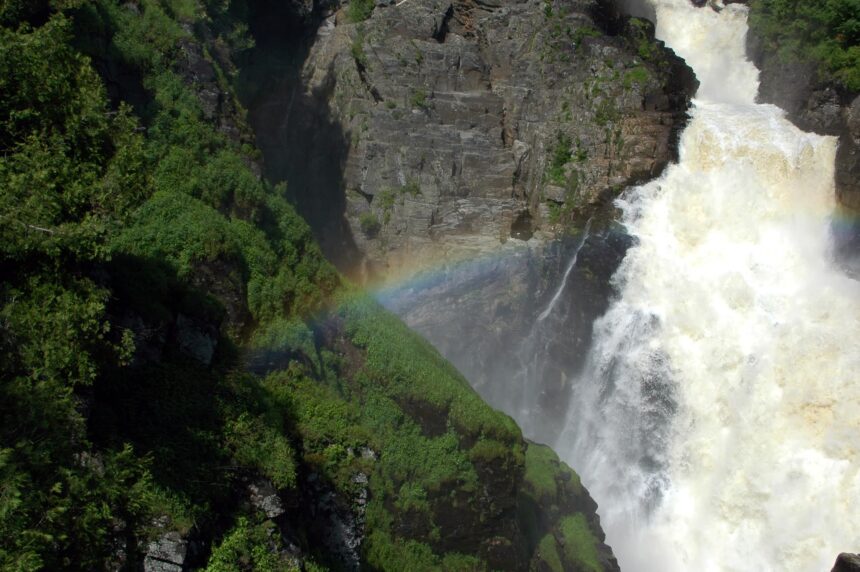
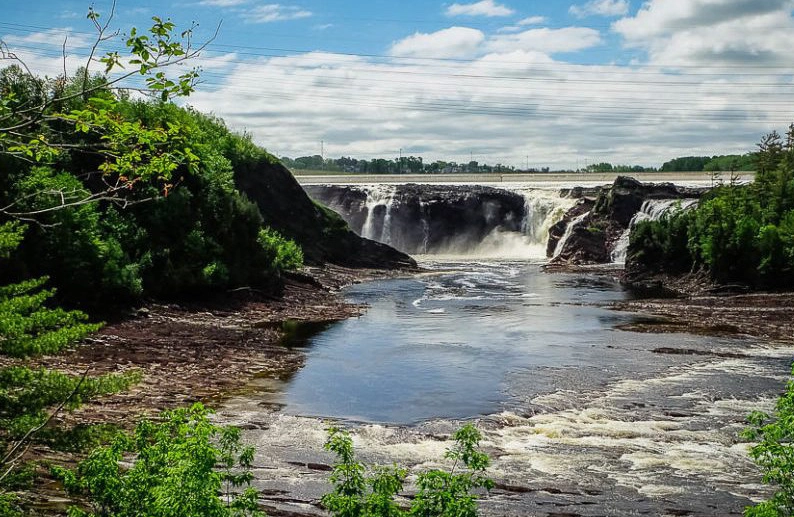
Fifteen minutes east of the old city, the Chute Montmorency falls 83 metres over a basalt cliff: taller than Niagara, though far narrower. The site carries a suspended bridge over the falls, a cable car, and a 487-step staircase that doubles as the actual hiking challenge. Beyond Montmorency, Canyon Sainte-Anne in Beaupré offers a longer and considerably less crowded alternative: three footbridges over a deep gorge carved by the Sainte-Anne-du-Nord river, reached by interconnecting trails totalling roughly five kilometres in length. The canyon charges 18.50 dollars for adult admission, with reduced rates for children and seniors, and closes between late October and early May.
Charlevoix’s southern edge
An hour northeast along Route 138 takes you to the Parc national des Grands-Jardins, where the Pioui trail climbs above the tree line to expose a boreal landscape of caribou-habitat vegetation. At 10.6 kilometres and with a gain of 350 metres, Pioui ranks among the best moderate hikes in eastern Canada. The trail is accessible May through October. In winter, the park maintains groomed cross-country skiing routes, though the most exposed high-elevation terrain becomes too cold for casual outings. The Sépaq pass covers entry; the 10.15-dollar daily fee applies outside pass-holder periods.
A seasonal cheat sheet
Spring, between mid-April and mid-May, is mud season at elevation. Municipal parks like Mont-Wright dry faster than the provincial parks and remain the better option. June through September covers the full menu, with August offering the most stable weather and the clearest long-distance visibility. October delivers foliage, with the last two weeks of September and the first week of October peaking at this latitude. The elevation gradient in Jacques-Cartier produces a week of staggered colour that most visitors find rewarding. Winter hiking requires snowshoes except on packed municipal trails, and daytime temperatures between minus eight and minus fifteen are common. The hours of daylight drop to roughly eight by late December, which compresses the available trail time considerably for winter outings.