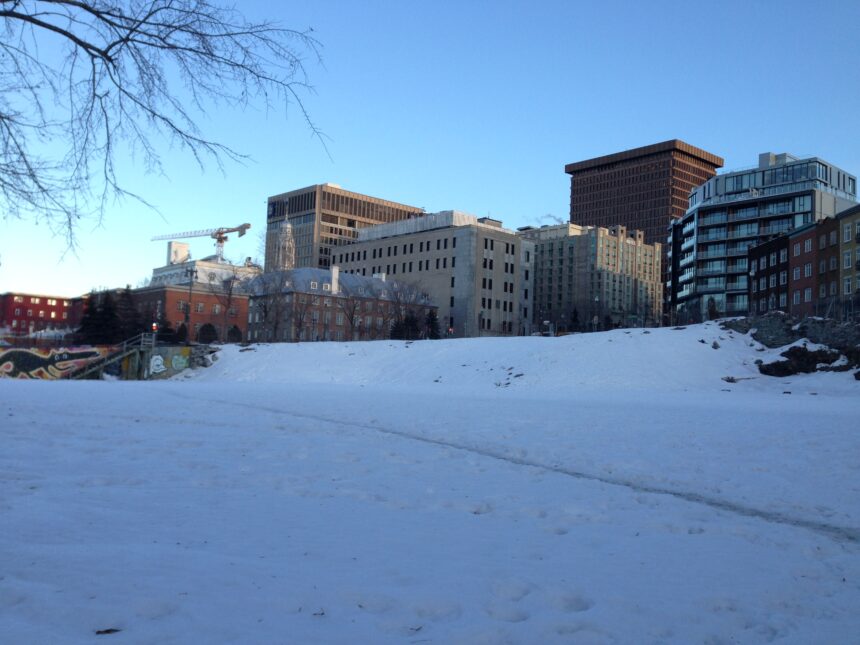
The Îlot Saint-Vincent-de-Paul, a fenced-off lot on the edge of Old Quebec that has been vacant since the Patro Saint-Vincent-de-Paul building was sold in 1987, will finally be built on. Québec City, the Quebec government and Ottawa confirmed the financing package on April 2: 151 social housing units on a $55.7-million project, with construction slated to begin in spring 2027 and delivery expected in late 2028 or early 2029.
The building
The funding breakdown reflects the three-way partnership. Ottawa contributes $11.2 million through its Build Canada Homes program, the federal Crown corporation model introduced by legislation on February 5, 2026. The Société d’habitation du Québec adds $8.6 million. The City of Québec puts in $4.5 million. The remainder comes from mortgage financing and contributions from La Bouée, the non-profit qualified developer that will coordinate construction alongside Action-Habitation, the Fédération des coopératives d’habitation de Québec et Chaudière-Appalaches, the Comité populaire Saint-Jean-Baptiste, and the architecture firm Lafond Côté.
About one-third of the 151 units will have two or more bedrooms, a concession to the project’s critics who had argued that downtown social housing in recent years leaned too heavily toward studios and one-bedrooms at the expense of families. Roughly 20 percent of the units will fall in the “intermediate” affordability band, priced below market but above traditional social housing rates. The complex will also include an 80-place early childhood education centre, community gardens, and a linear promenade along the lot.
History and origins
Mayor Bruno Marchand has repeatedly referred to the site as a “dead tooth” in the city’s urban fabric. His administration bought the land from hotelier Jacques Robitaille in early 2025 for more than $12 million, reversing nearly four decades of private ownership that had produced successive plans (luxury hotel, condominiums) and no construction. The church originally on the site was demolished more than 15 years ago. Since then the lot has sat behind hoardings at one of the most visible entrances to the Faubourg Saint-Jean-Baptiste, a short walk from the Porte Saint-Jean.
The Îlot Saint-Vincent-de-Paul announcement was paired with a broader federal-provincial commitment made the same day: a $200-million partnership to build approximately 865 affordable, supportive and transitional housing units across Quebec under the Build Canada Homes framework. Fourteen of the projects are for supportive or transitional housing, for a combined 390 units aimed at people experiencing homelessness, women fleeing domestic violence, and people in recovery. The memorandum of understanding that enables this cooperation was signed by Ottawa and Quebec on January 21, 2026, after months of negotiation over jurisdictional boundaries that nearly derailed the program.
Seasonal character
Summer and fall 2026 will be spent on archaeological surveys of the site, a legal requirement given its location inside the Old Quebec heritage perimeter, followed by soil decontamination work. The building’s final design, by Lafond Côté, features two brick-and-aluminum structures linked by a “contemporary arch” drawing on the form of the lost church. Whether the project delivers on its 2028-2029 schedule will depend substantially on the archaeological phase: sites in Old Quebec routinely yield material from the French and British colonial periods that can extend excavation timelines by months.
The Faubourg Saint-Jean-Baptiste neighbourhood association has pushed for social housing on this lot since at least the late 1990s. Action-Habitation coordinator Bruno Dion noted earlier in the consultation process that the Îlot project would be the first substantial social or community housing development in the Faubourg since 2006. That gap reflects a broader pattern in Québec City’s inner neighbourhoods, where rising land values, condominium development pressure, and the limited inventory of publicly-owned lots have made new social housing progressively more difficult to finance.