Alto, the Crown corporation overseeing the proposed Toronto-Québec City high-speed rail project, wraps up its first formal round of public consultations on April 24, 2026. The 14-week consultation, launched January 15, is the initial engagement exercise for a $80-billion megaproject that would run 300 km/h trains on roughly 1,000 kilometres of dedicated electrified track between Toronto and Québec City, with intermediate stops at Peterborough, Ottawa, Laval and Montreal. Construction on the first segment is targeted for 2030; full corridor operation would not occur until the 2040s at the earliest.
Seasonal character
The project advanced from feasibility study to procurement on February 19, 2025, when the federal government awarded the design-build-operate contract to Cadence, a consortium of CDPQ Infra, AtkinsRéalis (formerly SNC-Lavalin), Keolis, SYSTRA, SNCF Voyageurs and Air Canada. The Abacus Data polling firm released a survey in early April 2026 showing 62 percent of Canadians support the project against 18 percent opposed. That support level is substantially higher than most comparable Canadian megaprojects have enjoyed at equivalent stages of planning.
For Québec City, the transformational implications are not abstract. The current Via Rail corridor service to Montreal runs three to four times a day with a scheduled travel time of 3 hours 15 minutes to Gare Centrale. Alto’s proposed service time on the same segment is approximately 1 hour 30 minutes. The Toronto-Québec City end-to-end journey, currently 9+ hours by Via or 90 minutes by air plus the 3-hour security-and-transfer overhead, would fall to approximately 3 hours 15 minutes station to station. That is air-travel-competitive time at substantially better total trip economics and carbon profile.
Where things stand today
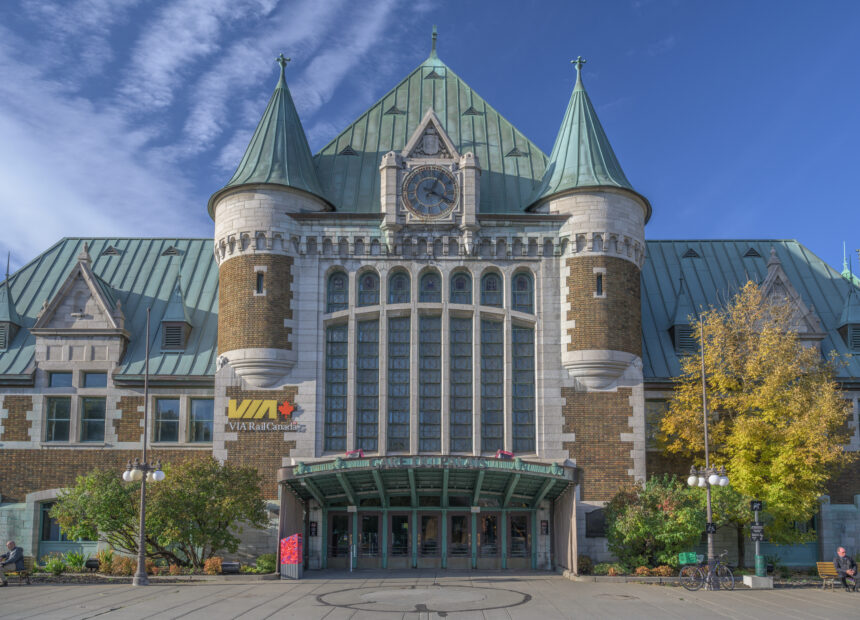
The Québec City station’s precise location remains undetermined. Gare du Palais, the historic CN rail station in the Lower Town that currently serves Via Rail’s corridor trains, is the most likely candidate, and the consultation materials treat it as the presumed endpoint without formally committing. The TramCité alignment currently moving toward 2027 construction does not currently include a Gare du Palais stop, an integration gap that would need to be resolved before Alto construction begins if passengers are to transfer efficiently between the two systems.
Skeptical analysis of the project is increasing in volume as the timeline firms up. The Hub, a centre-right Canadian policy publication, published an analysis on April 14 questioning Alto’s 25-million-annual-passenger projection against the comparable ridership of existing Canadian rail. Concerns from Transport Canada observers have also focused on the Cadence consortium’s track record. AtkinsRéalis and CDPQ Infra have been involved in rail projects, notably Montreal’s REM light rail, that encountered significant cost overruns and scheduling delays during construction. The federal government has defended Alto’s procurement model as distinct from REM’s, with a stronger public oversight component.
How locals use it
CEO Martin Imbleau has framed the public consultation period as an opportunity to shape the project before engineering studies lock in routing decisions. “We’re not in the ‘if’ anymore,” Imbleau told the Montreal chamber of commerce on January 13. Residents of Québec City, Lévis and the Chaudière-Appalaches region who want to participate can do so through Alto’s online consultation platform, scheduled virtual sessions or in-person open houses. The deadline is April 24, 2026. After that date, the team moves to engineering studies for the first-phase segment, which reporting suggests will likely be Toronto-Montreal rather than Montreal-Québec.
The political question overshadowing the timeline is whether the project survives the October 2026 Quebec provincial election and the next federal vote. Alto is federally led and federally funded in its initial phase, but Quebec’s cooperation on land assembly, regulatory approvals and station area planning is essential, particularly in the Montreal-Québec segment. A Parti Québécois or Conservative Party of Canada government at either level could substantially alter the project’s scope, timeline or funding commitments. For Québec City residents watching infrastructure that will reshape their connection to the rest of Canada, the next 12 months matter more than the projected 2030 construction start.