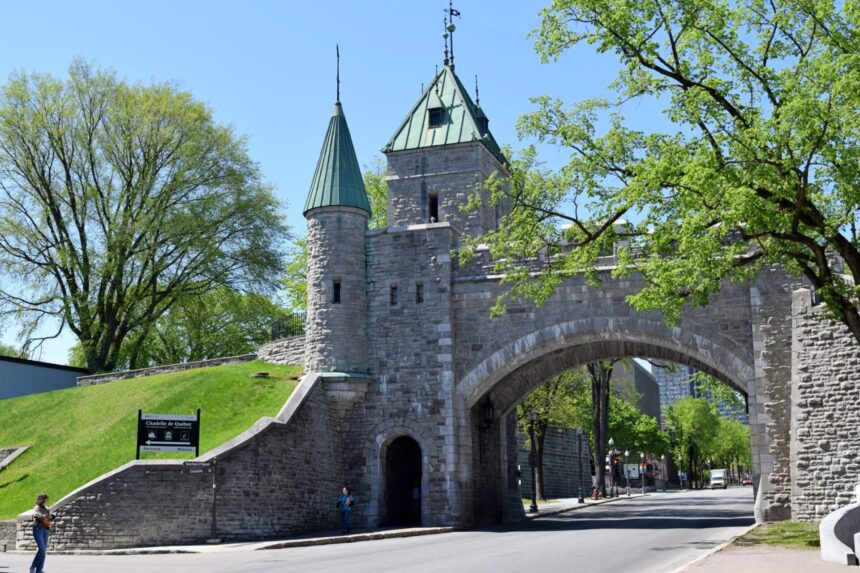
The Colline Parlementaire (Quebec City’s parliamentary district, the dense concentration of government buildings, ministerial offices, and cultural institutions along the Grande Allée and Boulevard René-Lévesque) undergoes a remarkable transformation at nightfall: the daytime’s bureaucratic intensity (the traffic of civil servants, lobbyists, journalists, and political staff that gives the district its peculiar professional energy) dissipates, and the heritage buildings’ illumination reveals an architectural drama that the daytime’s human activity partially obscures. A late-evening walk through the Colline Parlementaire (from the illuminated Fontaine de Tourny along the Grande Allée to the Grand Théâtre’s concert exit crowds, then back through the Rue d’Auteuil to the Porte Saint-Louis) is one of Quebec City’s finest urban experiences, available free of charge at any hour.
The Illuminated Hôtel du Parlement
The Hôtel du Parlement (the 1886 Second Empire building whose 22 bronze historical figures are visible on its facade) is illuminated at night by the floodlighting that the Commission de la capitale nationale du Québec (CCNQ) maintains as part of the Illumination program for the capital’s most significant public buildings. The building’s facade, lit from below in warm white light, presents a different character from its daytime appearance: the architectural details (the mansard roofs, the pavilion towers, the sculptural program) are highlighted by the low-angle illumination in a way that the diffuse daytime light does not achieve. The view of the illuminated parliament from the Fontaine de Tourny (the fountain’s bronze figures lit against the building’s facade) is among the finest urban compositions available for evening photography in any Canadian city.
The Grand Théâtre After a Concert
The Grand Théâtre de Québec’s post-concert atmosphere (the crowd emerging from the Salle Louis-Fréchette after an OSQ or Opéra de Québec performance, the animated conversations in the lobby where the Jordi Bonet mural provides an extraordinary backdrop for post-concert socializing, and the dispersal into the surrounding restaurants and bars that constitute the post-concert Colline Parlementaire social scene) provides access to Quebec City’s most concentrated cultural life. The combination of a Grand Théâtre concert (tickets available at legrandtheatre.qc.ca) with a post-concert supper at one of the adjacent Grande Allée or Rue d’Auteuil restaurants constitutes one of the finest cultural evenings available in the capital (a genuinely Québécois experience of high cultural programming combined with the convivial social life that the Grande Allée’s restaurant strip provides.
The Quiet Night Streets
Beyond the illuminated main boulevards, the Colline Parlementaire’s side streets (Rue de la Chevrotière, Rue D’Artigny, Rue Honoré-Mercier) are among the quietest and most atmospheric streets in Quebec City after dark) the ministerial offices closed, the government traffic absent, and the heritage streetscapes (the Victorian and early 20th-century commercial buildings that line these streets) lit only by the municipal streetlighting. Walking these streets at 10 PM on a winter weeknight, with the breath visible in the cold air and the sound of the city reduced to the distant traffic of the Grande Allée, provides the most complete contrast to the daytime political intensity of Quebec City’s government district, an experience of the city’s heritage physical fabric unmediated by the human activity that normally occupies it.