The Cathedral of the Holy Trinity sits one block south of the Château Frontenac on Rue des Jardins, an unassuming Georgian building that most visitors walk past without noticing. Built between 1800 and 1804, it was the first Anglican cathedral constructed outside the British Isles, and for two centuries it has carried the complicated role of minority institution in an overwhelmingly Catholic and francophone city.
What sets it apart
The site itself says something about early British authority after the Conquest. The land belonged to the Récollet Franciscan order until their monastery burned in 1796. Governor Lord Dorchester, looking for a prominent plot, pressed the Crown into purchasing the ruin and transferring it to the Anglican Church. King George III paid for the construction personally from his privy purse, a detail that remains carved into the foundation stone.
The architecture, by Captain William Hall and Major William Robe of the Royal Artillery, is a deliberate copy of St. Martin-in-the-Fields in London. The proportions are strict, the portico unornamented, and the spire of thirty-nine metres still climbs above most of the surrounding rooftops. The interior has box pews, a rare survival anywhere in North America, and the royal pew, reserved for the sovereign or the representative, is marked with a brass cipher. The pews in the nave were originally rented to parishioners, a practice that persisted until 1959.
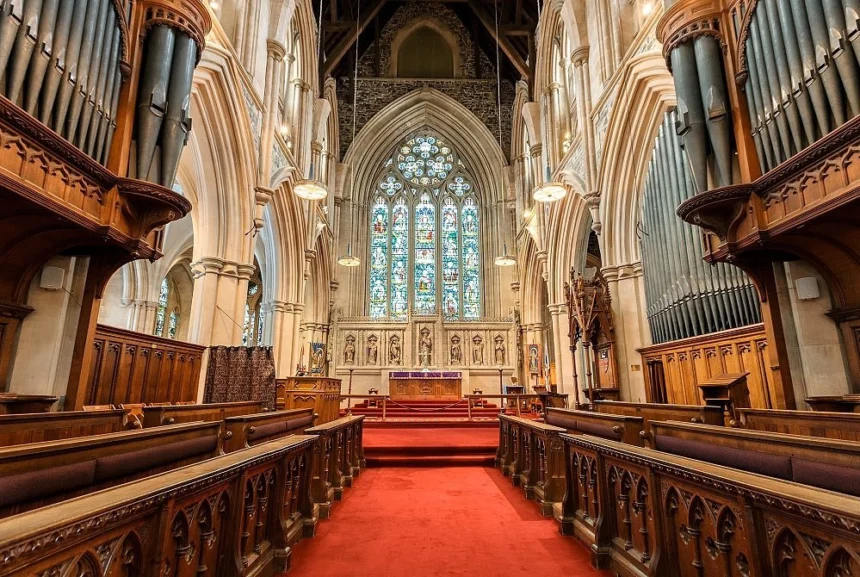
Inside, the objects to look for are specific. The stained glass in the east window was installed in 1845 and shows scenes from the life of Christ in a style that predates the Pre-Raphaelite revival. The pipe organ, a Casavant Frères instrument of 1909, is still used for Sunday services and for a concert series that runs from June through August. The bishop’s throne, on the south side of the chancel, is carved from oak that was cut on the Plains of Abraham in 1804. A set of communion silver given by George III sits in the vestry and is brought out on feast days.
Where things stand today
The congregation reflects the city’s anglophone demography. Québec City has roughly fifteen thousand mother-tongue English speakers, down from a peak of about forty thousand in 1901, and the Anglican parish today numbers a few hundred active members. Sunday Eucharist at 10.30 is offered in English, and a French service at 9.00 draws a smaller group of bilingual parishioners and francophone converts. The rector and the dean are both bilingual.
The cathedral has weathered three kinds of stress. The first was demographic: the emigration of anglophone Québecers after the 1976 election of the Parti Québécois reduced the active membership by about half over twenty years. The second was financial, as maintenance costs on a two-hundred-year-old building with slate roofs and stone walls rose steadily. The third is the slower crisis of religious practice affecting every mainline Christian denomination in Canada. The cathedral responded by opening the building to concerts, lectures, and guided visits, all of which generate revenue and cultural traffic without compromising the worship space.
The small burying ground behind the building holds about two hundred graves, mostly from the early nineteenth century. The weathered slate headstones are worth ten minutes. Governor Robert Shore Milnes is buried there, as is Jonathan Sewell, the first Chief Justice of Lower Canada, along with several merchant families whose names show up on plaques around the Old Port: the Prices, the Douglases, the Patersons.
History and origins
For a visitor, the cathedral is open daily from June through September, roughly 10.00 to 17.00, and less reliably in the other months. Admission is free, though a three-dollar donation is encouraged. Guided tours in English run on the hour in summer and are led by members of the congregation rather than by professional guides, which gives them a looseness and depth that professional tours usually lack. The booklet at the entrance, in English and French, is the best thirty pages of printed history on this building available anywhere.
Seen against the Basilique-Cathédrale Notre-Dame de Québec three blocks east, Holy Trinity is the quieter institution: smaller, less ornate, less freighted with official ceremony. That is probably why it repays a visit. The Anglican minority in this city has never been dominant, and the building records that minority condition with honesty rather than grandeur.