The Hôtel-Dieu de Québec ( established in 1639 by the Augustinian Sisters of Mercy (Augustines de la Miséricorde de Jésus), three French nuns who arrived in Quebec City on August 1, 1639, led by Marie de Saint-Ignace (Marie Guenet, 1602-1657) ) is the oldest hospital in North America north of Mexico and one of the oldest continuously operating healthcare institutions in the western hemisphere. From its founding in a small wooden building near the base of the Cap Diamant cliff to its current role as one of the five sites of the Centre hospitalier universitaire de Québec-Université Laval (CHU de Québec-UL), the Hôtel-Dieu de Québec has provided medical care in the colonial capital for 385 consecutive years through wars, epidemics, fires, political transformations, and the complete revolution of medical science from humoral theory to genomic medicine.
The Augustinian Sisters: Founders & Sustainers
The three Augustinian nuns who founded the Hôtel-Dieu ( Marie de Saint-Ignace, Anne de Saint-Bernard, and Marie de Saint-Bonaventure ) were responding to the call of Marie-Madeleine de Vignerot (Duchesse d’Aiguillon, niece of Cardinal Richelieu), who funded their passage and the hospital’s establishment as a personal mission of charitable service to the Indigenous and colonial population of New France. The hospital’s first patients were primarily Indigenous people Algonquin, Huron-Wendat, and Montagnais (Innu) brought to the hospital with infectious diseases for which the European contact had reduced their immunity. The sisters learned Indigenous languages to communicate with their patients and maintained a mission of service to both the Indigenous and colonial population that distinguished the Hôtel-Dieu from the purely colonial-oriented institutions that followed.
The Epidemics
The Hôtel-Dieu’s history is inseparable from the epidemic history of Quebec City the cholera epidemics of 1832 and 1854 (each killing hundreds in the city), the typhus epidemic of 1847 (the overflow from Grosse-Île’s overwhelmed quarantine facilities reached Quebec City’s streets and the Hôtel-Dieu’s wards), the smallpox epidemic of 1885 (which killed 3,000 people across Quebec in the period before vaccination became general), and the 1918 influenza pandemic that overwhelmed all of Quebec City’s healthcare facilities. Each epidemic tested the hospital’s capacity, required emergency expansion of facilities, and resulted in the deaths of nursing sisters who exposed themselves to deadly pathogens in the course of their care. The Augustinian Sisters’ role in epidemic response over three centuries is among the most significant contributions to public health in Canadian history.
The Monastère des Augustines
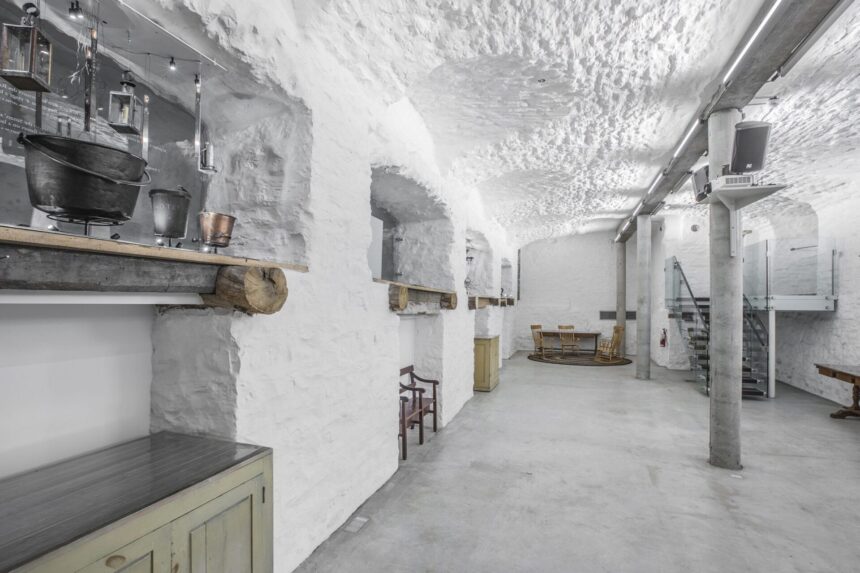
The Monastère des Augustines ( adjacent to the current Hôtel-Dieu de Québec hospital on the Rue des Remparts in the Old City ) has been converted into a unique heritage wellness retreat that provides accommodations, a spa, a museum, and interpretive programming about the Augustinian Sisters’ 385-year mission. The Monastère (opened as a public heritage site in 2015) occupies the historic conventual buildings that housed the sisters’ community and now operates as a social enterprise whose revenues support the preservation of the Augustinian heritage. The museum collections ( medical instruments, religious objects, paintings, and the extraordinary archive of the sisters’ records ) constitute one of the most complete documentations of 17th-19th-century medical and religious life available in Quebec. Overnight stays at the Monastère provide the most engaging heritage accommodation experience in Quebec City.