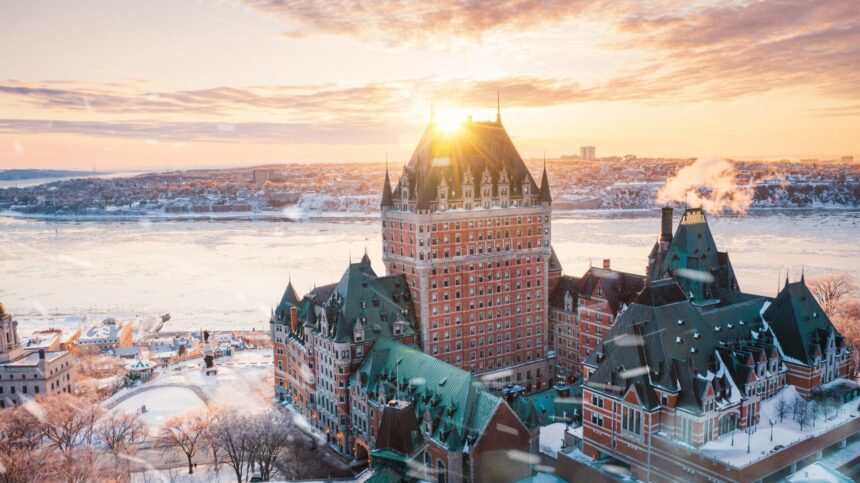
Quebec City has 340 years of continuous construction recorded in surviving buildings, from the 17th-century stone structures of the seminary to the 1988 Safdie museum on the waterfront. This is the deepest architectural timeline in Canada. Ranking these buildings means weighing three things simultaneously: age, architectural quality, and historical importance. A building that is very old but architecturally mediocre ranks lower than a building that is somewhat younger but represents the best work of its era. The list below tries to do that honestly. If what you came for is simply the oldest one, that is answered first, immediately below.
Which is the oldest building in Quebec City?
There is no single answer, and the reason is worth a paragraph because it is the whole difficulty of the question. The province’s heritage register, the Répertoire du patrimoine culturel du Québec, is careful never to crown one building outright. What it does give is dates, and the dates split the answer three ways depending on what you are asking.
The oldest house: the Maison François-Jacquet-dit-Langevin (1675), at the corner of rue Saint-Louis and rue des Jardins, now the restaurant Aux Anciens Canadiens. The Ursulines granted the lot to François Jacquet in November 1674 and the house went up the following year, with enlargements around 1690 and again in 1795 and 1818-1820. The register calls it one of the oldest surviving houses in the Vieux-Québec heritage site and in Québec as a whole — one of, not the. That hedge is the register’s, and it is honest: a house standing for 350 years is never entirely original fabric.
The oldest institutional building: the Aile de la Procure of the Séminaire de Québec (1678-1681). The Ville de Québec heritage file gives 1678 and names the Procure, Parloirs and Congrégation wings as the oldest construction in the seminary complex. An earlier building of 1675-1677 stood on the same spot, but of it only the vaulted cellars and Monseigneur de Laval’s kitchen survive, and the wing above was rebuilt and raised after the fire of 1865.
The oldest structure in the wider region: the Maison des Jésuites de Sillery, whose fabric runs from about 1637, outside the Old City. It is older than either of the two above and is the reason the answer has to specify whether you mean the city or the region.
The ranking that follows is a different exercise. It weighs age against architectural quality and historical importance, so the oldest building is not automatically first.
Tier 1: Irreplaceable (Pre-1700)
1. Aile de la Procure, Séminaire de Québec (1678-1681)
The oldest institutional building in Quebec City and the most complete surviving example of 17th-century institutional construction in Canada. The Maison Jacquet, three streets away, is three years older, but it is a house; this is a working institution that has never stopped being one.
2. Notre-Dame-des-Victoires church (1688, rebuilt after 1759)
Built above the foundations of Champlain’s 1608 Habitation. The oldest stone church in Canada still in continuous use.
3. Maison des Jésuites de Sillery (c. 1637-1702)
The oldest surviving non-military structure in the Quebec City region, built for the Jesuit mission to the Algonquin peoples.
Tier 2: Architecturally Exceptional (1700-1850)
4. Maison Chevalier (1752)
The finest surviving New France merchant house. The best example of its type in the country.
5. Château Frontenac (1893, Bruce Price)
Architecturally the most internationally recognized building in Canada. Price’s château style defined how Canada decided to look to the world for the next century.
6. Hôtel du Parlement (1886, Eugène-Étienne Taché)
The most important public building in Quebec, home to the province’s legislative assembly for 140 years.
7. Basilique Notre-Dame de Québec (rebuilt 1922, original fabric 1647)
The ecclesiastical centre of French Canada for 375 years.
8. Gare du Palais (1915, Harry Pringle)
The finest surviving CPR château-style railway station east of the Rockies.
Tier 3: Historically Essential
9. Holy Trinity Cathedral (1804)
The first Anglican cathedral built outside the British Isles.
10. Grand Théâtre de Québec (1971, Victor Prus)
The most significant post-war cultural building in the city. Houses the Jordi Bonet mural, which is worth the visit on its own.
11. Monastère des Augustines (17th-19th century)
The surviving convent of the women who founded North America’s oldest hospital.
12. Musée de la Civilisation (1988, Moshe Safdie)
The best example of heritage-contemporary architectural integration in Quebec City.
13. Morrin Centre (1862, converted from 1812 jail)
Home of the Literary and Historical Society of Quebec, Canada’s oldest English-language cultural institution.
14. Citadelle of Quebec (1820-1850, Royal Engineers)
The largest British fortress in North America, still garrisoned by the Royal 22nd Regiment.