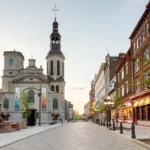
Place de Paris ( the public square in Quebec City’s Old Port, between the Rue Dalhousie and the St. Lawrence River, adjacent to the Musée de la Civilisation ) is the most explicit physical expression of the France-Quebec cultural relationship in any Canadian public space: a square created through a formal civic gift from the City of Paris to Quebec City, furnished with a sculpture (Dialogue entre deux mondes, by French sculptor Jean-Pierre Raynaud, installed 1987) that represents the encounter between the Indigenous and European worlds at the foundation of Quebec City’s history. The square’s creation in the 1980s reflected the broader France-Quebec relationship of the Quiet Revolution and post-Quiet Revolution era, when the cultural and political connections between Quebec and France reached their most intensive period of mutual engagement.
The France-Quebec Relationship
The France-Quebec cultural and political relationship ( which intensified dramatically following Charles de Gaulle’s 1967 “Vive le Québec libre!” declaration from Montreal’s City Hall balcony ) has produced an array of institutional, cultural, and economic connections that distinguish the Quebec City-France relationship from any other sub-national-to-national connection in Canadian political life. The French government’s Office franco-québécois pour la jeunesse (OFQJ), which facilitates youth cultural and professional exchanges between France and Quebec, has operated since 1968; the Délégation générale du Québec à Paris is the closest thing to an embassy that Quebec maintains in any world capital; and the cultural exchange programs, film co-production treaties, and academic reciprocity arrangements between Quebec and France create a bilateral relationship of unusual depth for entities of their respective sizes.
The Dialogue entre deux mondes Sculpture
The sculpture Dialogue entre deux mondes (Dialogue between Two Worlds), created by French artist Jean-Pierre Raynaud and installed in Place de Paris in 1987, consists of a cube of black granite bearing the cross-section silhouette of a vessel (referencing the ships that connected France and New France across the Atlantic) placed adjacent to a sphere of white marble. The two geometric forms ( the angular European regularity of the cube and the natural completeness of the sphere ) are interpreted as representing the encounter between the European (French colonial) world and the Indigenous (pre-colonial American) world that Champlain’s founding of Quebec City initiated. The sculpture’s abstraction (the forms are not figurative) invites multiple interpretations; the critical readings that have been offered since installation ( some arguing that the sculpture privileges the European geometric order over the Indigenous natural world ) reflect the evolving understanding of the colonial encounter’s asymmetries that has developed in the decades since the sculpture’s installation.
The Square as Event Space
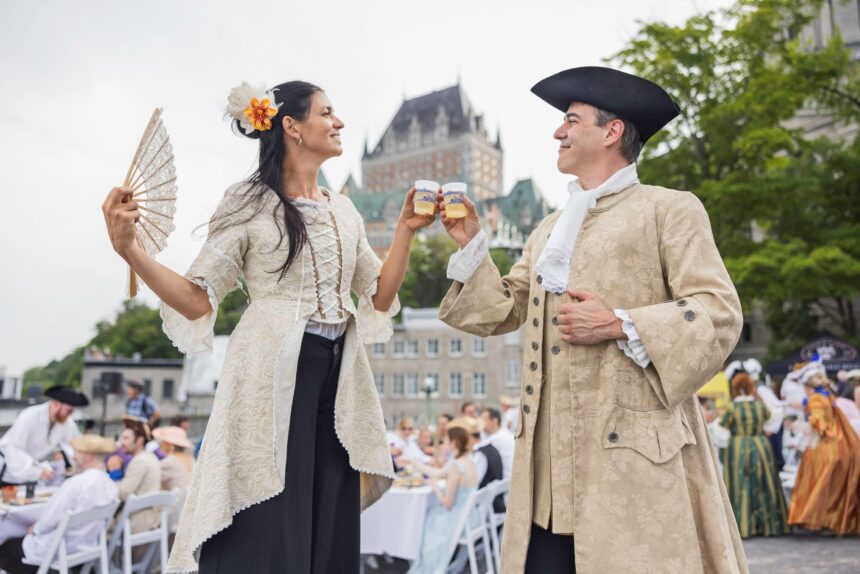
Place de Paris’s role as an event space ( summer festival programming, outdoor performances, dance events, and the occasional food market that supplements the Marché du Vieux-Port’s year-round offerings ) has given the square a functional vitality that many purely monumental public spaces lack. The square’s central paved area carries most of that programming, around the permanent sculpture and the fixed infrastructure that stays in place year-round. The square’s position ( adjacent to the Musée de la Civilisation, the Old Port’s cruise terminal approach, and the Old City’s Lower Town commercial district ) gives it high pedestrian traffic throughout the tourism season.