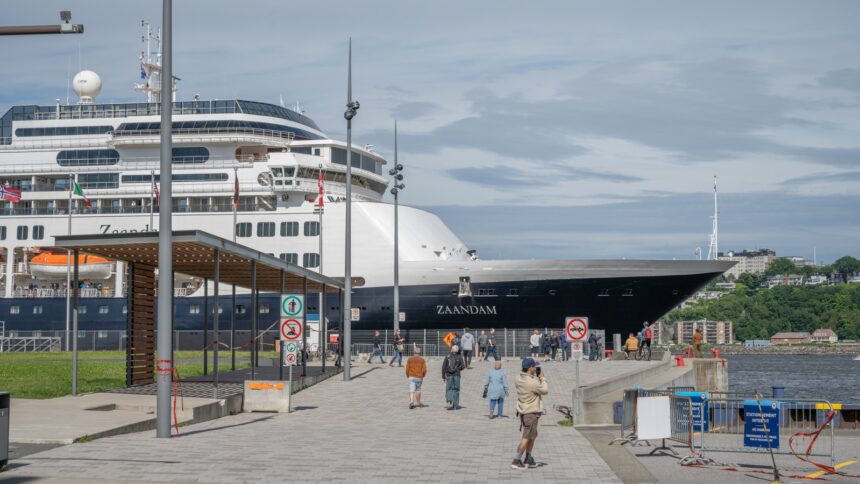
The Port of Québec closed its 2026 international cruise season on 12 November with 126 513 cruise passengers carried on 100 calls by 29 different ships from 23 lines. Le Soleil reported the same figures under a headline saying there were nearly 10% fewer passengers than in 2025. Both numbers come from figures the Port itself published. They are also answers to different questions, and the distance between them decides whether this season reads as a destination losing ground or as one that finished ahead of its own plan.
- Three official baselines, three different falls
- The two seasons are not the same length
- Against the Port’s own forecast, the season ran ahead
- What has actually been shrinking
- The number the Port chose to lead with
- What the season is worth has not been published
- Shore power is funded, and later than the Port said in July
- What it means if you arrive by ship
Three official baselines, three different falls
The Port’s own announcement contains no comparison with 2025 at all. The comparison came from outside it, and the 2025 number you start from changes the answer.
Le Soleil, whose report is signed Paul-Robert Raymond, measured against nearly 140,000 — the rounded total the Port itself used when it closed the 2025 season in November 2025. Against that rounded 140,000, the fall is 9.6%, which the headline rounds up to nearly 10%.
The Port has since published two precise totals for the same season. At its March 2026 cruise forum it gave 135,933. Its 2025 annual report gives 136,464, and breaks out 71,025 passengers who embarked or disembarked here. Against the forum’s 135,933 the fall is 6.9%; against the annual report’s 136,464 it is 7.3%.
The two official totals are 531 passengers apart. The Port has published no explanation for the gap, and none is invented here: both figures appear above with the document each one comes from.
The two seasons are not the same length
There is a second reason to handle any year-on-year figure carefully. The 2025 season ran from 28 January to 2 November, the first time in the Port’s history that cruise ships called in all four seasons. The 2026 season was planned to run from 13 April to 1 November, and the closing release describes calls as taking place between April and November. Le Soleil describes the season as having run from April to October.
So the 2025 total includes winter calls, and the 2026 total has none to include. The Port has not published an April-to-November subtotal for 2025, which means no exact like-for-like comparison can be made from the public record. How much of the gap the missing winter accounts for is therefore undocumented, and this article does not estimate it.
Against the Port’s own forecast, the season ran ahead
One comparison does not depend on any of that. In March 2026 the Port published what it expected the season to be: approximately 115,000 cruise passengers, 100 stopovers including 20 arrival and departure operations, and four maiden calls.
The season delivered exactly 100 calls and exactly four maiden calls. On passengers it finished about 10% above the forecast.
The release is not quite consistent with itself on that count. Its opening line says ships called at the Port more than 100 times between April and November, and its own highlights box says 100. Le Soleil also says 100. The distinction matters because the same opening line claims a third consecutive year above that mark.
That is the same order of magnitude as the fall reported elsewhere, pointing the other way. Both are arithmetic on published numbers, and neither one on its own describes the season.
What has actually been shrinking
The Port’s end-of-season releases do make one consistent series, because calls and ships are counted the same way every year. In 2024 it reported 112 ship stopovers, 154,299 cruise passengers, 42 different ships from 23 cruise lines and 28 arrival and departure operations. In 2025 it reported 103 calls, 35 ships, 22 lines and 21 cruises that began or ended here. In 2026, 100 calls, 29 ships and 23 lines.
Against 2024, calls are down about 11% and passengers about 18%. The count of distinct ships has dropped from 42 to 29 while the count of lines has held. The average number of passengers per call has slid with it: about 1,378 in 2024, about 1,320 in 2025 on the Port’s March 2026 total, about 1,265 in 2026.
That last line is arithmetic, not an explanation. The Port publishes neither the size of the ships that called nor how full they were. The public record therefore does not say whether the ratio fell because vessels were smaller, sailed emptier, or carried a different mix of transit and turnaround passengers. What the series does show is narrower, and still matters to the city: fewer calls, and fewer distinct ships, than two years ago.
The number the Port chose to lead with
The Port’s headline claim this year is not volume but function: nearly 50% of 2026 passengers began or ended their journey in the Capitale-Nationale rather than passing through for a day.
That matters commercially, and Olga Farman, the Port’s president and chief executive, says why in the release. Passengers who start or finish a cruise here sleep in hotels, eat in restaurants and use local transport. It is also the one place where this year’s framing deserves a check. For 2025 the Port reported the equivalent share as 52%, with those passengers spending an average of 17.5 hours in the city. Nearly 50% is not an increase on 52%.
Samantha McKinley, director of Destination Québec cité, adds a figure from the destination side in the same release: nearly 60% of cruise passengers return later for a longer stay. That is the association’s own statement, published without a supporting study attached.
What the season is worth has not been published
No economic figure for 2026 has been released at all.
Two numbers do circulate, and they do not measure the same thing. Closing the 2025 season, the Port said the industry had generated $172 million in economic spin-offs in 2024. The 2025 annual report says international cruising generates over $192 million in added value for Québec’s GDP every year, with the Capitale-Nationale accounting for around a third of that economic impact. Spin-offs for one region and added value for a whole province are different measures on different territories. Adding them together, or swapping one for the other, produces a number that means nothing.
For scale, the Port’s 2024 release put cruise passengers at 4% of all tourists in the city.
Shore power is funded, and later than the Port said in July
Electrifying Wharf 30, the cruise berth, is now fully paid for. The project is costed at $23 million. Half comes from the federal government under the Green Shipping Corridor Program announced in November 2024, with $4 million from Québec and up to $7.5 million from the Port itself. A further $1.1 million went to Wharf 101, which handles cargo.
The schedule has moved. The July 2026 release said shore power was expected to be available starting in the fall of 2028. The 12 November release says commissioning is now anticipated for 2029. The Port has published no reason for the change.
The benefit is a projection and not a result: the Port expects around 90% less greenhouse gas from cruise calls in port waters, nearly 70,000 tonnes over ten years. Nothing is operational yet, and ships calling at Québec City this season still ran their auxiliary engines at the quay.
What it means if you arrive by ship
Winter cruising returns in February, according to the closing release, with Ponant’s Le Commandant Charcot — the first hybrid electric polar exploration ship to run on liquefied natural gas. The release names no other 2027 dates and gives no 2027 passenger forecast.
The Port also recorded its 3 millionth cruise passenger during the 2026 season. It did not say when, and no date for it has been published anywhere we could find.
For anyone planning around ship days, the steadiest number is the oldest one. Since 2014 the Port has capped cruise visitors at 15,000 in a single day. That is a ceiling on the busiest possible day rather than a description of a normal one, and with 100 calls spread across a season running from April to November, many days on the Old Port waterfront bring no ship at all. The walk from the terminal out to Pointe-à-Carcy, the ferry across to Lévis and the river itself are there on the quiet days too.