Saint-Augustin-de-Desmaures is an independent city on the western edge of the Québec City agglomeration. It is not a district of Québec City proper, though it is often treated as part of the metropolitan whole. The distinction matters for anyone thinking about a move: Saint-Augustin has its own mayor, its own municipal budget, its own property tax rates, and its own planning decisions. What it shares with its larger neighbour is the regional labour market, the road network, and an agricultural-to-suburban character that has shifted rapidly over the past twenty years.
Geography and setting
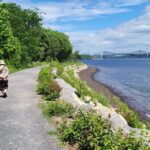
The city sits on the north shore of the Saint-Laurent, roughly twenty kilometres west of Vieux-Québec via Autoroute 40. Its southern edge traces the river itself, giving it an unusual asset among Québec City suburbs: long stretches of shoreline, some of it undeveloped and still agricultural. The interior of the city is flatter than central Québec, and the land historically supported mixed farming, dairy, and market gardens.
Residential development has concentrated along the northern half, close to the autoroute, while the southern corridor along Route 138 retains a village character near the original parish core. The Jardin Roger-Van den Hende, the teaching botanical garden of Université Laval, sits at the eastern border and is one of the region’s underused green spaces.
The economy
Saint-Augustin’s economy is shaped by two major employers: the Industries Bonneville manufacturing group and a cluster of businesses around the ParcTech innovation park. The city also hosts Eddyfi Technologies, a global testing-and-inspection firm, which has anchored a local tech presence. These are not household names outside the region, but they offer the kind of mid-career engineering and trades jobs that make a suburb financially sustainable for families.
A meaningful proportion of residents commute into central Québec City or across the river to the south shore. The city’s tax base benefits from both the industrial footprint and a growing residential population.
Housing market
Single-family homes dominate. Prices in the municipality sat in the 450,000 to 650,000 CAD range through 2024 and have continued to climb into 2026, with waterfront properties and homes on larger lots at the top of the spectrum. New subdivisions north of the autoroute have added inventory over the past five years, targeting first-time buyers from within the region. Condo development is limited and mostly recent.
Property taxes in Saint-Augustin run slightly lower than in Québec City proper, which is one of the factors drawing families across the boundary. The trade-off is fewer services and less public transit; buyers should test the commute before committing.
Schools and families
The Centre de services scolaire des Découvreurs serves the francophone population. The district includes several primary schools, the Polyvalente de l’Ancienne-Lorette nearby, and access to the Québec English School Board catchment for anglophone families. Cégep de Sainte-Foy and Université Laval are both within a fifteen-minute drive. For young families, the combination of space, schools, and post-secondary proximity is part of the appeal.
Recreation
Parc-nature de la Pointe-aux-Prairies sits at the western edge, with trails, a beach on the Saint-Laurent, and a nesting area for migratory birds. The city maintains several community arenas and an outdoor skating rink network. Cycling is better than in most western suburbs: the Corridor des Cheminots extension and the route verte along Route 138 give riders protected access to the river and to the bike network that runs back into central Québec.
Winter recreation is less dramatic than in the northern suburbs closer to Stoneham, but the Plateau du Mont-Sainte-Anne cross-country trail network is accessible within a forty-five-minute drive.
Who the city suits
Saint-Augustin-de-Desmaures suits families who want more land, a shorter distance to the airport, and a lower property tax bill, and who are willing to drive for most amenities. It suits industrial and tech workers whose employers have moved to the western corridor. It does not suit anyone who wants to walk to a café, catch a tram to work, or raise a family inside a school-to-park walking radius. The fundamental geography is suburban, and the lifestyle follows.