



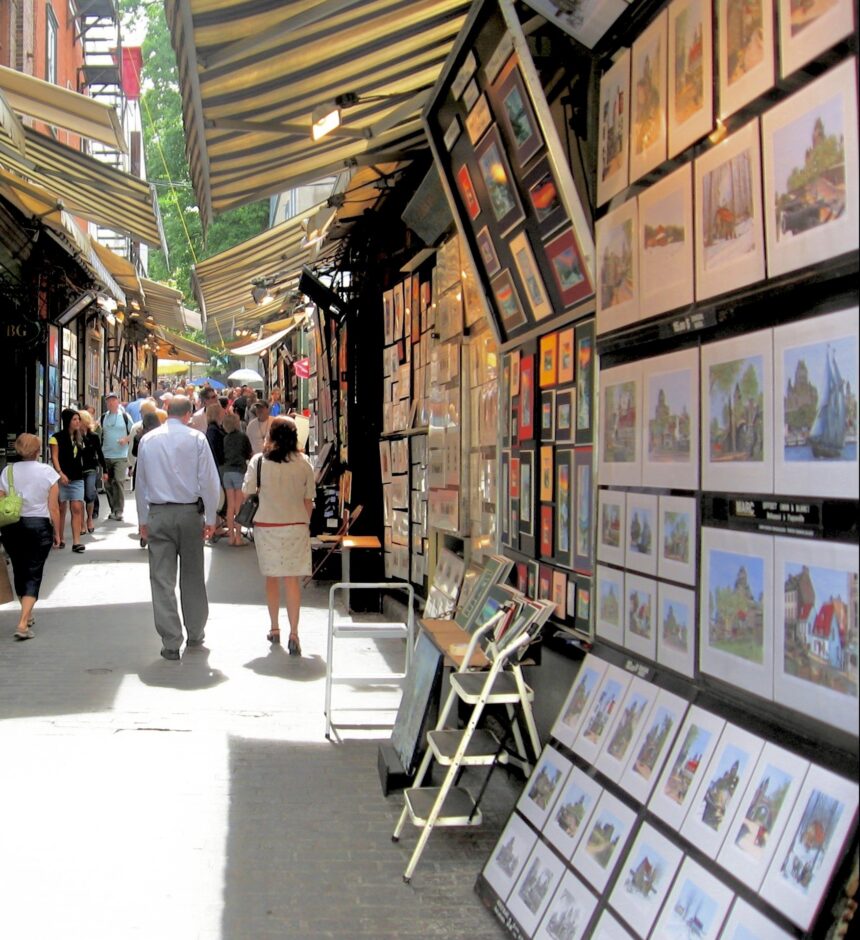
Rue du Trésor is a short pedestrian alley in the Upper Town of Old Quebec that runs from Rue de Buade, opposite the Notre-Dame-de-Québec basilica, down to Rue Sainte-Anne at the edge of Place d’Armes. It measures roughly seventy metres end to end and is wide enough for two people abreast. For several decades it has functioned as a permanent open-air gallery where painters and printmakers display their work on the stone walls.
How the alley became an artists’ market
The practice of hanging art on the walls of Rue du Trésor began in the early 1960s with a small group of students and local artists who obtained informal permission to set up on summer weekends. The arrangement grew, was formalised by the city, and eventually took the shape it has today: a cooperative of juried members who rent wall space under a rotating schedule. The association operates year-round, though the number of exhibitors peaks between May and October and drops to a handful during the winter.
The name itself predates the art market by more than two centuries. In the French régime, residents of New France carried their taxes along this alley to the royal treasury, which stood at one end. The street took its function as its name and kept it long after the treasury had moved.
What is actually sold there
The inventory is mostly original works on paper: watercolours, etchings, engravings, and pen-and-ink drawings. Subject matter leans toward views of Quebec City, the Château Frontenac, the Petit Champlain district, winter scenes on the Île d’Orléans, and maritime motifs from the St. Lawrence. Some artists also show oils and acrylics on canvas, and a few specialise in caricature portraits done on the spot.
Reproductions are clearly labelled as such by cooperative rules. An original watercolour in a modest size generally begins around one hundred and fifty dollars and rises with dimensions and reputation. Signed limited-edition prints are cheaper and are often sold unframed, which helps visitors fit them into luggage. Most exhibitors accept credit cards, and receipts are issued on request for customs declarations.
When to visit
The alley is busy from late morning until early evening through the summer and during the Christmas Market period in December. For a calmer visit, arrive before ten in the morning on a weekday. The light is better for photographing the works, the artists have time to talk about their methods, and negotiation on framing or grouping is easier without a queue behind you. Rainy days cut the crowd further; the walls are sheltered by awnings extended from the building fronts, and most exhibitors remain in place.
Photography and etiquette
Photographing individual works for personal reference is generally discouraged, since the images are the artists’ stock in trade. Wider shots of the alley as a streetscape are accepted and common. When in doubt, ask the exhibitor whose wall you are facing; the answer is usually a courteous yes or no rather than a hard rule. Tipping is not expected, and bargaining is acceptable in a restrained way, particularly on multiple pieces from the same artist.
What else to do nearby
The alley sits within a two-minute walk of several of Old Quebec’s primary sights. The Notre-Dame-de-Québec basilica is immediately at its upper end, and the cathedral’s interior repays a short visit. Place d’Armes, with the former Palais de Justice and the statue of Samuel de Champlain, is at the lower end. The Château Frontenac is a block east, and the Terrasse Dufferin begins behind it, offering the standard long view over the St. Lawrence. A cup of coffee in one of the Rue Sainte-Anne cafés, a purchase on Rue du Trésor, and half an hour on the Terrasse make a workable morning in the Upper Town.
Access is unrestricted. The alley is free to enter, open in all weather, and step-free at both ends, though the adjoining Sainte-Anne and Buade are sloped. The closest public restrooms are in the basilica’s visitor area and at the tourist information centre on Rue Sainte-Anne. If you intend to buy, carry a card rather than cash; most exhibitors have moved off a cash-only footing, and the amounts involved in original work make tapping the simpler method.








