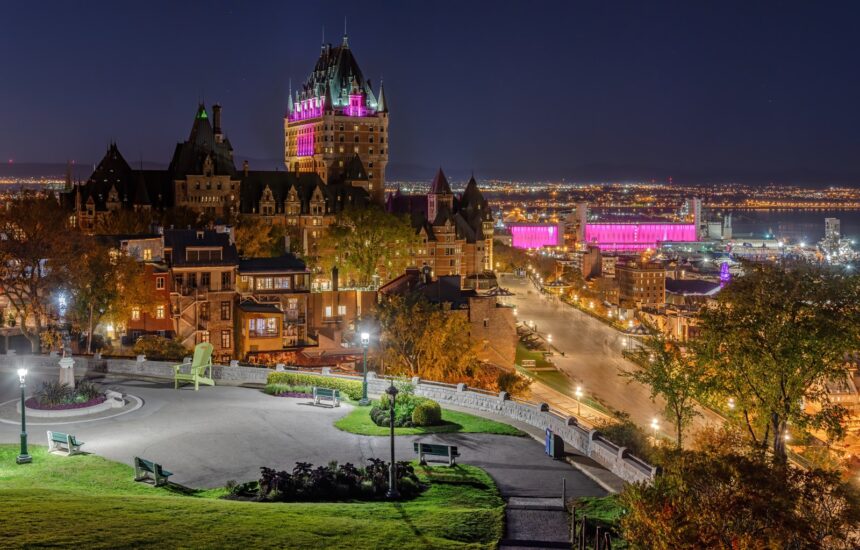
Tanière³ operates in a vaulted stone cellar underneath a heritage hotel in the Old Port of Quebec City. The dining room seats a small group at a single counter that faces the open kitchen, and the restaurant serves one long tasting menu per sitting, with a single seating each night. The format is rare in Quebec City, where the traditional fine-dining model involves à la carte service in a conventional dining room. Tanière³ commits fully to the omakase-style encounter: everyone in the room eats the same menu, moves through it at the same pace, and watches the kitchen execute it from an arm’s length away.
What to order
The restaurant’s name carries its lineage. An earlier version of Tanière operated in Sainte-Foy before closing and reopening in its current Old Port location, with the “³” denoting the third iteration of the concept. The current room is dramatically different from the previous ones: stone vaults, low lighting, no tablecloths, and a kitchen counter built so that the pass is directly in front of the diners. The cooking has been retuned for the smaller room and the longer menu, which runs to well over a dozen courses depending on the evening.
The cuisine is a modern interpretation of Quebec ingredients, with foraged and local elements featured prominently. Fish comes from the Saint Lawrence and the Gulf; game comes from regional suppliers; greens, mushrooms, and seasonal wild elements are sourced from foragers working in the Laurentian and Appalachian forests around the city. The menu changes with the seasons and is not advertised in advance; the only description the restaurant provides before a booking is a general note on allergies and dietary restrictions. Guests who cannot eat particular ingredients can declare that when reserving, and the kitchen adjusts accordingly.
What it costs
The pricing sits at the top of the Quebec City market, well above the range of a typical fine-dining restaurant in the city. The fixed-menu cost shifts with inflation, and the restaurant publishes current pricing on its website rather than in printed materials. Wine pairings add substantially to the base cost. The restaurant does not offer an abridged menu or an à la carte option. Reservations open several months ahead through the restaurant’s website and fill quickly, particularly for weekend evenings. Cancellation policies are strict, as they usually are at establishments with small dining rooms and multi-course formats.
The service model matches the kitchen. Staff move between the counter and a small preparation area without interrupting the pace. Each course is explained in French or English depending on the guest’s preference, and questions are welcomed. The sommelier works the room independently, and the wine list leans toward natural and low-intervention bottles with a strong Quebec representation and a selective international list. Cocktails are not a focus; the restaurant does offer a short aperitif list and an amuse-bouche drink pairing at the start of the meal.
On foot from downtown
For visitors to Quebec City, Tanière³ is best understood as a destination meal rather than an occasional dinner. The evening runs several hours from arrival to departure, and the pacing does not accelerate for late bookings. Guests who have booked an early-morning flight the next day should not plan to close the restaurant. Dress code is smart casual rather than formal; no tie is expected, and the low-lit stone room rewards darker clothing for photographs. The restaurant sits within walking distance of most Old Port hotels.
Tanière³ occupies a small category of Quebec City restaurants that function more like an event than a meal. L’Initiale, the Relais et Châteaux room a few blocks away, held a similar position until its closure in 2019, with a different approach: a conventional dining room rather than a counter, a longer-established kitchen, and a more traditional service style. Ciel!, the revolving restaurant in a nearby hotel, operates in the opposite register with a much broader menu and a tourist clientele. Tanière³ is neither of those: it is among the most concentrated, most focused, and most operationally ambitious fine-dining operations in the city, and the scarcity of its seats is part of the point.