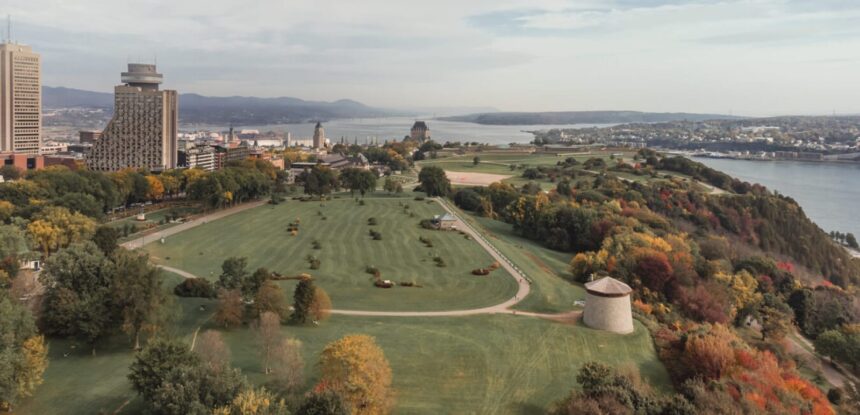
Most first-time visitors to the Plains of Abraham experience a small moment of cognitive dissonance. They’ve arrived at one of the most historically significant battlefields in North America — the site where, in 1759, the British army defeated the French in a 20-minute engagement that effectively ended New France as a political entity — and they’re expecting to feel historical weight, solemnity, scale.
Instead, they see kids on skateboards. Joggers. Families picnicking. Summer festivals with 100,000 attendees. Cross-country skiers in winter. A farmers market. A snow sculpture festival. A massive symphony concert on the solstice.
The Plains of Abraham is all of these things at once. That’s not a contradiction; it’s the point. The Plains are simultaneously a battlefield, an urban park, and a living civic space. Knowing how to experience all three layers is the key to actually getting what the Plains offer.
The Basics
The Plains of Abraham (officially Parc des Champs-de-Bataille) cover 98 hectares (242 acres), making them roughly the size of New York’s Central Park. They stretch along the clifftop west of the Old City, bounded by Grande Allée to the north, the St. Lawrence cliff to the south, the Citadelle to the east, and the Musée National des Beaux-Arts at the western end.
The park is free and open 24/7 year-round. Specific attractions within it (museums, towers) have their own hours and admissions.
The Historical Layer
The 1759 Battle
On the early morning of September 13, 1759, General James Wolfe’s British forces climbed a small goat path up the cliff from the river and deployed on the plains above. The French army under the Marquis de Montcalm, surprised by the speed of the British approach, marched out of the city and engaged them on open ground.
The battle lasted approximately 20 minutes. Both commanders were mortally wounded. The French line broke. Within days, Québec surrendered. The war continued another four years, but the Battle of the Plains of Abraham has become the iconic moment of the Conquest.
The 1760 Battle of Sainte-Foy
Less famous but worth knowing: the French tried to retake Québec the following spring. The Battle of Sainte-Foy (April 28, 1760) was fought on what’s now the western edge of the Plains. The French won tactically but couldn’t follow through to capture the city. That’s where the historical reversal lies: the “glorious defeat” at Sainte-Foy preserves a certain French-Canadian narrative of resistance that the pure-defeat narrative of 1759 doesn’t.
The 19th Century: Fortifications and Use
After the British established control, the Plains became a military training ground. The four Martello Towers you can see today were built in the 1810s as defensive positions against potential American attack. The British army drilled here regularly through the 19th century.
The 20th Century: Park Creation
In 1908, as part of the tercentennial of Québec City’s founding, the Plains were transferred from federal military control to park status. The formal park was gradually developed with lawns, trees, and the museums you see today.
The Park Layer
Walking and Running
The Plains are crisscrossed with paved walking paths and grass areas. A full perimeter walk runs about 6 kilometres. Joggers and walkers use the park year-round, with summer seeing dense morning and evening activity.
Winter Activities
In winter, the Plains become one of the best urban winter-sports venues in North America:
- Cross-country ski trails — groomed tracks for multiple skill levels. Equipment rental at the Discovery Pavilion.
- Snowshoe trails — following the major paths.
- Winter walking — when the paths are cleared, an excellent way to experience the park.
- Sledding — informal but popular.
Summer Activities
- Picnic areas — designated grass sections for group use.
- Running — the most popular use of the park.
- Frisbee, soccer, informal sports — open lawn areas accommodate most recreational activities.
- Dog walking — on-leash, widely popular.
- Cycling — the paved paths are bike-friendly.
Year-Round Spaces
Several specific features in the park:
Jardin Joan of Arc — A formal French garden with the famous equestrian statue of Joan of Arc.
Parc des Gouverneurs — A smaller adjacent park at the eastern edge, worth a brief visit.
The Promenade des Gouverneurs — An elevated cliffside walkway connecting the Plains to the Château Frontenac via the Citadelle’s exterior. Spectacular views.
The Museums and Cultural Layer
The Plains of Abraham Museum
Located in the Discovery Pavilion at the eastern entrance. Focuses on the 1759 battle and the broader Seven Years’ War. 90-minute to 2-hour visit. Around $15 admission.
This is the essential historical stop if you want to understand what happened on the land you’re walking.
The Martello Towers
Four round stone towers from the 1810s stand on the Plains. Tower 1 is usually open as a supplementary museum in summer months. Interior visits are brief (20-30 minutes) but give a clear sense of early 19th-century defensive architecture.
Musée National des Beaux-Arts du Québec (MNBAQ)
At the western end of the Plains. The province’s largest art museum, with rotating exhibitions and a substantial permanent collection. A full visit takes 2-3 hours. Around $20 admission.
The MNBAQ itself is worth a dedicated half-day, but you can combine a brief visit with Plains walking if time is tight.
The Festivals and Events Layer
The Plains host significant public events throughout the year:
Festival d’été de Québec (July) — Major music festival with performances on the Plains. 500,000+ attendees over 11 days. Huge crowds, significant security, worth planning around if you’re visiting in early July.
Carnival de Québec (February) — Ice palace, snow sculptures, night parades partly on the Plains.
Fête nationale (June 24) — Concerts and fireworks for Québec’s provincial holiday.
Canada Day (July 1) — Public celebrations, sometimes with fireworks.
Orchestre Symphonique de Québec outdoor concerts — Summer evenings bring free classical music to the Plains.
The Suggested Plains Experience
The 60-Minute Overview
Enter at the Discovery Pavilion (eastern end). Walk west through the historic core, visiting the Martello Tower area and key 1759 battlefield sites. Exit near the Musée des Beaux-Arts. Covers the essential history and the visual sense of the park.
The Half-Day Deep Dive
Add the Plains of Abraham Museum to the overview walk. Include a stop at the Joan of Arc Garden. Lunch at a Grande Allée restaurant. Total: about 4 hours.
The Full Day
Combine the above with a visit to the MNBAQ, plus additional time for the Citadelle (whose general admission includes a 60-minute guided tour) and walking the fortifications along the Plains’ eastern edge. Total: full day, 6-7 hours of activity.
Practical Tips
Entrances: Multiple, including via Grande Allée, via the Promenade des Gouverneurs from the Château Frontenac, and at the western edge near the Musée des Beaux-Arts.
Free parking: Limited at the Discovery Pavilion lot. Paid parking nearby on Grande Allée.
Restrooms: At the Discovery Pavilion and at the Musée des Beaux-Arts.
Food: No restaurants within the park. Grande Allée has many options just north.
Weather: The Plains are exposed — wind matters in winter, sun matters in summer. Dress appropriately.
Best time for photos: Early morning or late afternoon for golden light. Winter snow creates dramatic scenery.
FAQ
Is the Plains of Abraham the same as the Battlefield Park?
Yes. “Parc des Champs-de-Bataille” is the French official name; Plains of Abraham is the English historical name. Same place.
Can I bring dogs?
Yes, on leash. Very dog-friendly park.
Is there cell service throughout?
Yes, reliable throughout the park.
Are the Martello Towers always open?
No. Seasonal hours, typically summer only. Check in advance.
How crowded does it get?
Very crowded during Festival d’été. Moderately busy summer weekends. Quiet most weekdays and throughout winter.
Final Word
The Plains of Abraham reward visitors who engage with all three layers — the battlefield history, the urban park function, and the festival/cultural calendar. A quick walk-through misses most of what’s here. A dedicated half-day with museum visits and attention to the specific features on the land gives you a meaningful experience of one of the most historically significant sites in North America. It’s also, not incidentally, one of the most beautiful urban parks in Canada. Both things are true at once.