The first time you walk through the Dalhousie Gate of the Citadelle and the massive wooden doors close behind you, something subtle happens. The traffic noise drops away. The modern city recedes. You’re suddenly on a 37-acre star-shaped fortress, 100 metres above the St. Lawrence, where soldiers have lived and worked without interruption since the 1820s. And that’s the thing most visitors don’t fully grasp about La Citadelle: it isn’t a museum. It’s a working army base that happens to welcome the public.
That distinction matters. It shapes everything from what you’ll see to what you’re allowed to photograph to why you can’t just wander around on your own. After walking these ramparts dozens of times — with history buffs, with first-time visitors, with skeptical teenagers — I’ve come to think of the Citadelle as one of Québec City’s most misunderstood landmarks. Too many people treat it like a 90-minute checklist stop. It deserves more.
A Fortress Built for a War That Never Came
Construction began in 1820, ordered by the British military in the aftermath of the War of 1812. The Americans had tried to invade Québec twice — in 1775 and again in 1813 — and London wasn’t taking chances with a third attempt. The British engineer Colonel Elias Walker Durnford designed what you see today: a textbook example of the Vauban star fort, the defensive geometry pioneered by the French military engineer Sébastien Le Prestre de Vauban in the 17th century.
The design is brilliant in a cold, calculating way. Every angle of the fortress can be defended by fire from two adjacent bastions, meaning no attacker can approach any wall without being caught in a crossfire. The walls slope outward (the glacis) to deflect cannon fire. The dry moats force attackers into kill zones. It took 30 years and the labour of hundreds of workers — many of them Irish immigrants — to complete. And no one ever attacked it. The Americans stayed home. The British kept paying the garrison. By the time the fort was finished, the threat it was built to repel had quietly evaporated.
What happened next is what makes La Citadelle genuinely interesting. In 1920, after the British handed the fortress over to Canadian control, it became the home of the Royal 22e Régiment — the famous “Van Doos,” Canada’s French-language infantry regiment founded during the First World War. They’ve been there ever since. That continuous 100-plus-year military occupation makes La Citadelle the longest continuously occupied fortification in North America, and one of only a handful in the world where the public can tour an active army base.
What You’re Actually Allowed to See
Because it’s operational, you can’t freelance here. All public access is by guided tour only, departing roughly every hour from the visitor centre just inside the Dalhousie Gate. Tours run in both English and French; French tours tend to be a touch longer and more detailed, in my experience, but both cover the same core ground.
A standard tour takes you through:
- The powder magazines from the 1750s — predating the British fort, these are the oldest structures on site, built by the French.
- The governor general’s residence (from the outside only; the governor actually lives here part of each year).
- The Royal 22e Régiment Museum, which occupies a former powder magazine and tells the regiment’s story through Vimy Ridge, Ortona, Korea, and modern peacekeeping missions.
- A walk along the ramparts, where the view over the St. Lawrence and the Laurentian foothills is arguably the best panoramic vista in the city.
- The main parade square, where the Changing of the Guard ceremony happens each summer morning.
Tour guides here are almost always current or retired military, which gives the commentary a different texture than a civilian historical tour. They tend to be blunt about what worked and what didn’t in various campaigns, and they don’t romanticize. If you ask a real question, you’ll get a real answer.
The Changing of the Guard: Go, But Manage Expectations
From roughly late June through early September, the Changing of the Guard ceremony happens daily at 10 AM on the main parade square. Admission is included in your tour ticket if you time it right.
It’s photogenic. Bearskin caps, scarlet tunics, a goat (Batisse, the regimental mascot, is a real goat — not a joke), a military band. The whole thing takes about 35 minutes. Expect crowds, especially in July and August. Arrive 20-30 minutes early if you want a clean sightline, and position yourself on the right-hand side of the square as you face the ceremony — the light is better and you’ll see the incoming guard approach from that angle.
Is it the equivalent of Buckingham Palace? No. It’s smaller, less theatrical, and the spectator experience is more intimate than grand. But the ceremony itself is genuine military tradition, not a tourist performance, and that gives it weight that more famous ceremonies sometimes lack.
Practical Matters: Tickets, Timing, and What to Skip
Adult admission runs $22 per person and includes the 60-minute outdoor guided tour; it is $20 for seniors 65 and over and for students 18 and over, $8 from 11 to 17, and free for 10 and under. The Royal 22e Régiment Museum is included in the ticket. Combined passes with other Old Québec sites are sometimes available — check at the gate.
Best time of year to visit: Mid-May through late October for full access to the ramparts and the Changing of the Guard. Winter tours (November through April) operate on a reduced schedule, focus more on the interior museum, and skip the outdoor ceremonies — but the snow-covered ramparts are genuinely beautiful and the tours are less crowded.
How long to budget: A minimum of two hours. Plan for three if you want to linger in the museum, which is more substantial than most visitors expect.
What to wear: The ramparts are exposed on all sides, which means wind, sun, and in shoulder seasons, significant cold. Dress in layers even on a warm day. Comfortable walking shoes are mandatory — you’ll cover uneven stone, grass, and gravel.
Photography: Permitted in most areas, but not at the governor general’s residence and not during certain military operations. Your guide will tell you when to put your camera away. Respect those moments — it’s what makes this access possible at all.
What the Guidebooks Don’t Tell You
A few observations from repeat visits that rarely make it into the official copy:
The west bastion, looking out over the Plains of Abraham, is often overlooked by rushed tours but offers the best view of the 1759 battlefield where New France was effectively lost. If you’re here to understand the whole arc of Québec’s military history, ask your guide to linger there. Most will.
The Citadelle’s acoustics inside the powder magazine are extraordinary — thick stone walls, vaulted ceilings, no furniture. If you’re alone in there for a moment, speak quietly. You’ll hear yourself differently than you’ve ever heard yourself speak.
The Royal 22e Régiment Museum contains a World War I trench mortar captured at Vimy Ridge, still bearing its original German markings. The staff curator can often point it out if you ask. It’s one of the more affecting artifacts in the entire city.
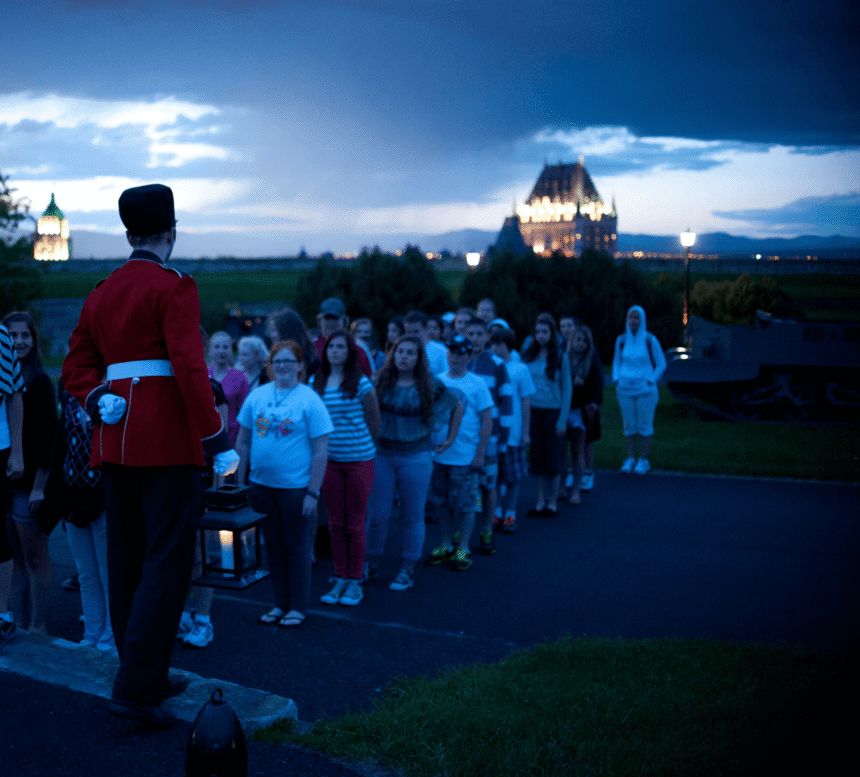
And if you’re visiting in summer, consider coming back at dusk for the Beating Retreat ceremony (select evenings, July-August). It’s less famous than the morning Changing of the Guard but more atmospheric, conducted by torchlight as the sun sets over the St. Lawrence.
Getting There
The Citadelle sits at the top of the old city, accessed via Côte de la Citadelle from Rue Saint-Louis. It’s a genuine climb — the entrance sits 100 metres above the river — so if you’re coming from the Lower Town, take the funicular up from Petit-Champlain first, then walk. From the Parliament area or the Château Frontenac, it’s a 10-15 minute walk uphill.
Parking at the site is limited and often full by 10 AM in summer. If you’re driving, use one of the Old Québec parking structures (Place d’Youville or Dalhousie) and walk in.
FAQ
Can I visit without a guided tour?
No. Because it’s an active military base, all public access is escorted. Tours run approximately every hour in season.
Is it accessible for visitors with mobility issues?
Partially. The visitor centre and museum are accessible. The ramparts and parade square involve uneven terrain and stairs. Contact the Citadelle in advance if you need accommodations.
Can I see the Governor General?
Probably not. The Governor General of Canada uses the Citadelle as an official residence a few weeks per year. When they’re in residence, a flag is raised. You can sometimes see the exterior of the residence, but the building itself is closed to the public.
Is the goat real?
Yes. Batisse is the regimental mascot of the Royal 22e Régiment, a tradition dating to 1955 when Queen Elizabeth II presented the first Batisse to the regiment. The current Batisse is Batisse XI or XII, depending on how you count.
How does it compare to the fortifications of Old Québec?
The city walls (which you can walk for free) are a different structure and a different era. The Citadelle is the final, largest link in that defensive system — the keep of the fortress city. See both if you can; they tell complementary stories.
Why It’s Worth Your Time
Québec City has more famous landmarks. The Château Frontenac gets the postcards. Petit-Champlain gets the Instagram shots. The Plains of Abraham gets the history-class field trips. The Citadelle gets the serious visitors — the ones who want to understand why this city is the only walled city north of Mexico, why it was worth building a fortress for 30 years, and why, a century after it was completed, Canadian soldiers still call it home.
Give it two hours. Ask your guide the hard questions. Stand on the ramparts in the wind and look out over the river, and you’ll understand something about this city that the more comfortable tourist sites can’t quite teach.
The Citadelle is a working military installation as well as a museum, and visiting hours follow the garrison’s calendar rather than a fixed tourist schedule. Current hours, guided-tour times and the Changing of the Guard calendar are published by the Citadelle de Québec itself.