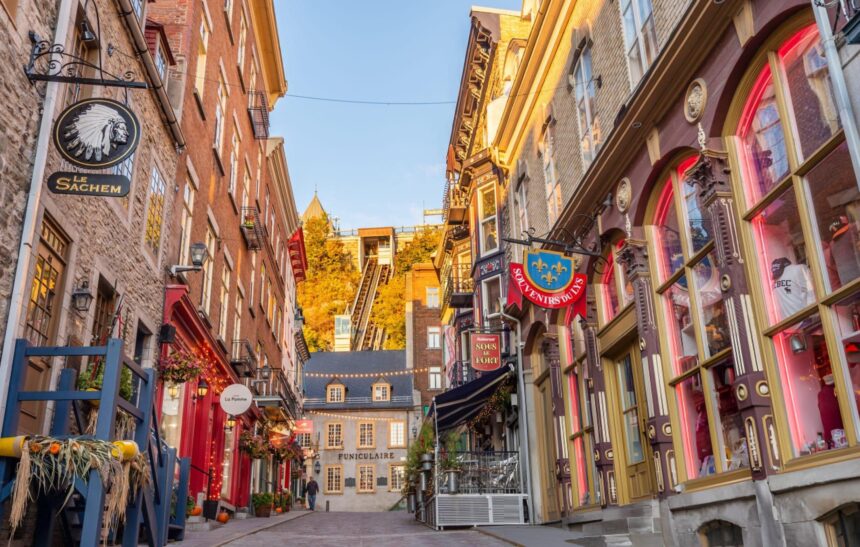
Québec City is not Montréal. The gay village here is one short street, not a whole district, and the scene is older, quieter, and more integrated into daily life. That can disappoint visitors arriving with Village Gai expectations. It rewards anyone who stays more than a weekend. The community’s size, roughly four thousand people who identify openly in a metropolitan area of eight hundred thousand, produces a tight social fabric without the commercial density of a larger gay capital. People know each other. That has advantages and disadvantages, depending on what you are looking for.
Where the scene lives
Rue Saint-Jean outside the walls, specifically the three blocks between Rue d’Aiguillon and Rue Sainte-Claire, is the closest thing to a village. Le Drague Cabaret Club, open since 1983 and by some measures the oldest gay bar in Québec, occupies the corner of Rue Saint-Augustin. Its basement dance floor, ground-floor cabaret stage, and upper-floor karaoke bar still draw the full generational spread on weekends. The Bar Le Boudoir nearby fills a smaller, quieter niche for those who want conversation rather than a dance floor. A few cafés on the same block are queer-owned without announcing it on signage; regulars know which ones.
The annual calendar
The Fête Arc-en-ciel de Québec takes place on Labour Day weekend at the beginning of September, organised around a march from Place d’Youville to the Parc de la Francophonie. Crowds have grown from a few hundred in 2006 to roughly thirty-five thousand in recent editions, drawing participants from across eastern Canada and northern Maine. The festival programs three days of concerts, a family picnic, a community day with health and advocacy booths, and a closing ball. Smaller events punctuate the year: a winter edition at the Grand Marché, film screenings at La Maison de la littérature, and trivia nights at Le Drague.
Community infrastructure
GRIS-Québec, founded in 1997, runs school outreach and speaker programs throughout the region. The Groupe TRANS Santé Québec provides health resources for transgender and non-binary residents and is attached to the CIUSSS de la Capitale-Nationale network. The Centre des femmes de la Basse-Ville on Rue Saint-Joseph holds a lesbian discussion group twice monthly. The Archives gaies du Québec, though headquartered in Montréal, maintains a Québec City satellite collection at the Bibliothèque Gabrielle-Roy in Saint-Roch, accessible on appointment. It holds periodicals, photographs, and oral histories going back to the 1970s activism at Université Laval. These organisations carry the community work that pure nightlife cannot, including peer-support groups, HIV-prevention outreach with the MIELS-Québec organisation, and legal clinics twice yearly for transgender name-change procedures.
What has changed and what has not
Older residents will readily tell you the scene was noticeably larger in the 1990s, before Montréal’s pull and the general dispersal of gay social life into apps and mixed venues. That shift is real. It is also incomplete: the Fête Arc-en-ciel has grown every year, Le Drague has survived three recessions, and a new generation of queer-owned businesses has opened in Saint-Roch below the cliff. The Pantoum recording studio, the Librairie Saint-Jean-Baptiste, and several Saint-Roch coffee bars fall into this quieter category, visible without being declared. The city has not lost its scene; it has reshaped it.
Practical notes for visitors
Same-sex couples can book any hotel without issue; the province has recognised civil unions since 2002 and marriage since 2004. Public displays of affection draw no reaction in the Saint-Jean-Baptiste corridor or in Saint-Roch, less reaction than in many American cities. The Château Frontenac lobby and the Vieux-Québec tourist strip are equally unremarkable in this respect. The one practical caveat is winter: the community’s venues cluster on streets that become genuinely difficult in January sleet, so check for winter cabaret schedules before planning a cold-season visit. Local event listings appear in Fugues magazine, which is distributed free in Saint-Roch cafés and most Saint-Jean-Baptiste bars, and on the Fête Arc-en-ciel’s year-round website.