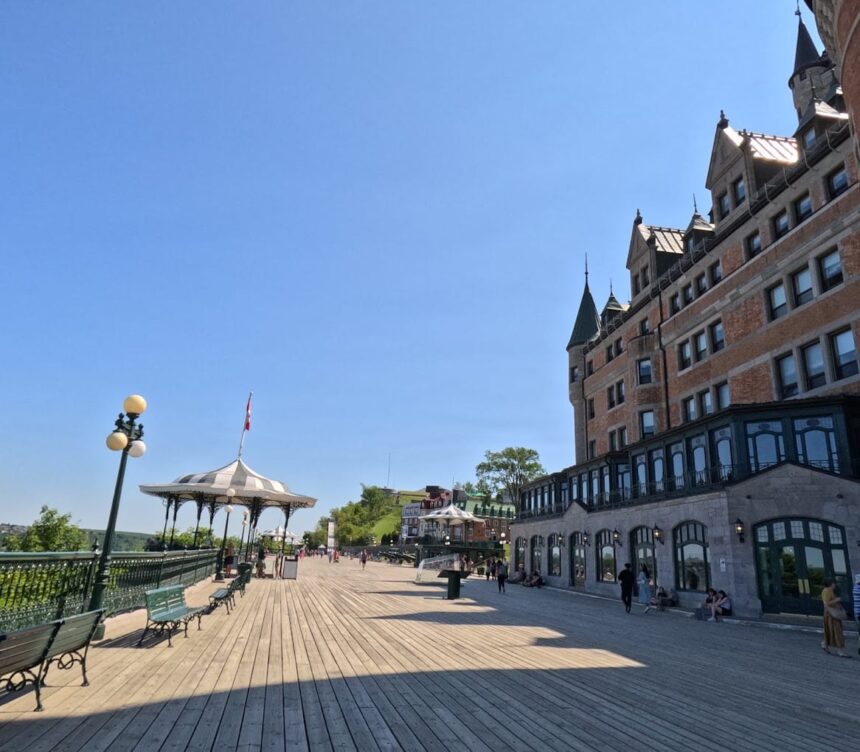
Every single visitor to Québec City eventually ends up on the Terrasse Dufferin. The 420-metre wooden boardwalk stretching east from the Château Frontenac, 75 metres above the St. Lawrence River, is the city’s most photographed spot, its most-used public promenade, and the place where the iconic views of Old Québec are captured.
It’s also more interesting than most visitors realize. Built in 1838, rebuilt in 1879, substantially renovated in 1933, and continuously maintained since, the Terrasse has 180+ years of civic history embedded in its wooden planks and iron railings. Here’s the complete guide.
The Basics
The Terrasse Dufferin is a public boardwalk running along the top of Cap Diamant cliff, extending from near the Château Frontenac east to the base of the Citadelle‘s fortifications. It’s free to access, open 24 hours a day year-round, and one of the most-used public spaces in Québec City.
Views from the terrace include:
- The St. Lawrence River flowing south toward Lévis
- The Lower Town and Petit-Champlain below
- The Laurentian Mountains in the distance to the north
- The Lévis shoreline across the river
- The Citadelle’s fortifications to the east
- The Château Frontenac from an angle most photographs capture
The History
The first version of the Terrasse Dufferin was built in 1838, shortly before a major fire destroyed the nearby Château Saint-Louis (the governor’s residence, which stood where the Château Frontenac now sits). The boardwalk was commissioned by Lord Durham, who felt the site deserved a public promenade.
The current configuration dates largely to 1879, when Lord Dufferin (the namesake of the terrace) completed a major reconstruction. The elegant iron railings, the distinctive pavilions, and the integration with the Citadelle approach were all Dufferin-era decisions.
The 1933 renovation added structural reinforcement and expanded the boardwalk to its current width. Since then, ongoing maintenance and periodic restoration have kept the terrace functional.
What to Do There
Walk
The obvious answer. Walking the full length takes 10-15 minutes at a leisurely pace. Do it both directions — east in the morning for sunrise light, west in the evening for sunset light.
People Watch
Particularly good in summer evenings. Tourists, locals, street musicians, couples, families — the terrace becomes one of the most populated public spaces in the city.
Street Performance
In summer, the terrace hosts licensed street performers — musicians, jugglers, acrobats, and others. The quality is generally high; many are serious professionals working the summer circuit.
Outdoor Café Service
Several kiosks and pavilions along the terrace serve coffee, snacks, and meals in summer season. Prices are tourist-elevated but the setting justifies a casual purchase.
Archaeological Remains
Visible under glass panels at the western end of the terrace: the foundations of the Château Saint-Louis, the 17th-century governor’s residence destroyed by fire in 1834. You can see the original French colonial foundations without leaving the boardwalk.
The Toboggan Slide (Winter Only)
From mid-December through early March, the historic wooden toboggan slide operates at the eastern end of the terrace. The tradition dates to 1884. Rides run about $4 per person. Classic Québec City winter experience.
The Funicular
The Funicular du Vieux-Québec descends from the terrace to Petit-Champlain in the Lower Town. About $5 each way. Scenic and useful — the easiest way to move between Upper and Lower Town.
Promenade des Gouverneurs
The terrace continues east as the Promenade des Gouverneurs — an elevated wooden walkway that skirts the Citadelle’s exterior and leads to the Plains of Abraham. This extension is arguably the most spectacular walking path in the city. Summer only (closed in winter).
Best Times to Visit
Sunrise: 6:00-7:00 AM in summer, 7:30-8:30 AM in winter. Uncrowded, golden light, best photography.
Sunset: 6:00-8:30 PM depending on season. Spectacular light on the Château and the river.
Evening (summer): 8:00-11:00 PM. Street performers, active atmosphere, warm summer nights.
Winter afternoons: Snow on the boardwalk, ice on the river, the classic winter postcard scene.
Photography Tips
- Wide-angle shots looking west toward the Château
- Telephoto shots looking out over Lévis and the river
- People silhouettes against sunset sky
- Detail shots of the iron railings, the wooden boards, the pavilion architecture
- Night shots with the illuminated Château as the subject
Evening light during the “blue hour” (shortly after sunset) gives the best combination of natural and artificial illumination.
Practical Information
Accessibility: The terrace itself is wheelchair-accessible. Some stairs connect different levels.
Restrooms: At the Château Frontenac, the funicular building, and several public facilities along the terrace.
Food and drink: Seasonal kiosks along the terrace; multiple restaurants in the adjacent Château Frontenac and Upper Town.
Weather considerations: Completely exposed — sun, wind, and snow all hit hard. Dress appropriately.
What Happens Here
The Terrasse Dufferin hosts many of the city’s major public moments:
- Canada Day gatherings and fireworks
- Fête nationale du Québec celebrations
- Summer concerts and small musical performances
- New Year’s Eve ice palace visits and gatherings
- Informal farewells and greetings — families waving to cruise ships departing the port below
For Québec City residents, the terrace is one of the few genuinely shared civic spaces — where everyone goes and everyone sees each other.
FAQ
Is the terrace always open?
Yes, 24 hours a day year-round. Some specific features (toboggan slide, summer kiosks) are seasonal.
Are dogs allowed?
Yes, on leash. Popular dog-walking spot.
Can I bring food?
Yes, generally. No open fires.
Is it safe at night?
Yes, very. Well-lit and well-travelled.
How long to spend there?
15 minutes for a quick walk; 45-60 minutes for photography; longer for events or dining.
Final Word
The Terrasse Dufferin is simultaneously a tourist icon and a genuine civic space. Visit it multiple times during your Québec City trip — at sunrise, at sunset, in good weather, in bad weather, during a specific event, and just casually between other activities. Each visit adds context and depth. It’s not a place to see once and cross off the list. It’s a place to return to, and to experience as it changes.