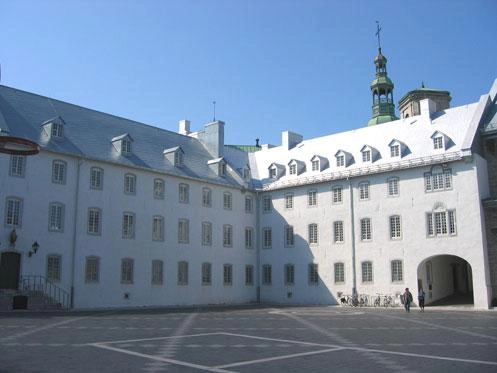
Quebec City’s higher education landscape is anchored by one of the oldest and most distinguished universities in the Americas Université Laval, whose origins trace to the Séminaire de Québec founded by Bishop François de Laval in 1663. The university, the four CEGEPs that prepare students for university, the Conservatoire de musique et d’art dramatique, and a network of specialized research institutions constitute an educational infrastructure of national significance that shapes both the city’s intellectual character and its economic development trajectory.
Université Laval: Founded 1663
Université Laval ( formally established as a university in 1852, though its ancestor institution (the Séminaire de Québec) dates to 1663 ) is Canada’s first French-language university and one of the oldest universities in North America. With over 47,000 students including approximately 6,000 international students from 130+ countries, the university is the second-largest francophone university in the world after the Université de Montréal. The campus in Sainte-Foy covers 1.7 square kilometres and includes a self-contained infrastructure of residences, sports facilities (the PEPS complex), the Centre hospitalier universitaire de Québec-Université Laval (CHUL), a shopping centre, and its own internal street network. Laval’s faculties of law, medicine, engineering, and natural sciences are among the most highly regarded in Canada; its forestry faculty is internationally recognized; and its research output contributes significantly to Quebec’s positioning as a knowledge-intensive economy.
The Four CEGEPs
Quebec City has four publicly funded CEGEPs (collèges d’enseignement général et professionnel), each with distinct orientations: Cégep de Sainte-Foy (the largest, near Université Laval, with pre-university and technical programs), Cégep Limoilou (in the Limoilou neighbourhood, with strong technology and business programs), Cégep Garneau (in Charlesbourg, known for its arts and health science programs), and Collège François-de-Laval (affiliated with the Séminaire de Québec, a private-sector CEGEP on the Colline Parlementaire). The CEGEP system ( unique to Quebec ) positions two years of post-secondary general or technical education between secondary school and university, graduating students at 18-19 for university entry and at 20-21 for technical careers.
Research Infrastructure
Quebec City hosts several significant research institutions beyond Université Laval: the Institut national de la recherche scientifique (INRS), a graduate-level research university with facilities in Quebec City specialising in water science, energy, and materials; the Centre de recherche du CHU de Québec-Université Laval, one of the largest hospital-based research centres in Canada; the Centre de recherche sur les soins et les services de première ligne de l’Université Laval (CERSSPL-UL); and the Quebec Genomics Centre. The federal government maintains several research facilities in the Quebec City area, including Agriculture and Agri-Food Canada’s research station and Canadian Forest Service operations linked to the Quebec forestry economy.