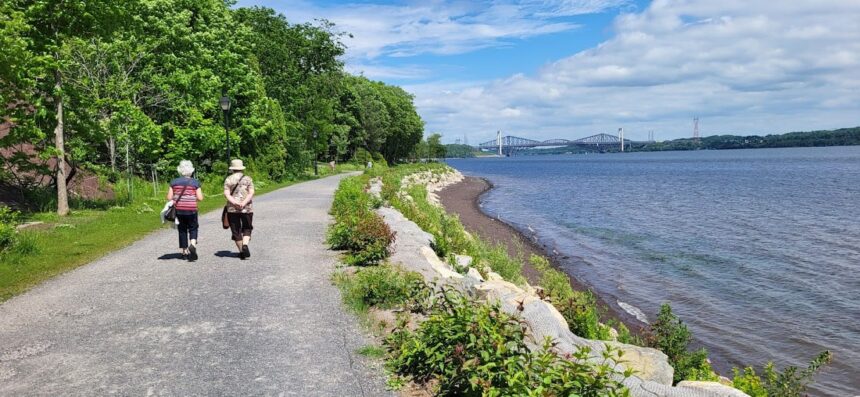
Quebec City’s relationship with its St. Lawrence waterfront ( historically defined by the industrial port infrastructure that separated the city’s residential and commercial fabric from the river ) is in active transformation as the 21st century’s priorities (public recreation, climate adaptation, and active transportation) compete with the 20th century’s legacy (highway infrastructure, port operations, and the functional separation of waterfront from urban life). Three major planning proposals are shaping the discussion of Quebec City’s waterfront future in the 2025-2033 period: the proposed Promenade Samuel-de-Champlain Phase 4 (which would extend the existing 8-km waterfront park eastward through the Beauport shore), the conversion of the Autoroute Dufferin-Montmorency to an urban boulevard (which would create new public space in the Lower Town waterfront zone), and the Port of Quebec’s expansion plans (which would add container terminal capacity that some advocates argue conflicts with the waterfront’s public recreation evolution).
Promenade Phase 4: The Eastern Extension
The proposed Phase 4 of the Promenade Samuel-de-Champlain ( which would extend the existing Promenade from the Old Port eastward along the Beauport shore to the Baie de Beauport urban beach and potentially beyond ) requires the conversion of the Autoroute Dufferin-Montmorency from a limited-access highway to an urban boulevard. The Quebec City municipal council formally requested this conversion in February 2023, citing the success of the Promenade’s existing phases and the provincial government’s own openness to discussing the transformation (Minister Geneviève Guilbault indicated in 2023 that she was open to the boulevard concept in the context of a Phase 4 project). As of early 2026, the provincial government has not committed to funding the conversion, but the planning discussion is ongoing and has significant support from urban planning, cycling advocacy, and neighbourhood organisations in the affected Beauport arrondissement.
Port of Quebec: Expansion vs. Public Access
The Port of Quebec’s operational plans ( including discussions of expanded container handling capacity at the Beauport 2020 development zone (an industrial port extension into the St. Lawrence shore east of the existing terminal facilities) ) have been in conflict with the public access and environmental objectives of the Promenade Phase 4 advocates. Port authorities argue that Quebec City’s strategic position as the furthest inland deep-water port on the St. Lawrence requires continued investment in commercial port capacity to maintain economic competitiveness; waterfront advocates argue that the long-term economic and quality-of-life value of a continuous public waterfront from Cap-Rouge to the Montmorency Falls exceeds the incremental value of additional container capacity. The tension between port commerce and public waterfront is a recurring theme in Quebec City’s urban planning debates.
The Vision: A Continuous Waterfront
The most ambitious waterfront vision ( articulated by urban planning advocates, cycling organisations, and some elected officials ) envisions a continuous active transportation and recreation corridor from the Cap-Rouge Bay in the west to the Chutes Montmorency in the east: approximately 60 kilometres of St. Lawrence waterfront accessible to pedestrians and cyclists without conflict with major motor vehicle traffic. This vision, which would require the Dufferin-Montmorency conversion, improved cycling infrastructure through the Beauport shore, and the Port of Quebec’s cooperation in providing public access through port territory, remains aspirational rather than committed. But the incremental progress ( the Promenade’s three completed phases, the Beauport shore linear park’s development, and the Corridor du Littoral’s eastern extension ) suggests that the direction is clear even if the pace and the specific solutions remain uncertain.